

Overview
A business loan broker takes your application to several lenders and is usually paid out of the deal it arranges. Choose one by asking how the broker is paid, which lenders will see your file and what each offer costs after fees.
This guide is for business owners, not for people who want to become brokers. It covers four things:
- Pay: How brokers earn their fee and when that fee comes out of your pocket.
- Law: What California, New York and Florida require providers to disclose.
- Checklist: Questions to ask a broker before you share bank statements.
- Math: How fees withheld at funding change the estimated APR of one loan.
What is a business loan broker?
A business loan broker is a person or firm that, for compensation, arranges commercial financing between a business and lenders that make their own credit decisions. The definition is drawn from Florida Statutes §559.9611(3) and California's commercial financing rules at 10 CCR §900(a)(8).
A broker does not decide on your application. A broker does not lend the money either. The lender underwrites the file, sets the price and funds the loan.
The broker's job sits in between. Per the California rule, that work can include advising on financing options and helping prepare applications. It can also mean delivering documents to the financer and getting your signature on financing documents.
A commercial loan broker does the same work. The two terms mean the same thing in practice.
Commera is a broker, not a lender. We compare offers from our lender partners.
Broker, loan marketplace or direct lender: which route fits?
A business owner has three routes to a loan: a broker, an online loan marketplace or a lender directly. Each route trades your time against control over who sees your file.
| Route | Who you deal with | Who sees your application | Where it fits |
|---|---|---|---|
| Broker | One contact who shops your file | Lenders the broker picks | A file that needs explaining, or no time to shop |
| Loan marketplace | An online form that matches you with lenders | Lenders on that platform | A standard request you want to compare yourself |
| Direct lender | The lender's own staff | Only that lender | Strong credit and a simple deal |
When you may not need a broker: Strong credit history and a simple deal point to a direct application. Go to your bank or a lender yourself. You keep control of your file. No one in the middle needs to be paid.
When a broker can help: A broker is useful when one lender's no is not every lender's no. A young business or an unusual purpose often falls in that group. The broker knows which lenders look at such files.
Before you pick a route, decide which product you need. Our guide to types of small business financing compares term loans, lines of credit and other options.
How do business loan brokers get paid?

Business loan brokers get paid in one of three ways: a commission from the lender at closing, a fee from you at closing, or both. Each model can be fair. The test is whether you see the amount in dollars before you sign.
Lender-paid commission: The lender pays the broker when the loan closes. You write no check. The cost can still reach you through the rate or the lender's fees.
Borrower-paid fee: You pay the broker at closing, often out of the loan proceeds. That fee shrinks the money that reaches your account. Per 10 CCR §900(a)(26), California's "recipient funds" exclude funds paid to third parties, including brokers.
Both: Some brokers collect from both sides. Ask for both amounts.
The conflict of interest: A broker paid more by one lender than another has a reason to steer you. Ask for the broker's pay in writing, in dollars, for each offer. A percentage alone is hard to compare.
Upfront fees: A fee before closing is a red flag. Per Florida Statutes §559.9614(1), a broker may not assess, collect or solicit an advance fee from a business. Florida defines an advance fee as any consideration a broker collects before closing, per §559.9611(2).
Florida allows one exception. You may pay for actual services needed to apply, such as a credit check or an appraisal. The payment must go by check or money order to a party independent of the broker.
How Commera is paid: Commera charges no fees to merchant applicants; we are compensated by funding partners on a completed transaction. Funder origination, underwriting, or closing fees may apply and are disclosed in your written offer before you sign.
What brokers and lenders must disclose: California, New York and Florida
California, New York and Florida require providers of commercial financing to give you a written cost disclosure. The table below summarizes the statute texts as of October 14, 2026.
| Rule | California | New York | Florida |
|---|---|---|---|
| Law | Fin. Code §§22800 to 22807 (SB 1235, amended by SB 33 and SB 362) | Fin. Serv. Law §§801 to 804 | Fla. Stat. §§559.961 to 559.9615 |
| Deal size covered, $ | Offers of 500,000 or less (§22800(n)) | Up to 2,500,000 (§802(g)) | 500,000 or less, deals closed on or after January 1, 2024 (§559.9612) |
| Who must disclose | The provider that extends a specific offer (§22800(m)) | The provider, including a person who "solicits and presents specific offers ... on behalf of a third party" (§801(h)) | A provider with more than five deals a year in Florida (§559.9611(10)) |
| What the disclosure shows | Amount, total dollar cost, term, payments, prepayment policy, annualized rate (§22802(b)) | Amount and disbursement, finance charge, APR, total repayment, term, payments, other fees, prepayment, collateral (§§803 to 804) | Amount, funds disbursed, total paid, total dollar cost, payments, prepayment (§559.9613) |
| APR required | Yes. Since January 1, 2026, also whenever a charge, pricing metric or amount is stated for a specific offer during the application (§22806(b)) | Yes (§804(c), estimated APR for sales-based financing §803(c)) | No |
| Rules for brokers | License to broker loans made by a finance lender (§§22004, 22100) | A broker cannot be a recipient (§801(i)) | No advance fee, no false statements, address and phone number in ads (§559.9614) |
| Exempt | Depository institutions, deals secured by real estate (§22801) | Financial institutions, deals secured by real estate (§802) | Insured banks, deals secured by real estate, leases (§559.9612) |
Source: California Financial Code and 10 CCR §900, New York Financial Services Law and Florida Statutes, statute texts as of October 14, 2026.
Who discloses: In all three states the duty sits with the provider. New York's definition of provider also covers a person who solicits and presents specific offers on behalf of a third party, per Financial Services Law §801(h).
Florida enforcement: Per Florida Statutes §559.9615, the Attorney General enforces the law. Fines run $500 per incident, up to $20,000 in total, or $1,000 per incident, up to $50,000, after a written notice of a prior violation. The same section creates no private right of action.
Exempt deals: Bank loans and deals secured by real estate fall outside all three laws. Ask for the same items anyway. A lender that will not put the amount, cost and APR in writing is telling you something.
Other states: Rules differ by state; not legal advice. Outside these three states, ask the broker which disclosure rules apply to your offer.
A checklist to vet a business loan broker before you sign anything
To vet a business loan broker, ask ten questions before you share bank statements or sign a fee agreement. Each question has a normal answer. Write the answers down.
| Question to ask the broker | A normal answer |
|---|---|
| How are you paid, and by whom? | A written answer that says who pays the broker, when, and how much |
| Do I pay anything before closing? | No. Florida bans broker advance fees, apart from third-party costs to apply |
| Which lenders will see my file, and who gets my bank statements? | Named lenders, and your consent before each submission |
| What credit check will run, and when? | Which lender pulls credit, at which stage, and what kind of inquiry it is |
| Are you licensed where a license is required? | In California, for loans made by a finance lender, a license number you can check with the state regulator |
| Will I get a written disclosure for each offer? | Yes, from the provider, before you sign |
| What are the estimated APR and total repayment of each offer? | Both figures, in writing, for every offer |
| What is your position on stacking? | No second loan or advance on top of an open one without a plan to repay both |
| What happens if every lender declines? | You owe nothing, and the broker tells you which lenders saw your file |
| What is your street address and phone number? | A real office and a direct line. Florida requires both in broker ads |
Stacking means taking a second loan or advance while the first is still open. Two daily or weekly payments can strain cash flow fast. Ask the question even if you have no open balance today.
### Red flags
- Upfront fees: An "application" or "processing" fee paid to the broker before closing.
- Promised approval: Only a lender approves, after underwriting. A broker who promises approval before any lender has seen your file is selling.
- No APR: The broker quotes only a monthly payment, a rate or a factor rate.
- Pressure to sign today: An offer that expires in hours leaves no time to compare.
- Blank fields: You are asked to sign documents with empty amounts or dates.
- No lender name: The broker will not say which lender is making the offer.
How to check a broker's offer: estimated APR and total repayment
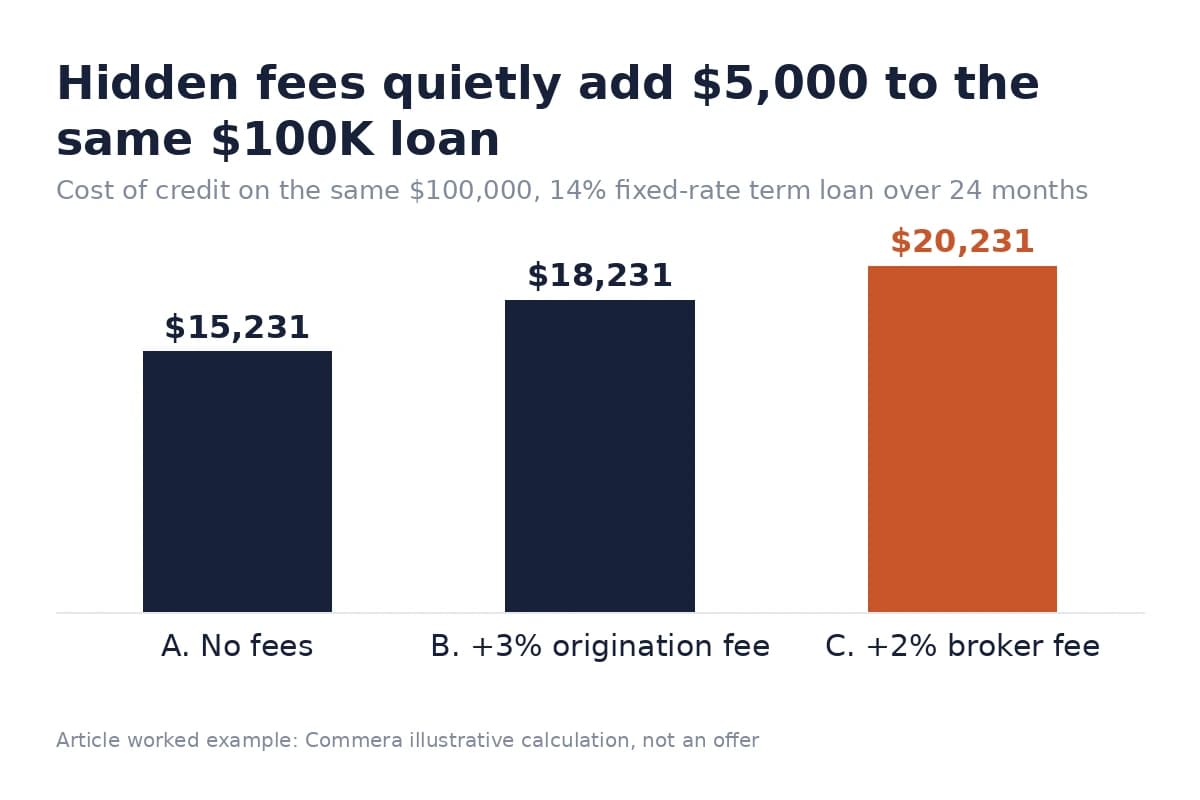
To check a broker's offer, compare the cash that reaches your account, total repayment and estimated APR. The interest rate alone can hide fees withheld at funding.
Methodology: Commera illustrative calculation with assumed inputs, not an offer and not a real deal. The loan is a fixed-rate term loan with equal monthly payments. Estimated APR is the internal rate of return of the monthly cash flows times 12. That is the actuarial method of Regulation Z, which New York's §804(c) cites.
Cash reaches you on day zero, and the first payment falls one month later. The example assumes no prepayment and no late payments. A broker commission paid by the lender is not in your cash flows, though it can be built into the rate. Same loan, three fee setups.
| Loan term | Value |
|---|---|
| Principal, $ | 100,000.00 |
| Interest rate, % | 14.00, fixed |
| Term, months | 24 |
| Monthly payment, $ | 4,801.29 |
| Scenario | Withheld at funding, $ | Cash in hand, $ | Total repayment, $ | Cost of credit, $ | Est. APR, % |
|---|---|---|---|---|---|
| A. No fees | 0 | 100,000 | 115,230.96 | 15,230.96 | 14.00 |
| B. Origination fee of 3% | 3,000 | 97,000 | 115,230.96 | 18,230.96 | 17.12 |
| C. B plus a 2% broker fee paid by you | 5,000 | 95,000 | 115,230.96 | 20,230.96 | 19.27 |
Source: Commera illustrative calculation, not an offer. Cost of credit equals total repayment minus cash in hand. Real terms are set by financing providers and are subject to underwriting.
What changes: The rate, the payment and total repayment are the same in all three rows. Only the cash in hand drops. You repay the same amount on less money. In this illustrative calculation, scenario C carries an estimated APR of 19.27%.
Rate is not APR: An offer that quotes only an interest rate shows the price of the money. It does not show the price of the deal. Ask for the APR, which includes fees. Per the table above, California and New York require providers to state it.
Merchant cash advances: An advance is priced with a factor rate, not an interest rate. Factor rates do not represent APR. Read factor rate versus APR before you compare an advance with a loan.
Fixed-payment loans: For how term loans are structured and who they suit, see our page on business loans.
Questions to ask before you sign the offer
Before you sign a financing offer, confirm seven terms in writing. Each one changes what the deal costs or what you risk.
- Cash in hand: How much reaches your account after every deduction? Match it to the disbursement line of the disclosure.
- Prepayment: Can you pay off early? Do you still owe unpaid finance charges if you do? Per New York Financial Services Law §804(h), providers there must disclose any finance charges beyond accrued interest and any extra fees due on early payoff.
- Collateral and UCC lien: What secures the loan? A lender may file a UCC lien on business assets. Ask which assets it covers and when it is released.
- Signing personally: Will you sign a personal pledge to repay the business's debt? If so, your own assets are at stake if the business does not pay.
- Payment frequency: Monthly, weekly or daily? Match the schedule to how cash comes in.
- Servicing: Who collects payments, and who do you call with a problem?
- Refinancing: If you refinance, are there fees outside the finance charge?
An advance and a loan answer these questions differently. Compare the two in our guide to merchant cash advance versus a business loan.
If the broker answers in writing and the numbers match the disclosure, judge the offer on its terms. If the answers are vague, walk away before you sign. With your documents ready, you can start an application and ask for every offer in writing. Terms vary by provider and are subject to underwriting.
Broker disclosure: Commera Finance is a broker, not a direct lender. Financing providers make their own eligibility, underwriting, approval, pricing, and term decisions.
Sources
- California Financial Code, Division 9.5, Commercial Financing Disclosures, §§22800 to 22807, accessed October 14, 2026
- California Financial Code §22004, accessed October 14, 2026
- California Financial Code §22100, accessed October 14, 2026
- California Code of Regulations, title 10, §900, definitions, via Cornell LII, accessed October 14, 2026
- New York Financial Services Law §801, accessed October 14, 2026
- New York Financial Services Law §802
- New York Financial Services Law §803
- New York Financial Services Law §804
- Florida Statutes 2026, §559.9611, Definitions
- Florida Statutes 2026, §559.9612, Scope
- Florida Statutes 2026, §559.9613, Disclosures
- Florida Statutes 2026, §559.9614, Prohibited acts
- Florida Statutes 2026, §559.9615, Enforcement