
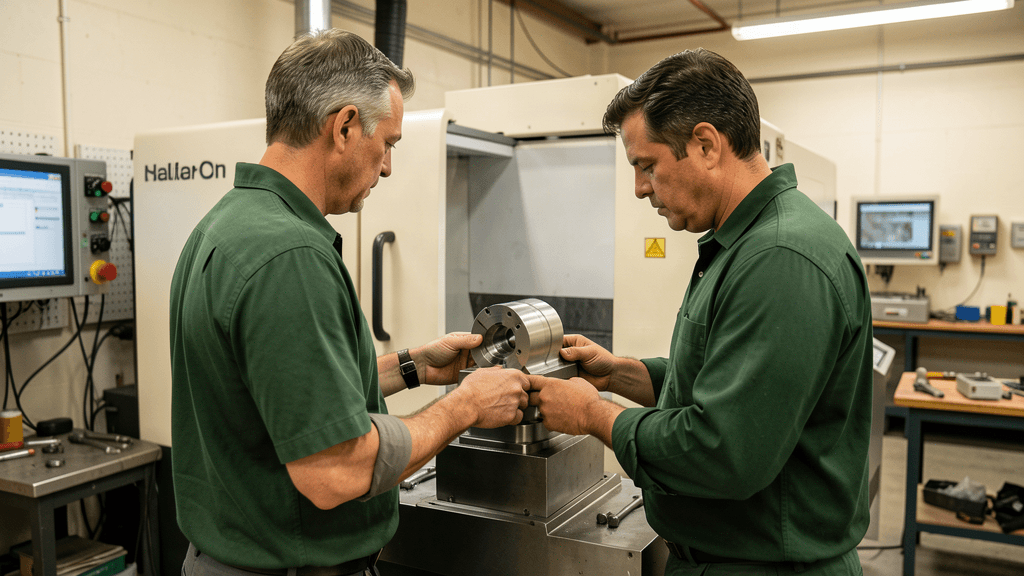
Validate demand before choosing a factory
Manufacturing government contracts can support a focused shop, but a large spending total is not a business case. Define one product family, one production process, a buyer problem, likely lot size, geography, and lead time. A statement such as low-volume machined replacement parts for a named asset class is testable. General metal manufacturing is not.
Use the small-business entry guide to establish the basic contracting path. This page starts with demand and delivery evidence. The goal is a narrow, testable production thesis before the owner commits to a facility, machine, or supplier obligation.
Use NAICS, PSC, USAspending, and SAM together
The contracting officer selects the NAICS code that best describes the principal purpose under FAR 19.102. PSC codes describe the product or service purchased. Search several plausible combinations, then review actual descriptions instead of trusting code totals.
Use the USAspending API or interface for multi-year awards. Record buyer office, recipient, amount, place, contract type, and dates. Use SAM contract opportunities for active notices, attachments, amendments, interested-vendor signals, and search alerts. Historical awards show demand evidence. Open notices show current buying signals. Neither guarantees accessible work.
Measure buyer and incumbent concentration
Group awards by agency, contracting office, incumbent, PSC, and geography. If most dollars sit with one buyer or one incumbent, interview the buyer's small-business office and likely primes before investing. Review recompete dates, lot sizes, set-aside history, and whether awards bundle many product families.
A concentrated market is not automatically bad, but it raises relationship and access risk. Record who controls specifications, qualification, ordering, and the likely recompete so the entry plan addresses the actual gate. The subcontracting opportunity guide may offer a lower-risk entry when a prime controls the vehicle or integration work.
Prove specifications, quality, and make-buy
From representative notices, download drawings, standards, inspection clauses, and packaging rules. Separately capture delivery destinations, first-article requirements, and quality-system terms. Build a requirement register with an owner and evidence for each item. First-article approval can affect tooling, schedule, and cash, so price it separately when required.
For every operation, decide make or buy. Record machine capacity, setup, cycle time, and yield. Add inspection and outside processing. Then document the backup supplier, minimum order, lead time, and change control. Cybersecurity belongs in the plan only when applicable contract clauses or covered information require it. Do not turn a generic concern into a claim that every machine shop needs the same program.
Build unit economics and the cash cycle
Price a representative unit in four groups. Start with material and direct labor. Add machine time, tooling, outside processing, and inspection. Finish with packaging, freight, scrap, overhead, and profit. Reconcile the extended price to the solicitation quantity and test lower yield, expedited freight, and a supplier delay. Include nonrecurring engineering and first-article cost where applicable.
Then map cash by week from material deposits through production, inspection, acceptance, invoice, and collection. A profitable unit can still consume cash. Use the government contract bidding process to carry these costs into a compliant price.
A 30-day validation sprint
Days 1 to 5: define the product-process-buyer thesis and code set. Days 6 to 10: collect several years of awards and a current notice sample. Days 11 to 15: measure buyer and incumbent concentration. Days 16 to 20: quote materials, outside processes, inspection, freight, and tooling. Days 21 to 25: interview buyers, primes, and suppliers. Days 26 to 30: build a go, partner, acquire, or stop memo with evidence gaps.
The sprint should end with named buyers, representative requirements, supplier quotes, and throughput math. It must also show unit economics, cash timing, and explicit disqualifiers. If it ends only with a NAICS code and spending total, the thesis is not ready.
Make-buy, source rules, and supplier risk
A shop can lose a bid after pricing if its planned supply chain conflicts with the solicitation. For a set-aside supply acquisition, analyze the nonmanufacturer rule and any waiver under FAR 19.505. Review the applicable limitations on subcontracting clause in FAR 52.219-14. The answer depends on the procurement, size representation, waiver status, and work actually performed.
Build a contract-specific make-buy sheet. For every component, record whether the shop makes it, buys it, or subcontracts an operation. Add country of origin, named source requirement, lead time, quality evidence, alternate source, and effect on the limitation calculation. Domestic-source rules are not interchangeable. Identify the exact clause and agency supplement before representing compliance.
Qualification barriers belong in the schedule and price:
- First article: Confirm sample quantity, test method, approval authority, and whether early production is at risk.
- Quality system: Map required inspections, records, calibration, traceability, and corrective action.
- Approved sources: Verify supplier and material qualifications before relying on a quote.
- Special processes: Confirm outside heat treatment, coating, welding, or testing capacity.
- Delivery: Include inspection, packaging, marking, and shipping requirements from the solicitation.
A single-source supplier deserves a disruption case. Price a qualified alternate where possible. Contract-specific qualification beats a generic claim that the shop is government ready.
Illustrative unit economics for one production lot
Illustrative assumptions, not market averages: a solicitation calls for 500 machined units. Proposed price is $240 each, so revenue is $120,000. Material is $42 per unit. Direct labor is $58, outside processing is $18, and inspection and packaging is $12. Variable cost is $130 per unit, or $65,000 for the lot.
Lot-level fixed costs are $14,000 for programming and tooling. Add $9,000 of allocated overhead and $6,000 of contingency. Total estimated cost is $65,000 plus $29,000, or $94,000. Expected profit is $120,000 minus $94,000, or $26,000. That reconciles to $52 per unit.
Now test failure. If 25 units are scrapped after outside processing, replacement variable cost is $3,250. If first-article approval adds $2,000 of holding and rescheduling cost, expected profit falls to $20,750. The model excludes any cost the contract does not allow the company to recover.
Use the worked example as a template:
- Reconcile quantities to each contract line item.
- Separate one-time tooling from recurring unit cost.
- Add supplier minimums and realistic yield.
- Price inspection and documentation labor.
- Test scrap, rework, late material, and a rejected first article.
The bid only works if the downside remains deliverable and cash-positive.
Finance only the validated constraint
After validation, match capital to the constraint. A durable machine may fit equipment financing down payments. Award-stage labor and materials may fit the government contract financing guide. Invoiced accepted work may support receivables financing.
Commera Finance is a business capital advisor arranging financing through partner lenders, not a direct lender. Bring the award or opportunity, quotes, model, cash forecast, and existing obligations to a financing review. Financing cannot create demand or correct an infeasible specification. Recheck supplier validity, inspection capacity, and downside cash before accepting any term sheet.
Sources