
What is medical equipment financing?
Medical equipment financing is a loan or lease that lets a practice pay for diagnostic, treatment or office equipment over time, usually with the equipment itself as collateral. You get the machine now and pay for it from the revenue it helps produce.
The equipment covers a wide range: ultrasound and X-ray units, lasers, exam tables, sterilizers, and the computers and servers that run your EHR. A lender finances the machine, and the machine secures the deal.
The choice that matters most is the structure. A loan, a $1 buyout lease and a fair market value (FMV) lease can carry similar monthly payments and very different totals. This guide compares all three on one machine in an illustrative calculation, then shows what a lender reads in a practice file.
For the general mechanics across industries, see our guide to equipment financing. Commera is a broker, not a lender. We compare offers from our lender partners.
Loan, $1 buyout lease or FMV lease: how they differ
A loan makes you the owner on day one. A lease leaves ownership with the lessor until the end of the term. The end of the term is where the three structures split. Healthcare equipment financing offers usually come in one of these three forms.
| Structure | Who owns it during the term | What happens at the end | Who it fits |
|---|---|---|---|
| Equipment loan | You, with the lender holding a lien | The lien is released after the last payment | A practice with cash for a down payment that plans to keep the machine for years |
| $1 buyout lease | The lessor | You buy the machine for $1 | A practice that wants to own the machine but keep cash at signing low |
| FMV lease | The lessor | You buy at fair market value, return the machine or extend the lease | A practice that expects to replace the machine when the technology moves on |
Medical equipment leasing is not a cheaper loan. It is a different contract.
A lease is not a loan; ownership, tax treatment and end-of-term obligations depend on the lease type and the specific contract. Consult a tax advisor.
The same choice by useful life shows up in other trades. Our guide to restaurant equipment financing works through it for kitchens.
Worked example: one $120,000 machine financed three ways
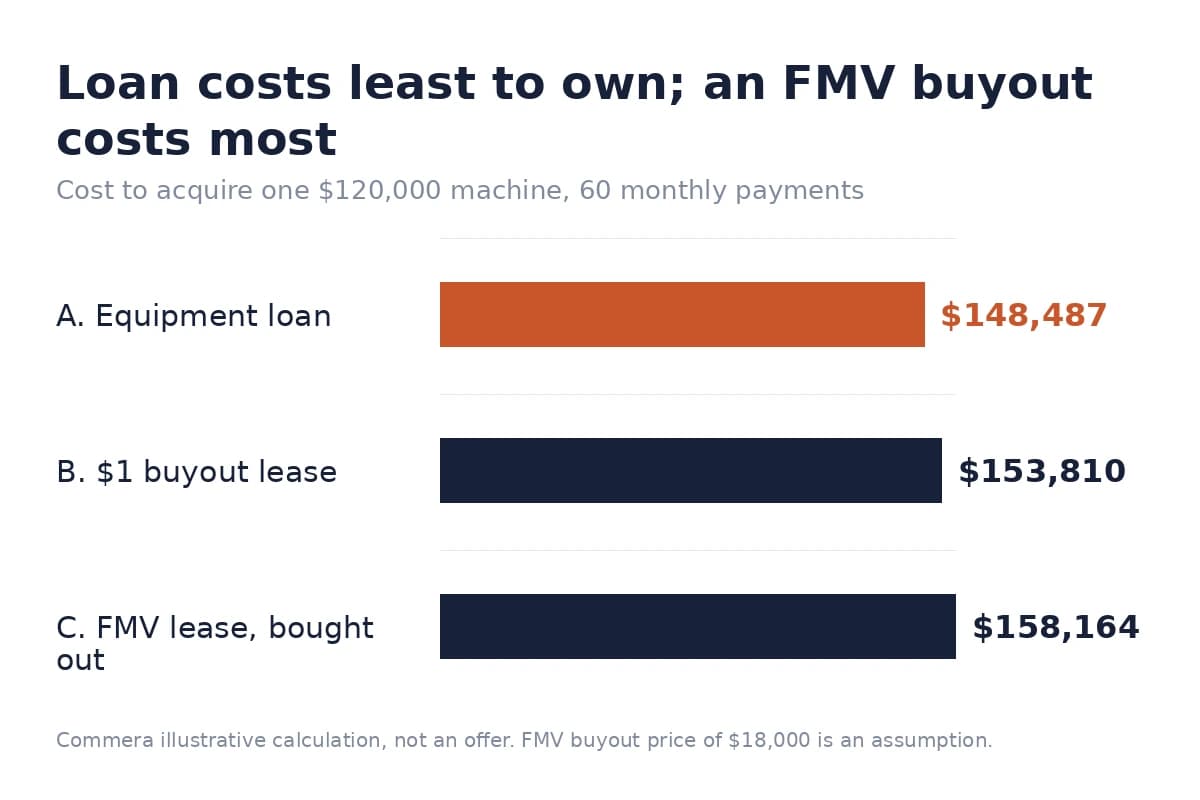
In a Commera illustrative calculation, the loan costs least to own, the $1 buyout lease costs more, and buying out the FMV lease costs the most. The FMV lease has the smallest required payments if you hand the machine back.
Methodology: Commera illustrative calculation, not an offer and not a real deal, and the equipment price is an assumption rather than a market price. All three options run 60 monthly payments and charge a $395 documentation fee at signing, with no refundable deposit. Service contracts and insurance are not included in any of the payments. Lease C assumes no end-of-term fee, and return shipping, de-installation or renewal payments depend on the specific contract and are not included.
The loan rate assumes Prime of 7.00%, per Federal Reserve H.15 released October 23, 2026, plus 2.5 points. The lessor does not state a rate in either lease, so both lease payments were priced at an assumed 10.5% lessor yield, paid at the start of each month. The FMV lease assumes a 15% residual value. The estimated APR in this illustrative calculation uses the IRR method on monthly payment dates, with the fee included.
| Line | A. Equipment loan | B. $1 buyout lease | C. FMV lease |
|---|---|---|---|
| Equipment cost, $ | 120,000 | 120,000 | 120,000 |
| Paid at signing, $ | Down payment 12,000 (10%) + fee 395 | First payment 2,556.90 + fee 395 | First payment 2,329.49 + fee 395 |
| Refundable deposit, $ | None | None | None |
| Amount financed, $ | 108,000 | Not stated by the lessor | Not stated by the lessor |
| Rate | 9.50% fixed (rate is not APR) | Not stated in the contract | Not stated in the contract |
| Monthly payment, $ × number | 2,268.20 × 60, in arrears | 2,556.90 × 60, first one at signing | 2,329.49 × 60, first one at signing |
| Total repayment of the loan, $ | 136,092.00 | n/a | n/a |
| Required payments under the contract, $ | 148,487.00 with down payment and fee | 153,809.00 (60 payments + fee) | 140,164.40 (60 payments + fee) |
| End of term | You own it from day one | Buyout for $1 | Buy at market value, return or extend |
| Cost to acquire, $ | 148,487.00 | 153,810.00 | 158,164.40 if bought for an assumed 18,000 |
| Est. APR | About 9.66% | About 10.65% | About 10.63%, buyout scenario only |
Sources: Commera illustrative calculation. Prime rate per Federal Reserve H.15, release of October 23, 2026.
How the APRs are built. In this illustrative calculation, loan A counts the amount financed, less the fee, against 60 payments in arrears. Lease B counts the machine at month 0, less the first payment and the fee, then 59 payments and the $1 buyout in month 60. Lease C uses the same cash flows, with the assumed buyout price in month 60 instead of $1.
FMV return scenario. In the illustrative calculation, returning the machine makes lease C cost $140,164.40 in rental over the term, and you own nothing. No APR is shown for that path, because without a buyout price there is no cash flow to measure it against.
That buyout price is a scenario assumption, not a forecast. Nobody knows what the machine will sell for in five years. If the market price comes in higher, buying out lease C costs more.
Three takeaways from the illustrative numbers:
- In this illustrative case, loan A needs $12,000 of your cash on day one. Both leases need only the first payment and the fee.
- Lease C has the smallest required payments, yet buying at market value is still the most expensive path to ownership here.
- The loan comes out ahead only because of the assumed rates. A lessor quoting a lower yield can reverse the order.
To test your own price, rate and term, run the numbers through our funding calculator.
What lenders check in a medical practice
A lender checks that the practice can make the payment from cash it actually collects. Billed charges are not cash in the bank. Insurers pay on their own schedule, so a busy practice can still run short.
The standard file has four parts:
- Time in business. How long the practice has billed under its current owner.
- Licenses. Active state licenses for the providers who will use the machine.
- Owner's personal credit. Many lenders also ask the owner for a personal pledge to repay.
- Bank statements. Months of deposits, to compare with what the practice bills.
Payer mix and receivables. Money arrives only after payers process claims, and Medicare shows the timing clearly. Under 42 U.S.C. § 1395u(c), Medicare contractors must pay at least 95% of clean Part B claims within 30 calendar days. The same section bars payment of electronic claims within 13 days of receipt, and of other claims within 28 days.
That is the floor for a clean claim. A claim with a defect waits longer.
So a lender reads the aging of your receivables and your denial rate, not just revenue. A practice with large, old unpaid balances looks weaker than its billings suggest. Bring an aging report and a payer mix summary with the application.
New practice. A practice without billing history has no receivables to show. The file leans on the owner's credit, cash reserves and a projection. Startup costs beyond equipment are a separate question, and medical practices need a different build from most small businesses.
Used equipment. Used machines can be financed, but terms tend to run shorter. Expect the lender to ask for the machine's age and an assessment of its condition.
All terms are subject to underwriting.
Manufacturer financing or an independent lender?

A manufacturer's or dealer's finance program is convenient because the offer arrives with the quote. Convenience is not price. Put the captive offer and an independent lender's offer side by side on the same lines as the worked example.
Ask each provider the same questions:
- What are the total required payments under the contract, with every fee at signing?
- How does the contract end: a nominal buyout, an FMV buyout, return or renewal?
- If it is an FMV lease, who sets the market value at the end of the term, and when?
- What is the est. APR for a scenario where you end up owning the machine?
- Is the service contract inside the monthly payment or billed separately?
- Is there a prepayment penalty if you pay off the contract early?
- Who owns the machine, and what happens to it, if the practice defaults?
- Who pays to de-install and ship the machine back at the end of an FMV lease?
A low monthly number can hide a service contract or a costly buyout. Compare totals, not payments.
Animal health runs on the same logic. Our guide to veterinary practice financing covers the same loan or lease choice for clinics with a different payer base.
Taxes: Section 179 and bonus depreciation
Section 179 lets a business expense the cost of qualifying equipment in the year it is placed in service, up to an annual limit. For tax years beginning in 2026, that limit is $2,560,000, per IRS Rev. Proc. 2025-32, section 4.24. Under the same section, the limit shrinks once Section 179 property placed in service that year exceeds $4,090,000.
Bonus depreciation is the second tool. The One, Big, Beautiful Bill made 100% additional first year depreciation permanent for eligible property acquired after January 19, 2025, per IRS IR-2026-06 and Notice 2026-11.
A lease changes the picture. Whether you or the lessor claims the deduction depends on the lease type and the contract terms, and a buyout lease and an FMV lease can be treated differently. Consult a tax advisor before you pick a structure for the deduction.
When you have a quote in hand, you can compare equipment financing offers from our lender partners on the same terms.
Broker disclosure: Commera Finance is a broker, not a direct lender. Financing providers make their own eligibility, underwriting, approval, pricing, and term decisions.
Sources
- Federal Reserve, H.15 Selected Interest Rates, bank prime loan rate, release of October 23, 2026
- 42 U.S. Code § 1395u, Provisions relating to the administration of part B, subsection (c)
- IRS, Rev. Proc. 2025-32, section 4.24
- IRS, IR-2026-06, January 14, 2026
- IRS, Notice 2026-11
- SBA, SOP 50 10 8.1, effective October 1, 2026