
Overview

*A staffing agency owner oversees a temporary crew at work while the agency manages the payroll-to-collection gap.*
Payroll funding for staffing agencies is short-term capital used to cover wages while customer invoices remain unpaid. For agencies with eligible B2B invoices, payroll funding is commonly structured as receivables financing: a funder advances part of an invoice, holds the balance as a reserve, and releases the reserve less its fee after the customer pays.
Commera's receivables financing page shows an illustrative advance-rate range of 70% to 95%, with 85% as the calculator default. The page's FAQ says fees commonly run 1% to 3% per 30 days on invoice face value; its interactive calculator currently allows a broader illustrative range of 1% to 5%.
Commera is a broker, not a lender. We compare offers from funding partners. Approval, pricing, reserves, recourse, guaranties, and funding speed depend on the applicant, receivables, customers, agreement, and funding partner.
Factoring fees are not APR. To evaluate an offer, calculate the total dollar cost over the expected collection period and compare that cost with the spread left after payroll burden and other direct costs.
Search terminology varies. Invoice factoring for staffing agencies and staffing factoring companies generally refer to receivables-based funding. Staffing agency loans and a staffing agency line of credit are debt products. Temp agency funding and payroll financing for staffing are broader terms. Healthcare staffing factoring applies the same receivables concept to eligible healthcare staffing invoices.
Why growing staffing agencies can run short of cash
Staffing firms may pay workers weekly while customer invoices remain outstanding for several weeks. Growth widens that timing gap because each new order creates another payroll before it creates a collection.
Public filings show the scale of receivables at two large staffing companies. Kforce reported $190,461,000 of year-end net trade receivables and $1,329,007,000 of 2025 revenue. A rough Commera calculation, $190,461,000 divided by $1,329,007,000 and multiplied by 365, equals 52.3 days. Robert Half reported $748,457,000 of year-end net accounts receivable and $5,378,506,000 of 2025 service revenue. The same calculation equals 50.8 days.
These are point-in-time, company-wide receivables-to-revenue ratios. They use year-end receivables rather than average receivables and do not isolate temporary-staffing invoices or prove that every client pays on that schedule. Neither company disclosed these rough ratios as days sales outstanding. Robert Half's denominator also includes all reported segments, including Protiviti and permanent placement.
Payroll deadlines can arrive much sooner than customer collections. Agencies should model their actual payroll calendar, invoice-approval process, and customer payment history before choosing a financing structure.
Nearly 2.2 million temporary and contract employees worked for U.S. staffing companies during an average week in 2024, according to the American Staffing Association. Agencies managing that weekly payroll cadence need to plan cash around invoice approval, billing, disputes, and collection. The broader operating model is covered in How to Start a Staffing Agency.
How payroll funding for staffing agencies works
One invoice can produce three cash movements:
- The agency submits an eligible invoice, often with approved timesheets or other supporting records.
- The funder advances an agreed percentage of the invoice face value.
- The funder holds the remaining amount as a reserve, then releases it less applicable fees after collection, subject to the agreement.
For example, an 85% advance on a $27,000 invoice provides $22,950 in immediate cash and leaves a $4,050 reserve before fees. If the customer pays the funder directly under a notification arrangement, the customer receives payment instructions or a notice of assignment. Non-notification structures may also be available. The cited Commera page explains both structures but does not establish how common either one is among staffing agencies.
Factoring underwriting and pricing commonly emphasize invoice quality, the customer's ability to pay, and payment timing; the agency, guarantors, structure, and agreement may still affect approval and terms. Clean timesheets, accurate invoices, and a clear customer acknowledgment process can make a receivable easier to verify. A disputed invoice may be ineligible or remain outstanding longer, depending on the facility terms.
The fee convention matters. A fee quoted as a percentage per 30 days may increase as the invoice ages. Some agreements prorate by the day, while others use minimum periods, stepped fees, or additional charges. Compare the agreement's actual fee schedule, not just its headline percentage.
What one weekly payroll costs in this example
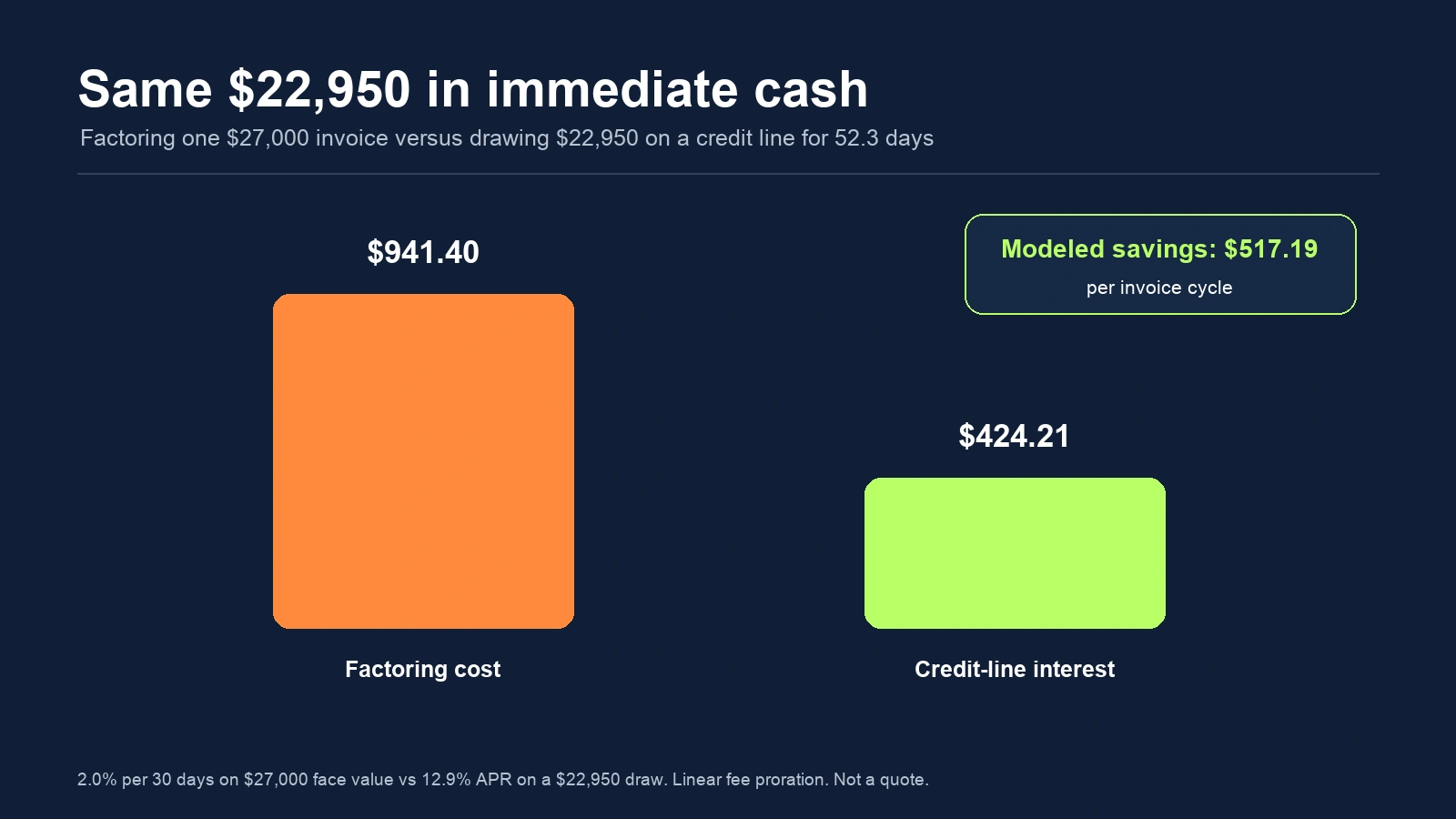
*For the same $22,950 in immediate cash, a credit line costs $517 less than factoring one $27,000 invoice. Commera illustrative calculation: 2.0% per 30 days on $27,000 invoice face value versus 12.9% APR on a $22,950 credit-line draw for 52.3 days. Not a market quote.*
Consider an illustrative weekly assignment with 25 workers, 40 hours per worker, an $18 hourly pay rate, and a $27 hourly bill rate. The pay rate, bill rate, staffing level, hours, and collection period are assumptions, not market averages.
Illustrative calculation for one week
| Line item | Formula | Amount |
|---|---|---|
| Gross payroll | 25 x 40 x $18 | $18,000.00 |
| Employer Social Security and Medicare | $18,000 x 7.65% | $1,377.00 |
| Modeled FUTA | $18,000 x 0.6% | $108.00 |
| Modeled cash out | $18,000 + $1,377 + $108 | $19,485.00 |
| Customer invoice | 25 x 40 x $27 | $27,000.00 |
| Illustrative spread after modeled federal employer taxes | $27,000 minus $19,485 | $7,515.00 |
The Social Security Administration lists a 2026 Social Security taxable wage base of $184,500 and a 6.2% employer rate. Medicare adds a 1.45% employer rate with no taxable maximum. The 7.65% line assumes each worker remains below the Social Security wage base.
The IRS FUTA guidance states a 6.0% FUTA rate on the first $7,000 paid to each employee and a credit of up to 5.4%. The $108 FUTA line assumes every modeled wage dollar remains within each employee's first $7,000 of annual wages and that the employer qualifies for the full 5.4% state credit. Credit-reduction states or an unavailable state credit can increase FUTA.
This model excludes state unemployment tax, workers' compensation, benefits, paid leave, payroll processing, recruiting costs, background checks, and other direct costs. The $7,515 figure is therefore an illustrative spread, not accounting gross profit.
Using the rough 52.3-day Kforce ratio only as a scale illustration, the agency would carry about 7.47 weekly payrolls before collecting the first invoice. Multiplying $19,485 by 52.3 divided by 7 produces about $145,581. This is not a forecast. It inherits the limitations of the public-company ratio and the simplified payroll model.
Factoring versus a credit line on the same immediate cash
The comparison below holds immediate cash constant at $22,950. Factoring advances $22,950 against a $27,000 invoice. The credit-line column assumes a $22,950 draw, not a $27,000 draw.
| Illustrative route | Factor the $27,000 invoice | Draw $22,950 on a credit line | Wait for the customer |
|---|---|---|---|
| Invoice face value | $27,000.00 | $27,000.00 | $27,000.00 |
| Cash available now | $22,950.00 | $22,950.00 | $0.00 |
| Rate used | 2.0% per 30 days | 12.9% APR | None |
| Days until customer payment | 52.3 | 52.3 | 52.3 |
| Modeled cost | $941.40 | $424.21 | $0.00 |
| Total invoice proceeds after modeled financing cost | $26,058.60 | $26,575.79 | $27,000.00 |
| Annualized figure | 28.6% simple annualized equivalent on the advance, not APR | 12.9% APR | None |
The factoring example assumes the 2.0% per-30-day fee is prorated linearly over 52.3 days. Actual agreements may use minimum periods, stepped fees, or additional charges. The calculation is $27,000 x 2.0% x 52.3 divided by 30, which equals $941.40.
The credit-line example uses the 12.9% modeled calculator default shown on Commera's business line of credit page. It is an illustration, not a rate quote. The calculation is $22,950 x 12.9% x 52.3 divided by 365, which equals $424.21. Actual rates, fees, approval, collateral, draw rules, and timing depend on the applicant and funding partner.
For the same $22,950 in immediate cash, the modeled credit line costs $517.19 less than factoring one $27,000 invoice. Under the same amount, rate, 52.3-day duration, utilization, and no-extra-fee assumptions, the modeled difference is $517.19 per invoice and $26,893.86 across 52 invoices.
The factoring cost equals 12.5% of the modeled $7,515 spread. That comparison is useful, but the spread still excludes several direct costs. The simple annualization is 28.6% on the $22,950 advance, before ancillary fees; it is not APR and does not include compounding.
The zero-cost waiting column also requires the agency to supply its own cash. Before choosing a route, check what your receivables may support.
Payroll funding, factoring, a credit line, and an EOR
Payroll funding describes the cash-flow objective. Receivables financing or factoring is one mechanism. A business line of credit is another. An employer of record, or EOR, changes the employment structure rather than simply advancing cash.
| Option | What supports it | How cost is commonly structured | Primary constraint | Potential fit |
|---|---|---|---|---|
| Invoice factoring | Eligible invoices and customer credit, plus the full facility structure | Fee tied to invoice face value and time outstanding | Eligible receivables, customer limits, concentration, disputes, and agreement terms | Agencies with verifiable B2B invoices and a timing gap |
| Business line of credit | Applicant financials, credit, collateral, and lender criteria | Interest on the outstanding draw, plus any fees | Approved credit limit and draw conditions | Agencies with established financials and predictable needs |
| Employer of record | EOR approval of the agency, customer, workers, and assignment | Contracted service charge or share of billings | EOR appetite, contract terms, compliance, and account economics | Agencies choosing to outsource employer responsibilities |
| Internal cash | Cash on the balance sheet | No third-party financing charge | Available liquidity | Agencies able to fund growth without weakening reserves |
Factoring capacity may rise with eligible billings, but eligibility rules and debtor limits can prevent a dollar-for-dollar increase. A line of credit has a stated limit that may change after lender review. Commera's line-of-credit page says online lines are often approved and drawable in one to three business days, but actual timing varies. See How a Business Line of Credit Works for the mechanics.
An EOR can place workers on the EOR's payroll and assume specified employer responsibilities under the contract. That can reduce the agency's direct payroll burden, but it also changes control, compliance responsibilities, margin, and customer economics. Review the agreement with employment and tax advisers rather than treating an EOR as interchangeable with financing.
What underwriters review
A receivables financier may review the staffing agency, its owners or guarantors, the facility structure, and the receivables themselves. Invoice quality, customer credit, payment timing, dilution, disputes, and customer concentration can all affect eligibility and terms.
Customer concentration can reduce eligible receivables or produce debtor-specific limits; thresholds vary by funder. Government receivables may also require separate assignment and payment procedures. See Government Receivables Financing for that issue.
The document list on Commera's receivables financing page includes:
- an accounts-receivable aging report and sample invoices
- customer details and payment terms
- three months of business bank statements
A funder may request additional items. Keep timesheets, customer approvals, contracts, credit memos, and invoice records organized before applying. A clean package does not ensure approval, but it makes the receivables easier to evaluate.
If you want to compare possible structures, start with pre-qualification. Offers, amounts, timing, credit review, and documentation requirements vary by profile and funding partner.
Payroll taxes do not wait for customer payment
Federal payroll tax deposits follow the employer's deposit schedule, not the customer's payment date. IRS employment-tax deposit guidance says employers with $50,000 or less in employment taxes during the lookback period are generally monthly depositors, with deposits due by the 15th day of the following month. Employers above $50,000 are generally semiweekly depositors and follow the applicable Wednesday or Friday deadline. A new employer is generally a monthly depositor during its first calendar year unless the next-day rule applies.
If you accumulate $100,000 or more of employment taxes on any day during a deposit period, the deposit is generally due the next business day. The same IRS guidance also explains the resulting semiweekly status rules.
Using unpaid employment taxes to fund payroll can trigger deposit penalties and, for unpaid trust-fund taxes, possible personal assessment against a responsible person. The IRS Trust Fund Recovery Penalty guidance says the penalty may apply when a responsible person willfully fails to collect or pay trust-fund taxes. Using available funds to pay other creditors can indicate willfulness, and collection may reach personal assets.
Confirm your deposit schedule and state obligations with your payroll provider, accountant, or tax adviser. Financing should cover a planned timing gap, not replace tax compliance.
SBA-backed working-capital options
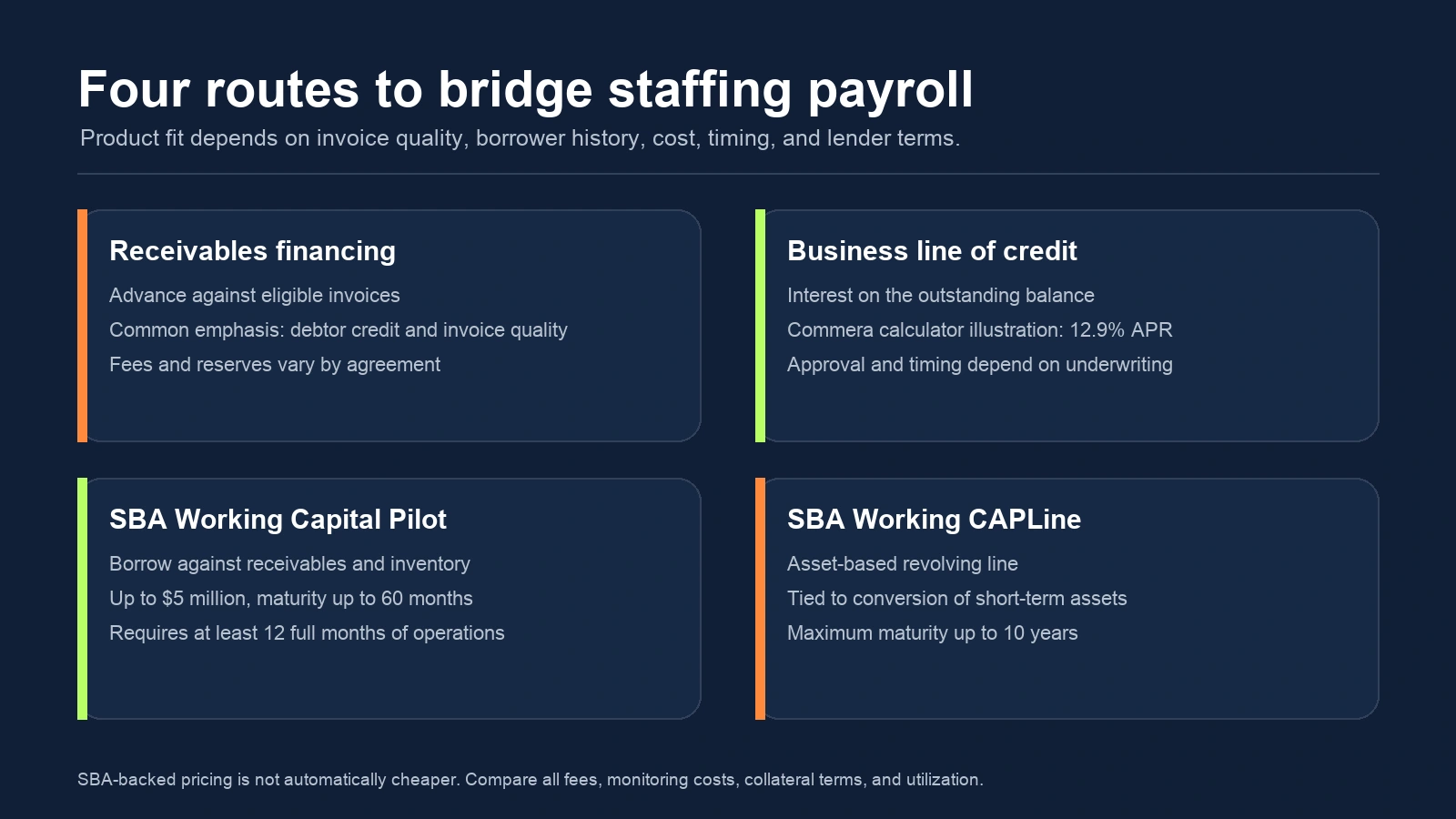
*Factoring may be available to newer firms, subject to invoice and debtor underwriting. The SBA Working Capital Pilot requires 12 full months of operations under the cited SBA page. For $350,001 and greater, its listed rate cap is the base rate plus 3.0%.*
The SBA 7(a) loan types page describes two programs relevant to receivables. The 7(a) Working Capital Pilot can support borrowing against accounts receivable and inventory, while Working CAPLine is an asset-based revolving line tied to short-term assets.
The cited SBA page lists a $5 million maximum loan size and maturity of up to 60 months for the Working Capital Pilot. It also lists SBA guaranties of 85% for loans of $150,000 or less and 75% above $150,000. For amounts of $350,001 and greater, the listed maximum rate is the base rate plus 3.0%.
The page requires 12 full months of operations before a Working Capital Pilot application and calls for timely financial statements, accounts-receivable and accounts-payable agings, and annual financial updates. The cited SBA page identifies WCP as a pilot and does not state an end date; confirm current availability with SBA and participating lenders.
Working CAPLine is described as an asset-based revolving line repaid through the conversion of short-term assets into cash. SBA says it is generally used by businesses that extend credit to other businesses. Its maximum maturity is 10 years, and collateral-monitoring fees may apply.
An SBA-backed line may price below factoring, but actual total cost depends on lender terms, guaranty fees, collateral-monitoring fees, utilization, and qualification. It may also require more operating history and documentation. Compare written proposals on total cost, timing, collateral, covenants, and availability rather than assuming one structure will always be cheaper.
What payroll funding does not fix
Payroll funding addresses timing. It does not repair a thin spread, inaccurate billing, disputed time, or dependence on one customer.
First, calculate the contribution from each assignment after wages, payroll taxes, workers' compensation, benefits, recruiting costs, and other direct expenses. Then subtract the proposed financing cost. If little remains, the bill rate or cost structure needs attention before the assignment scales.
Next, tighten billing. Late timesheets and disputed hours can delay invoicing or collection. When the fee rises with time outstanding, preventable billing delays increase financing cost.
Watch concentration too. A customer that represents most billings creates operating risk even before a funder applies a debtor limit. Customer concentration can reduce eligible receivables, increase reserves, or limit facility availability, depending on the funder.
Finally, monitor repeated full utilization. If receivables remain flat while the facility stays fully drawn, the financing may have shifted from a temporary bridge to a recurring operating cost. Compare it with a line of credit, revised payment terms, better collection, customer diversification, or retained cash. MCA vs. Invoice Factoring for B2B explains why a receivables-backed problem should not automatically be patched with a revenue-based advance.
Choosing a route for common staffing situations
If customers pay in 45 to 60 days and invoices are clean, compare receivables financing with a credit line using the expected collection period. Judge each written offer against the assignment's contribution after direct costs.
If the spread is thin, fix pricing or costs before financing the assignment. Funding changes timing and adds expense. It does not increase the amount the customer owes.
If a new contract is larger than available cash, model the need by weekly payrolls and the customer's actual payment cycle. The earlier illustration produced about 7.47 weekly payrolls at a 52.3-day period, but your requirement should use your own wages, burden, billing dates, approval lag, and payment history.
If the business has at least 12 full months of operations and current financial statements and agings, ask participating lenders whether the Working Capital Pilot or Working CAPLine is available. Compare any SBA-backed proposal with factoring and conventional credit based on total cost and usable availability.
How does payroll funding work?
For agencies with eligible B2B invoices, a funder may advance an agreed share of invoice face value, hold a reserve, and release the reserve less fees after customer payment. The exact advance, reserve, collection process, recourse, and fee schedule depend on the agreement.
How do I apply for staffing agency payroll funding?
Prepare an accounts-receivable aging report, sample invoices, customer details and payment terms, and recent business bank statements. A funder may also request timesheets, customer contracts, tax records, owner information, and other financial documents.
How much does staffing invoice factoring cost?
Commera's receivables financing FAQ says fees commonly run 1% to 3% per 30 days on invoice face value, while its calculator allows a broader illustrative 1% to 5% range. Your cost depends on the agreement, invoice amount, collection time, customer risk, volume, reserves, recourse, and ancillary fees.
What are the downsides of invoice factoring?
Potential drawbacks include fees that increase with time outstanding, reserves, customer notification, invoice verification, recourse provisions, concentration limits, ineligible invoices, minimums, and other contractual charges. Read the full agreement and model the cost under realistic payment delays.
Is payroll funding worth it for a small temp agency?
It can be useful when the assignment produces enough contribution after all direct costs and financing expense, and when preserving cash allows the agency to accept profitable work. Compare the funded and unfunded cash schedules. Do not judge the offer only by its headline percentage.
Can a newer staffing agency qualify?
A newer agency may qualify for receivables financing when it has eligible invoices and creditworthy customers, but approval, guaranties, reserves, and terms vary by funder. An SBA Working Capital Pilot application has a separate requirement for 12 full months of operations under the cited SBA page.
Will customers know about the facility?
Under a notification arrangement, customers receive payment instructions or a notice of assignment and generally pay the funder. Non-notification arrangements may also exist, subject to structure and approval. Confirm the communication and collection process before signing.
Is a personal guaranty required?
Requirements vary by funder and facility. Review the guaranty, recourse provisions, representations, default terms, and fee schedule with qualified counsel before signing. Do not assume that customer credit removes every obligation of the agency or its owners.
Is payroll funding a loan?
A true-sale factoring arrangement is structured as a purchase of receivables rather than a conventional loan, but legal characterization and recourse depend on the agreement and applicable law. A business line of credit is a loan. Ask counsel and your accountant how a proposed arrangement should be treated.
Sources
- Kforce Inc., Form 10-K for fiscal 2025, filed February 20, 2026
- Robert Half Inc., Form 10-K for fiscal 2025, filed February 13, 2026
- Social Security Administration, Contribution and Benefit Base
- IRS guidance for Form 940 and FUTA
- IRS guidance for employment-tax deposit requirements
- IRS, Employment Taxes and the Trust Fund Recovery Penalty
- American Staffing Association, Staffing Industry Statistics
- U.S. Small Business Administration, Types of 7(a) Loans
- Commera, Receivables Financing
- Commera, Business Line of Credit