
Semi Truck Financing for Owner-Operators
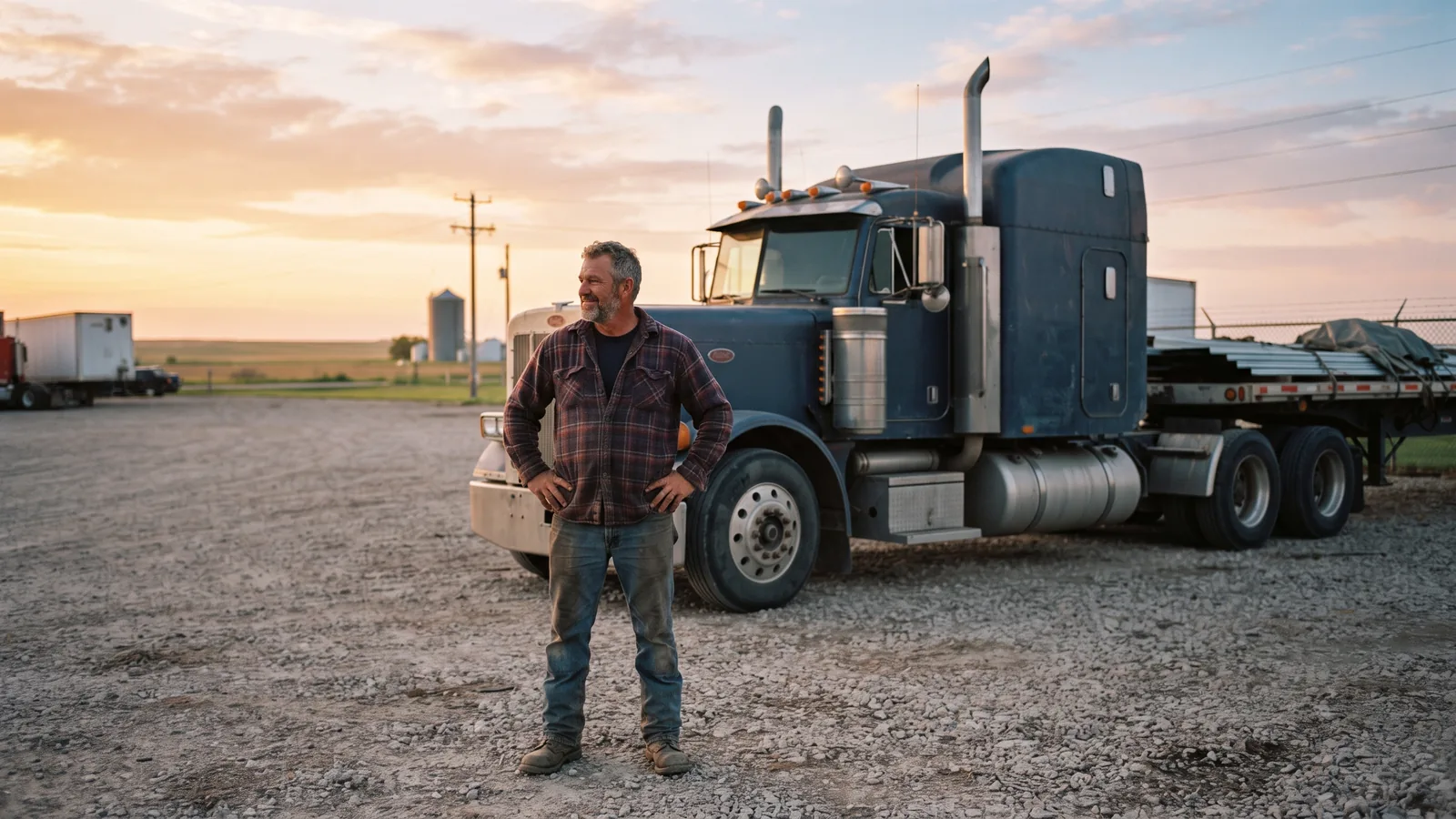
*A first-time owner-operator with his own sleeper tractor: the reader this guide is written for.*
How we calculated the examples: Every payment table uses the stated principal, APR, and term with standard monthly amortization. Per-mile figures divide annual payments by the stated annual miles. Dealer listings and public benchmarks are dated in the source list.
The short answer
Semi truck financing is a secured loan or lease used to buy a Class 8 tractor, with the truck itself pledged as collateral. Four kinds of money compete for your signature: dealer finance desks, manufacturer captives, banks, and independent equipment lenders.
Terms on transportation equipment commonly run up to 60 months. That is the illustrative ceiling published on Commera's equipment financing page, not an offer. Semi tractor financing on a high-mileage unit runs shorter, since a lender matches the term to the life left in the truck.
Commera is a broker, not a lender. We compare offers from our lender partners.
What a used sleeper actually costs today
A used over-the-road sleeper on a national dealer lot lists in the mid-to-high $70,000s as of September 22, 2026. Three units from Penske Used Trucks on that date:
| Unit | Odometer, miles | Listed price, USD | Location |
|---|---|---|---|
| 2020 Freightliner Cascadia 12564ST | 280,265 | $79,500 | Greensboro, NC |
| 2022 Freightliner T12664ST | 485,410 | $75,750 | Indianapolis, IN |
| 2022 Freightliner T12664ST | 545,300 | $74,250 | Brooklyn Park, MN |
Read the odometer before the model year. As of that snapshot, the oldest unit carried the highest price, because it had 205,000 fewer miles than the next unit. Between the two 2022 tractors, about 60,000 miles separated them and $1,500 separated their prices.
These are three individual listings, not a market average. Inventory turns constantly and prices move with it. Pull current listings before you budget.
New or used: where the money actually goes
New and used tractors cost money in different places. A new truck carries a federal excise tax and a factory warranty. A used truck skips the tax and inherits the repair bills.
The excise is 12% of the sales price on the first retail sale of a heavy truck chassis, body, or highway tractor, per IRS Publication 510. A second-hand purchase does not carry it. On a new unit it lands on the invoice, which means it lands in the amount you finance.
Then the warranty runs out. Base warranties on an over-the-road tractor typically expire at 400,000 miles and four years of highway operation, FleetOwner reports in its used Class 8 market guide. Under warranty, maintenance runs about 12 to 14 cents per mile. On equipment with 500,000 to 750,000 miles, the same guide cites ATRI figures of 24 to 28 cents.
Put those ranges against 100,000 miles a year. Maintenance on the covered truck works out to roughly $12,000 to $14,000 a year, and roughly $24,000 to $28,000 on the high-mileage unit. Both are illustrative Commera conversions of the ranges above. Retail dealers often attach a 30 to 90 day warranty, and auctions attach none.
So semi tractor financing is not a payment decision. It is a payment plus maintenance decision, and the lowest-priced truck on the lot frequently loses it.
Semi truck financing: what the payment looks like per mile
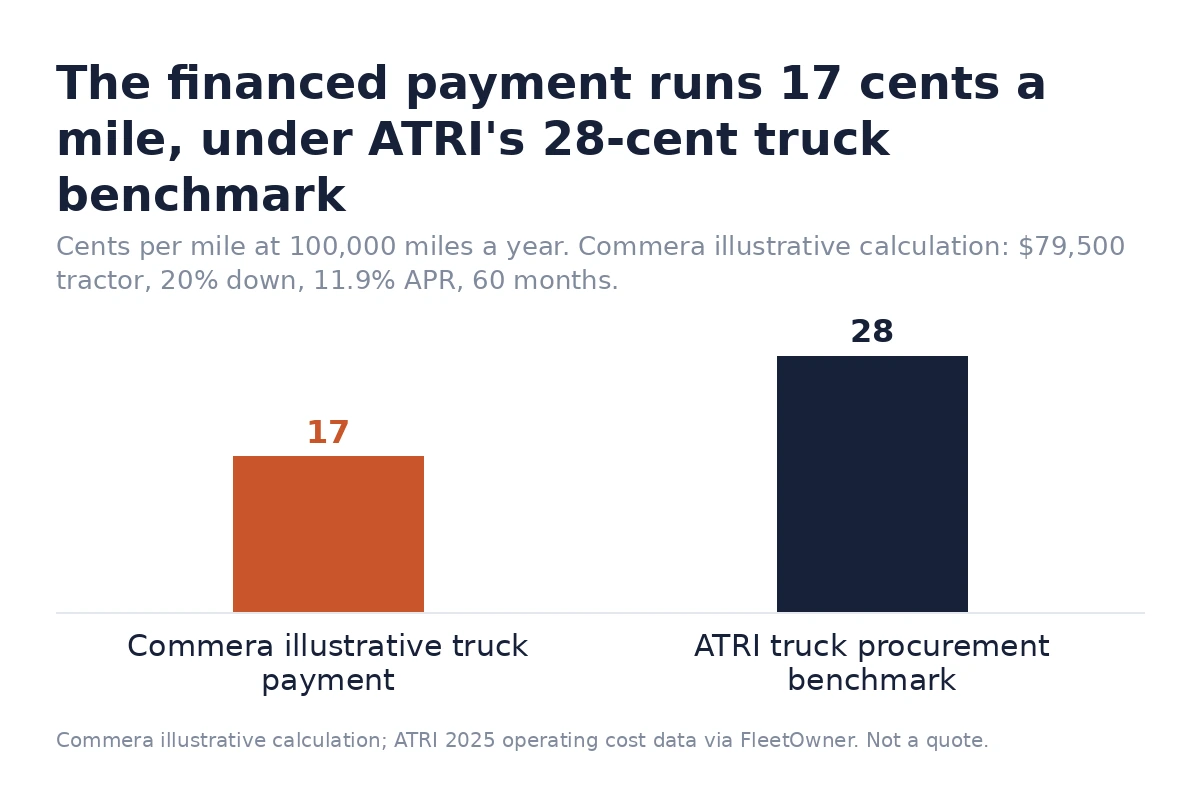
*The Commera illustrative truck payment is a smaller per-mile cost than ATRI's truck procurement benchmark.*
Financing a $79,500 tractor costs about 17 cents a mile at 100,000 miles a year. Here is the illustrative arithmetic, using the 2020 Cascadia above and the illustrative inputs published on Commera's equipment financing page.
Commera illustrative calculation.
| Line | Illustrative figure |
|---|---|
| Truck: 2020 Cascadia 12564ST, 280,265 miles | $79,500 |
| Down payment at 20% | $15,900 |
| Principal financed | $63,600 |
| Term | 60 months |
| Illustrative APR | 11.9% |
| Monthly payment | $1,411.54 |
| Total of 60 payments | $84,692 |
| Cost of financing over the term | $21,092 |
| Payment per mile at 100,000 miles a year | $0.17 |
The monthly payment produces $16,938.48 in annual debt service before insurance, fuel, maintenance, or trailer costs.
The 11.9% rate and the 20% deposit are illustrative planning inputs from Commera's equipment financing page, not a quote. Your written offer governs.
Now set 17 cents against the benchmark. ATRI put truck procurement at $0.28 per mile in its 2025 cost data, with trailer procurement at $0.12 on top, as broken down by FleetOwner. Total marginal cost reached $2.336 per mile in 2025, and $1.854 excluding fuel, according to ATRI.
The truck note is a minority line. Per ATRI, fuel ran $0.482 per mile, repair and maintenance $0.22, insurance $0.11. What sinks an owner-operator is idle weeks and a rate that will not cover them. Change the term or the deposit and price the structure in the funding calculator first.
What a lender looks at before the first truck
A lender underwrites three things: the tractor as collateral, your ability to operate it legally, and the cash you bring. First-truck files get read harder, because there is no ownership history behind them.
Start with the license. A combination vehicle rated at 26,001 pounds or more, towing over 10,000 pounds, requires a Group A CDL under 49 CFR 383.91. Entry-level driver training is mandatory for a first Class A credential under 49 CFR part 380, subpart F.
Then insurance. For-hire carriers hauling nonhazardous property in vehicles rated 10,001 pounds or more must keep $750,000 in financial responsibility, per 49 CFR 387.9. That is the federal floor, not the lender's list. Ask what coverage the lender wants, and get the premium quoted early.
The rest is predictable. Age and mileage set the resale value. A personal guarantee covers the fact that a single-truck company has no balance sheet. The deposit is the fastest lever you control, so see how equipment down payments change the structure, then use a pre-qualification to see which lenders will open the file.
Weak personal credit narrows the shelf rather than closing it. Expect fewer lenders, a larger deposit, and a higher cost of money. Ask for the price in dollars over the full term, not in payment-per-week language.
Semi truck lenders: dealer, captive, bank, independent

*Before comparing lenders, a first-truck buyer gathers the loan and insurance paperwork each one will ask to see.*
Semi truck lenders fall into four groups, and they price the same truck differently. The dealer sells speed. The bank sells price. The captive sells factory program terms, the independent flexibility on age and mileage.
| Lender type | What you get | Where the catch is |
|---|---|---|
| Dealer finance desk | One stop, submissions to several partner lenders, paperwork on the lot | Often quoted as a monthly payment. Ask for the rate and the total of payments in writing |
| Manufacturer captive | Factory-backed programs, mostly on new units of that brand | Ties the deal to one make, so program terms drive the truck choice |
| Bank or credit union | Usually the lowest-cost money available to you | Underwriting leans on history, which a first-truck file does not have |
| Independent equipment lender | Comfortable with older, higher-mileage tractors | Pricing varies widely, so compare total cost, not the payment |
Every one of them records a lien on the title. You hold the truck, the lienholder holds the release. No sale closes without a payoff letter, so ask how fast the release moves.
If you plan to use freight factoring, say so early, since some lenders read your receivables cycle as part of the file. For how a carrier covers fuel, payroll, and repairs between settlements, see funding for trucking companies.
Loan, lease, or a carrier lease-purchase
A loan buys the truck. A lease rents it with an end-of-term option. A carrier lease-purchase does both, and hands one company control of your freight, your settlement, and your truck payment.
That last structure drew a federal warning. In a January 2025 report to the Department of Transportation's Truck Leasing Task Force, the CFPB observed that drivers may enter these agreements without receiving basic cost-of-credit information, including APR equivalents or finance charges. The same report put the average auto loan default rate at 4.6% in Q3 2024, noted buy-here-pay-here dealers above 30% annually, and cited default rates on some truck lease portfolios of 90% to 95%.
Read that last figure twice. A portfolio where nearly every driver defaults is not a product having a bad year. It is a structure that expects the truck back.
The test is simple. If the company that dispatches you also owns your equity, you have nothing to push back with.
The tax side nobody quotes you
Buying a tractor moves four IRS numbers, and only two of them are deductions. Section 179, bonus depreciation, the retail excise tax, and the annual highway use tax all land in the year you take delivery.
For tax years beginning in 2026, the Section 179 expensing cap is $2,560,000, reduced dollar for dollar once property placed in service exceeds $4,090,000, per Rev. Proc. 2025-32. The One Big Beautiful Bill also made the 100% first-year depreciation deduction permanent for eligible property acquired after January 19, 2025, confirmed by Treasury and the IRS in January 2026.
Then the bills. A new tractor carries the 12% federal retail excise tax described above. Every owner of a vehicle with a taxable gross weight of 55,000 pounds or more files IRS Form 2290, and for an 80,000-pound tractor the full-period tax is $550.
A first-year write-off does not lower your monthly payment. It changes taxable income, a different account. Consult a tax advisor before planning around these figures.
Semi truck title loans: the rules that protect car buyers do not apply
A semi truck title loan is cash raised against a tractor you already own, using the title as collateral. Because that credit is taken for a business purpose, the protections drivers assume are automatic may not attach. Regulation Z does not apply to credit extended primarily for a business, commercial or agricultural purpose, per 12 CFR 1026.3(a)(1).
That does not mean no disclosure exists. State law and your contract can require more, and some lenders disclose voluntarily. The federal template you saw on a car loan is not certain to be there.
Ask for all of it in writing before you sign a semi truck title loan:
- the APR or the finance charge stated in dollars
- the total of all payments, plus the payment amount and frequency
- prepayment terms and every fee, including origination, documentation, and lien filing
- the default and repossession terms, in plain language
If a lender will not put those on paper, that is your answer. A title loan against a paid-off tractor converts your only earning asset into someone else's security interest.
If you have the deposit, if you have the miles, if you only have the truck
If you have the deposit and a clean license, shop the truck first and the money second. Get one dealer quote and one independent quote on the same unit. Compare the total of payments, not the monthly figure.
If you have the miles but a thin deposit, extend the search instead of the term. A lower price on a lower-mileage tractor beats a longer note on a cheaper one, because maintenance follows the odometer.
If you own the truck outright and need working capital, do not start with a title loan. Price a sale-leaseback and a working capital option side by side, and make every quote show the dollar cost over the term.
Frequently asked questions
Can you finance a semi truck if this is your first commercial loan?
Yes, though the file gets more scrutiny. Without ownership history, lenders lean on the tractor's value, your license and authority, the deposit, and a personal guarantee. Expect to supply bank statements and the purchase documents. Standards vary and are set by the lender.
How much cash do you need on top of the down payment?
More than most first-time buyers plan for. Beyond the deposit, budget for insurance premiums, plates and permits, the IRS Form 2290 highway use tax, a fuel float, and a repair reserve. Cash gaps usually arrive well before your first settlements do.
Can you get a truck loan with a new authority?
Sometimes, with a narrower shelf and a bigger deposit. A new authority gives a lender no revenue history, so resale value and your personal guarantee carry more weight. Some independent equipment lenders work with new authorities. Many banks do not.
Is dealer financing more expensive than an independent lender?
Not automatically, but it is harder to compare. Dealer desks often quote a monthly payment rather than a rate, which hides the term and the total cost. Ask every source for the same three figures: APR, total of payments, and all fees.
How long can you finance a semi truck?
Transportation equipment terms commonly reach 60 months, the illustrative ceiling published on Commera's equipment financing page. Used tractors usually get shorter terms, because a lender will not carry paper past the useful life of the collateral. Terms vary by lender and asset.
Can you finance a semi truck with bad credit?
Sometimes, at a higher price and with a larger deposit. Weaker credit shrinks the number of lenders willing to look, and the ones who remain charge for the risk. Focus on total dollar cost over the term, not the weekly payment.
Is a semi truck title loan a reasonable way to raise cash?
Rarely, and only after cheaper options are priced. Business-purpose credit sits outside Regulation Z, according to 12 CFR 1026.3(a)(1), so the consumer disclosures you expect may not be required. Demand the APR, the total of payments, and the repossession terms in writing first.
Do lenders require a personal guarantee on a truck loan?
Usually, on a single-truck company. The business has no balance sheet of its own, so the lender attaches the owner's. A guarantee means your personal assets stand behind the note if the truck stops earning. Read what survives a repossession.
Can you write off the whole truck in the first year?
Often yes, under Section 179 or bonus depreciation, subject to limits and business use. Per IRS guidance, the 2026 Section 179 cap is $2,560,000, and the 100% first-year bonus deduction is permanent for eligible property acquired after January 19, 2025. A deduction lowers taxable income, not your payment.
New or used: which is cheaper over five years?
It depends on where you want the cost. New adds the 12% federal excise tax per IRS Publication 510 and a higher payment, and it buys factory coverage. Used skips the excise and buys repair exposure, since base warranties typically end near 400,000 miles.
Sources
- Penske Used Trucks, unit listings 364557, 428665, 429618, captured September 22, 2026
- FleetOwner, Used Class 8 truck market guide
- ATRI, 2026 operational costs report, and FleetOwner's cost breakdown
- IRS, Publication 510, Rev. Proc. 2025-32, bonus depreciation guidance, Form 2290 instructions
- eCFR, 49 CFR 383.91, 49 CFR part 380 subpart F, 49 CFR 387.9, 12 CFR 1026.3
- CFPB, Observations on Truck Lease-Purchase Agreements, report to the DOT Truck Leasing Task Force, January 17, 2025