
What is bonus depreciation?
Bonus depreciation is a first-year federal tax allowance that lets a business deduct part or all of the cost of qualified property in the year it is placed in service. Per IRS Publication 946, it applies unless you elect out.
The all-of-the-cost version is now permanent. IRS Notice 2026-11 says the law made it so for qualified property acquired after January 19, 2025. Older contracts can sit under a lower rate, as the rate section below shows.
A deduction is not a refund. It lowers taxable income in one year and leaves less depreciation for later years. The loan payments stay the same either way.
Commera is a broker, not a lender. We compare offers from our lender partners. For the loan side of a purchase, start with our guide to equipment financing.
What equipment qualifies for bonus depreciation?
Equipment qualifies for bonus depreciation when it is tangible property depreciated under MACRS with a recovery period of 20 years or less, per IRS Publication 946. The same publication says the property can be new or certain used property.
Used equipment has its own test. Under 26 U.S.C. §168(k)(2)(E)(i), you must not have used the machine at any time before you acquired it, and you must buy it. A press from another shop's floor can pass.
A press you owned in recent years generally does not. A machine you leased and then buy is a question for your tax advisor.
Ask the seller for the machine's history. Keep the bill of sale with your tax records.
A loan does not get in the way: per IRS Publication 946, cost includes debt obligations, and our guide to the Section 179 deduction covers how Section 179 and bonus depreciation fit together.
So the allowance runs on the cost of the machine, not on the payments you have made. You can finance the equipment first and still have the tax question to answer. A loan and a deduction are separate decisions.
Which rate applies to bonus depreciation in 2026?
The rate for bonus depreciation in 2026 depends on when you acquired the machine, not on when it arrived. A machine acquired before January 20, 2025 and placed in service in 2026 gets 20%, per IRS Revenue Procedure 2026-15, section 2.02.
A machine acquired after January 19, 2025 gets 100% of its adjusted basis, under 26 U.S.C. §168(k)(1) and IRS Notice 2026-11.
The contract is what moves the date. Per sections 2.03 and 3.03 of IRS Notice 2026-11, the date under a written binding contract is the latest of signing, state-law enforceability, the end of any cancellation period, and the meeting of any contingency. Delivery alone does not reset it. A loan closing alone does not either, though a financing contingency in the contract may change the answer.
So dig out the signed purchase agreement before you plan around a rate. A quote is not the document to check. Ask your tax advisor whether your paper counts as a written binding contract.
Example: finding the rate for your machine
- Find the contract date. Pull the signed purchase agreement and note the day it became binding on you. With no written binding contract, ask your advisor what sets the acquisition date.
- Find the placed-in-service date. Note the day the machine was ready for its specific use. The older rate in this section depends on this date as well.
- Read the rate. Compare the acquisition date with the cut-off in this section. A contract on the earlier side takes the lower rate, and a contract on the later side takes the full rate.
Worked example: two machines, two contract dates
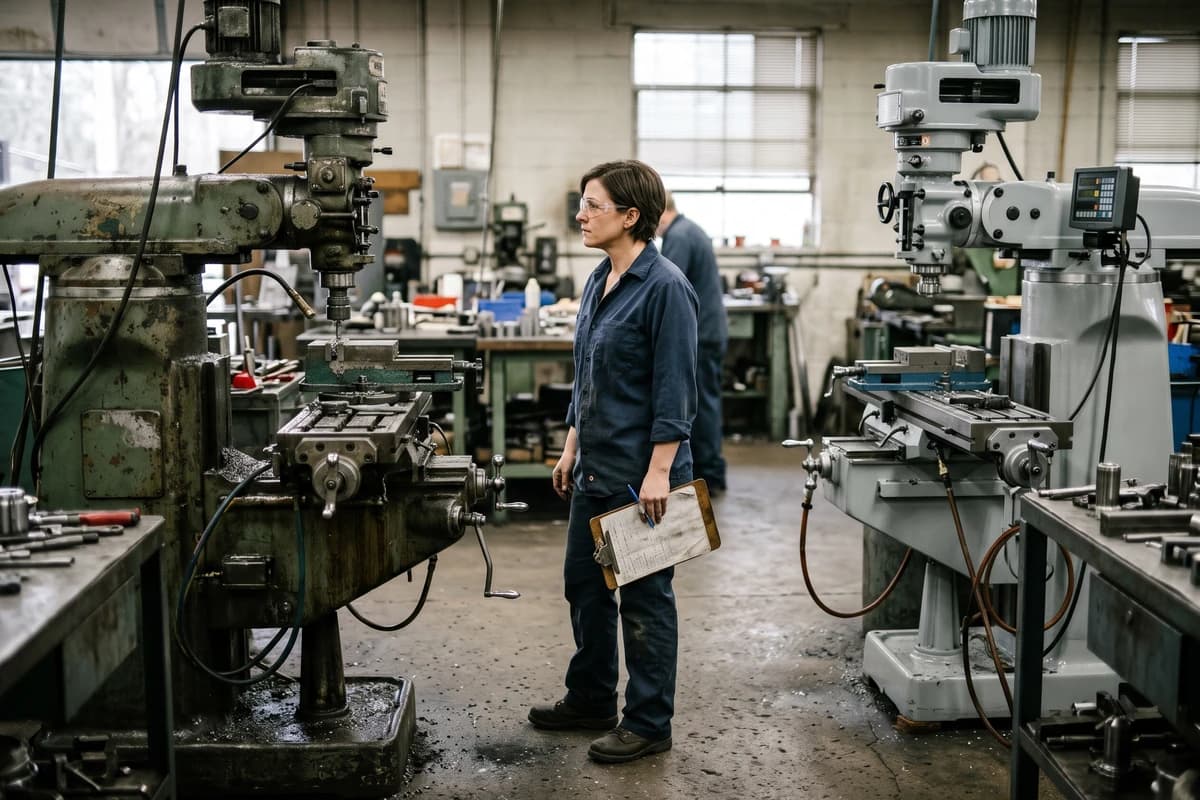
In this Commera illustrative calculation, two identical machines reach the shop in the same month and get very different first-year deductions. The only change is the contract date. Machine B deducts $64,000 more than machine A in the first year, which is $13,440 less federal tax that year.
Methodology: Commera illustrative calculation with assumed figures and illustrative dates, not a real deal and not tax advice. The buyer is a C corporation on a calendar year, taxed at 21% under 26 U.S.C. §11(b), with enough taxable income to use each deduction. Each machine costs $100,000, is 5-year MACRS property and is placed in service in January 2026, and the business places no other property in service that year. Because the machines go into service in January, the half-year convention applies instead of mid-quarter, and state tax is left out.
| Item | Machine A | Machine B |
|---|---|---|
| Written binding contract signed | December 10, 2024 | February 3, 2025 |
| Bonus rate, % | 20 | 100 |
| Bonus deduction, $ | 20,000 | 100,000 |
| Regular depreciation on the rest, year 1, $ | 16,000 | 0 |
| First-year deduction, $ | 36,000 | 100,000 |
| Federal tax effect at 21%, $ | 7,560 | 21,000 |
Machine A gets its regular depreciation at the year 1 percentage in IRS Publication 946, Table A-1. That percentage applies to the cost left after the bonus.
The gap is timing, not a lost deduction. Machine A deducts the rest of its cost in later years. Machine B has nothing left to deduct.
A few weeks between two signatures produced this gap. Check the date, then ask what it does to your return. This calculation is not tax advice. Consult a tax advisor.
Worked example: a financed $300,000 machine in a low-income year
In this Commera illustrative calculation, bonus depreciation does not change the six-year federal tax bill on a financed machine. The total is $88,200 with the allowance and $88,200 without it. Only the years change, and the loan payments do not move at all.
Methodology: Commera illustrative calculation with assumed figures, not a loan offer, not tax advice and not a real deal. The buyer is the same kind of C corporation, at the same federal rate, as in the first example. It buys one 5-year MACRS machine in January 2026 and places nothing else in service that year.
Illustrative profit before this machine's depreciation is $120,000 in every year from 2026 to 2031, with loan interest already counted. Without the allowance, deductions follow the half-year percentages in Publication 946, Table A-1: 20, 32, 19.2, 11.52, 11.52 and 5.76. State tax is left out.
The financing comes first:
| Loan figure | Amount |
|---|---|
| Machine price, $ | 300,000 |
| Down payment, $ | 30,000 |
| Loan amount, $ | 270,000 |
| Interest rate, fixed | 9.25% |
| Term, months | 60 |
| Monthly payment, $ | 5,637.57 |
| Total repayment, $ | 338,254.20 |
| Interest over the term, $ | 68,254.20 |
| Documentation fee at closing, $ | 1,500 |
| Estimated APR, with the fee | about 9.49% |
The rate is not the APR. The illustrative estimated APR is an IRR over the 60 monthly payments against $268,500, which is the loan amount net of the fee. Total repayment is 60 payments at the rounded amount, with 12 payments a year from 2026 to 2030.
Terms are illustrative and subject to underwriting. Our calculator can estimate the payment on a factor-rate advance, a different product from this loan.
Now the tax, year by year:
| Year | Loan payments, $ | Federal tax with bonus, $ | Federal tax electing out, $ | Difference, $ |
|---|---|---|---|---|
| 2026 | 67,650.84 | 0 | 12,600.00 | 12,600.00 lower with bonus |
| 2027 | 67,650.84 | 5,040.00 | 5,040.00 | 0 |
| 2028 | 67,650.84 | 7,560.00 | 13,104.00 | 5,544.00 lower with bonus |
| 2029 | 67,650.84 | 25,200.00 | 17,942.40 | 7,257.60 higher with bonus |
| 2030 | 67,650.84 | 25,200.00 | 17,942.40 | 7,257.60 higher with bonus |
| 2031 | 0 | 25,200.00 | 21,571.20 | 3,628.80 higher with bonus |
| Total | 338,254.20 | 88,200.00 | 88,200.00 | 0 |
With the allowance, the 2026 deduction is larger than the profit. That leaves a $180,000 loss to carry forward. Under 26 U.S.C. §172(a)(2), the carried loss can offset only 80% of taxable income in a later year.
In this illustrative case, 2027 uses $96,000 of the loss and pays tax on $24,000. Then 2028 uses the last $84,000 and pays tax on $36,000. From 2029, this machine adds no deduction.
Electing out spreads the illustrative deductions instead: $60,000, $96,000, $57,600, $34,560, $34,560 and $17,280.
Read the table against the payments. In this illustrative case, the allowance saves $18,144 of federal tax from 2026 to 2028, while the machine is new. That saving reverses from 2029 to 2031, and two of those years still carry a full year of payments.
Same total. Different years. The totals match here because profit and the tax rate never change, and the whole loss gets used. Neither column is the right answer for every business.
Loan interest is its own question, and our guide to the business loan interest deduction covers it separately. This calculation is not tax advice. Consult a tax advisor with your own projections.
When should you elect out of bonus depreciation?
You might elect out of bonus depreciation when spreading the deductions fits your expected profit better than one large first-year deduction. Per IRS Publication 946, the election works by class of property. It covers all property in that class placed in service during the tax year.
You cannot pick one machine and leave its twin in the same class. You also cannot change your mind freely. Publication 946 says you cannot revoke the election without IRS consent.
Two situations are worth raising. One is a deduction that would create a loss, since a carried loss can offset only 80% of later taxable income, according to 26 U.S.C. §172. The other is profit you expect to grow, when you may want deductions left for later years.
Questions for your tax advisor
- Will this deduction create a loss this year? Ask how much of the loss each later year could absorb. Then ask what tax you would owe in those years.
- Do you expect profit to grow? Bring your projections, not a guess. Ask whether keeping depreciation for stronger years fits your plan.
- What else lands in the same class this year? List every asset you will place in service. An election here reaches all of them, not just the financed machine.
- How does the tax line up with your loan payments? Bring the payment schedule. Mark the years when tax rises while payments still run.
- Might you sell the machine early? Give your advisor a rough exit date. A sale can change the math, as the next section explains.
The election is a tax decision with a long tail. Make the choice with your tax advisor, and make it before you file. Consult a tax advisor about your own return.
What can go wrong with bonus depreciation?
Bonus depreciation can go wrong when you sell the machine early, when the asset is a passenger car, or when your state follows other rules. Each of these can leave you with less than the first-year number suggested.
A sale can bring the deduction back. Per IRS Publication 946, a gain on disposal is generally recaptured as ordinary income, up to the allowance you took. A machine you plan to sell soon deserves a second look.
Passenger cars have a cap. Per IRS Revenue Procedure 2026-15, Table 1, the first-year depreciation limit is $20,300 for a passenger automobile placed in service in 2026 with the allowance. The full price of the car does not come off in year one.
Your state may not follow. State tax rules can differ from the federal allowance, so check yours before you count the saving.
The tax can drive the purchase. A deduction does not make a weak machine pay for itself. The machine decision comes before the tax one, and our guide to CNC machine financing covers the purchase side. Consult a tax advisor before you sign.
Broker disclosure: Commera Finance is a broker, not a direct lender. Financing providers make their own eligibility, underwriting, approval, pricing, and term decisions.
Sources
- IRS, Notice 2026-11
- IRS, Revenue Procedure 2026-15
- IRS, Publication 946, How To Depreciate Property
- IRS, Publication 946 (PDF), Table A-1
- 26 U.S.C. §168, Accelerated cost recovery system, Cornell LII
- 26 U.S.C. §172, Net operating loss deduction, Cornell LII
- 26 U.S.C. §11, Tax imposed (corporations), Cornell LII