

What is the Section 179 deduction in 2026?
The Section 179 deduction is a federal tax election that lets a business expense the cost of qualifying equipment in the year it is placed in service instead of depreciating it over several years. For the Section 179 deduction 2026, the cap is $2,560,000, per IRS Revenue Procedure 2025-32, section 4.24.
IRS Revenue Procedure 2025-32 sets two more numbers for tax years beginning in 2026. The cap shrinks dollar for dollar once the cost of Section 179 property you place in service passes $4,090,000. A sport utility vehicle counts for no more than $32,000.
Those figures are the inflation-adjusted versions of the statute. The Internal Revenue Code, 26 U.S.C. §179, as amended by P.L. 119-21 §70306, sets the base at $2.5 million and $4 million for tax years after 2024.
A deduction is not a discount. It lowers taxable income, and the tax you save depends on your rate and your profit. The rest of this guide shows how that works when a lender pays for the machine.
Commera is a broker, not a lender. We compare offers from our lender partners. For the financing side of a purchase, start with our guide to equipment financing.
Does financed equipment qualify for Section 179?
Financed equipment qualifies for Section 179 on the same terms as equipment bought with cash. IRS Publication 946 says the cost basis "includes the amount you pay in cash, debt obligations, other property, or services."
So the deduction runs on the full price of the machine. It does not run on the payments you have made by December 31. A business that puts a small share down and borrows the rest can still elect to expense the whole cost, subject to the limits below.
A loan is not a payment. The lender's money becomes part of your cost on the day you buy the machine.
Trade-ins work differently. Per Publication 946, when you buy with cash and a trade-in, the Section 179 cost "includes only the cash you paid." The value of the old machine does not count.
Before you finance the equipment, get an invoice and a loan agreement that both show the full purchase price. Your tax advisor will ask for them.
When is equipment "placed in service"?
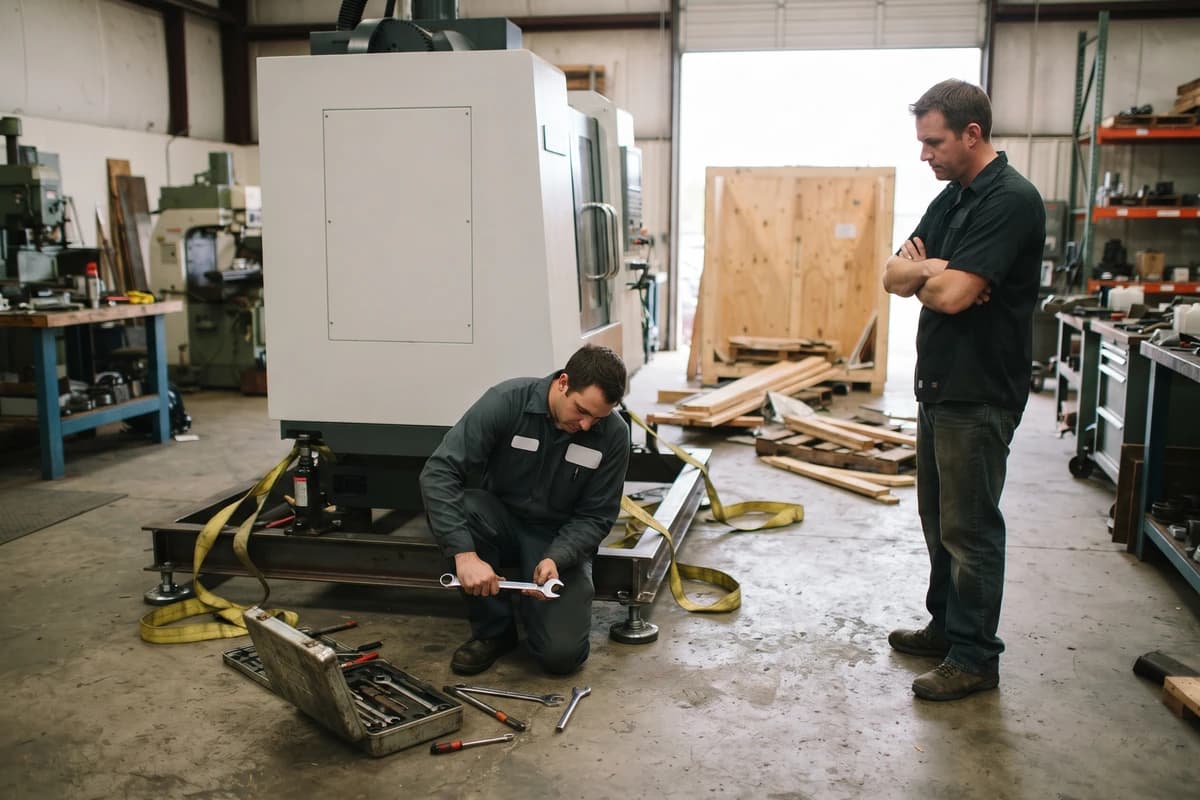
Equipment is placed in service when it is "ready and available for a specific use," per IRS Publication 946. Delivery alone does not do it. The machine has to be set up and able to run, even if you have not used it yet.
The date on the loan does not decide the tax year. Neither does the date you paid the dealer. What decides it is the day the machine can do its job.
IRS Publication 946 gives its own example. A machine was delivered in one year but was not installed and operational until the next year. The IRS treats it as placed in service in the second year.
Heavy equipment often needs rigging, power work and a technician's sign-off. Our guide to CNC machine financing covers installation and commissioning, which can take weeks. Plan the delivery date around the install date, not the other way round.
Worked example: delivered in December, ready in January
One financed machine shows how the placed-in-service rule plays out on a calendar. The dates are illustrative: a loan in November 2026, delivery in December and an install in January 2027.
- November: the loan closes. The business signs the loan agreement and the dealer gets paid. No deduction yet, because the machine is still at the dealer.
- December 18: the machine arrives. It sits on the shop floor, uncrated and without power. Delivery does not make it ready and available for its specific use.
- January 6: installation is done. The technician connects power, runs the test cut and signs off. Now the machine is ready to work.
- The next tax year: the deduction. The machine was placed in service in January, so the deduction belongs to the next year's return, under that year's limits.
The business owed loan payments before it had a deduction. A short delay on the install moved the tax benefit by a full year.
What limits can shrink the deduction?
Four limits in the statute and IRS Publication 946 can shrink the Section 179 deduction: the dollar cap, the business income limit, the business use test and the rules for pass-through owners. Each one can cut the deduction below the price of the machine.
The dollar cap and phase-out. The 2026 cap and the phase-out threshold from IRS Revenue Procedure 2025-32 are in the first section above. They matter mainly to businesses that buy several million dollars of equipment in one year.
The business income limit. Under 26 U.S.C. §179(b)(3), the deduction cannot exceed your taxable income from the active conduct of a trade or business for the year. A business with a thin year cannot use Section 179 to create a loss. Per Publication 946, the part you could not deduct "can be carried to the next year."
Business use above 50%. Per Publication 946, you can elect Section 179 only if you use the property more than 50% for business in the year it is placed in service. If business use later drops to 50% or less during the recovery period, Publication 946 says you may have to recapture the deduction as ordinary income.
Partnerships and S corporations. Per Publication 946, the limits apply both to the partnership and to each partner. Ask your tax advisor how this works for your entity.
Section 179 vs bonus depreciation: which applies first?
Section 179 applies first, then bonus depreciation, then regular depreciation. Per IRS Publication 946, bonus depreciation is a special allowance you take "after any section 179 deduction and before you figure regular depreciation under MACRS."
Bonus depreciation is back at full first-year expensing. IRS Notice 2026-11 says P.L. 119-21 made a permanent 100% first-year deduction for qualified property acquired after January 19, 2025. That is why bonus depreciation 2026 can cover the full cost of a new machine.
The two tools overlap but are not the same. Per IRS Publication 946, Section 179 has a dollar cap and an income limit. Bonus depreciation has neither, so it can produce a loss. You also choose them differently.
| Feature | Section 179 | Bonus depreciation |
|---|---|---|
| Limit in dollars | Yes, an annual cap and a phase-out | No dollar cap |
| Limited by business income | Yes, the excess carries forward | No, it can create a loss |
| How you choose | You elect it asset by asset | Applies by default; you elect out by class of property |
| Order in the first year | First | After Section 179, before MACRS |
Sources: IRS Publication 946, 26 U.S.C. §179(b) and IRS Notice 2026-11.
Per Publication 946, you can elect out of bonus depreciation "for any class of property." That choice covers every asset in the class placed in service that year. Which mix fits your return is a question for your tax advisor.
Worked example: deducting a financed $150,000 machine
In this Commera illustrative calculation, a C corporation finances a machine and expenses it in 2026. The federal tax saved in 2026 is larger than the cash the business spends in 2026. The loan payments still run for five more years.
Methodology: Commera illustrative calculation with assumed figures, not a loan offer, not tax advice and not a real deal. The buyer is a C corporation on a calendar year, taxed at 21% under 26 U.S.C. §11(b).
The machine is 5-year MACRS property, placed in service on December 15, 2026, and it is the only MACRS property the business places in service that year. Per IRS Publication 946, the mid-quarter convention then applies without expensing, because more than 40% of the year's depreciable basis landed in the last quarter. Per the same publication's tables, 5-year property placed in service in the fourth quarter gets 5% in the first year.
The loan terms and the $500 documentation fee are illustrative assumptions. The calculation covers federal tax only, and state rules can differ.
The financing:
| Loan figure | Amount |
|---|---|
| Machine price, $ | 150,000 |
| Down payment, 10%, $ | 15,000 |
| Loan amount, $ | 135,000 |
| Interest rate, fixed | 9.00% |
| Term, months | 60 |
| Monthly payment, $, first due January 15, 2027 | 2,802.38 |
| Total repayment, $ | 168,142.68 |
| Interest over the term, $ | 33,142.68 |
| Documentation fee at closing, $ | 500 |
| Estimated APR, with the fee | about 9.16% |
The rate is not the APR. The estimated APR is an IRR over the 60 monthly payments against the loan amount net of the fee. Total repayment uses the unrounded payment. Terms are illustrative and subject to underwriting.
In this illustrative case, cash out in 2026 is the down payment plus the fee: $15,500. Now the tax side, at two levels of profit.
| Scenario | Taxable income before machine, $ | 2026 deduction, $ | 2026 federal tax saved, $ | Carried forward |
|---|---|---|---|---|
| A1. Section 179 | 400,000 | 150,000 | 31,500 | Nothing |
| A2. Bonus depreciation, 100% | 400,000 | 150,000 | 31,500 | Nothing |
| A3. No expensing, elect out, mid-quarter 5% | 400,000 | 7,500 | 1,575 | The rest of the basis, through regular MACRS |
| B1. Section 179, income limit | 90,000 | 90,000 | 18,900 | $60,000 Section 179 carryover |
| B2. Bonus depreciation, 100% | 90,000 | 150,000 | 18,900 | A $60,000 loss; NOL rules apply, consult a tax advisor |
What the numbers say:
- The 2026 tax saving can exceed the 2026 cash. In illustrative scenario A1, the business saves $31,500 of federal tax and spends $15,500 in cash.
- The deduction moves tax in time. In this illustrative case, the business pays $33,628.56 a year on the loan from 2027 to 2031, and this machine adds no depreciation in those years. The cash still leaves.
- Interest is a separate deduction. Loan interest is not part of the expensing election. Your tax advisor treats it on its own.
- A thin year changes the form, not the first-year saving. In illustrative scenarios B1 and B2, the 2026 saving is the same. Section 179 carries the excess forward, and bonus depreciation turns it into a loss.
The machine here could as easily be a tractor. Our guide to semi truck financing shows the same tax question on a truck. To compare what the loan itself costs across lenders, see construction equipment financing rates.
This calculation is not tax advice. Consult a tax advisor before you buy for the deduction.
How to plan a year-end equipment purchase

A year-end equipment purchase works when the business can carry the payments and the machine is ready to run by December 31. Check cash flow first and the deduction second. The checklist below follows the rules above.
Year-end equipment purchase checklist
- Ready-to-work date. Confirm with the dealer when the machine will be installed and running, not just delivered. A January install moves the deduction to the next year.
- Full-cost paperwork. Keep the invoice and the loan agreement that show the full price. The deduction runs on cost, including the borrowed part.
- Business use share. Estimate how much of the use is business. If business use fails the test in the limits section above, the election is not available and recapture can follow.
- This year's profit. Compare your expected taxable income with the cost you plan to expense. The income limit decides how much you can expense this year.
- Five years of payments. Model the monthly payment against your slow months before you sign. The tax saving arrives once, and the payments arrive sixty times.
Run the numbers on a few loan sizes and terms. You can estimate the payment before you talk to a lender. Then take the checklist and the quote to your accountant.
State rules can differ from the federal rules. Consult a tax advisor before you decide.
Broker disclosure: Commera Finance is a broker, not a direct lender. Financing providers make their own eligibility, underwriting, approval, pricing, and term decisions.
Sources