
Overview
A business acquisition loan is a term loan used to buy an existing company. It is typically underwritten for repayment from business cash flow. Under SBA rules, individuals owning 20% or more of the applicant must provide an unlimited personal guaranty, and lenders may require additional guaranties.
SBA 7(a) loans can finance qualifying changes of ownership up to the program's $5 million loan limit. Conventional bank and seller-financed structures are also used. Banks may call the financing an acquisition business loan, a loan for business acquisition, or simply a loan to buy a business. The label changes, but the lender still needs to establish that the buyer can operate the company and that its cash flow can support the debt.
Business acquisition financing can combine bank debt, eligible buyer equity, and seller debt. A buyer financing a business acquisition should compare each source by total cost, control rights, collateral, and repayment timing. The search phrase "seller financing business acquisition" usually refers to a negotiated seller note used alone or beside senior financing.
The three main financing paths are:
- An SBA 7(a) loan from a participating lender
- A conventional bank term loan without an SBA guaranty
- A seller note, often used alongside bank financing rather than as a complete substitute
One date is especially important in 2026. SOP 50 10 8.1 takes effect on October 1, 2026 and changes several acquisition rules, including the debt service coverage standard for a first acquisition.
Commera is a broker, not a lender. We compare offers from lender partners. The SBA rules in this guide apply regardless of which participating lender prepares the credit decision.

What a business acquisition loan can cover
Under SBA rules, a 7(a) change-of-ownership loan can cover the purchase price, goodwill included in that price, working capital for the new owner, and eligible transaction costs. Valuation and Quality of Earnings fees can be part of total project cost. Because the required equity injection is calculated from total project cost, a buyer may need more than 10% of the advertised purchase price.
Appendix 15 of SOP 50 10 8.1 places change-of-ownership transactions into four categories:
- Initial Acquisition: The buyer is acquiring its first operating business.
- Business Expansion: An existing business acquires another business.
- Owner Buyout: One or more owners acquire another owner's interest.
- ESOP and Cooperative: The transaction transfers ownership through an eligible employee stock ownership plan or cooperative structure.
The category affects the equity and debt service coverage requirements.
Seller earnouts are prohibited under both SOP 50 10 8 and SOP 50 10 8.1. Under the newer SOP, buyer rebates remain permissible, but they must be applied to reduce the 7(a) loan principal. Effective October 1, 2026, SOP 50 10 8.1 does not permit 7(a) Small underwriting for change-of-ownership transactions.
Franchise resales and partner buyouts also run through the applicable change-of-ownership rules.
Goodwill has a separate tax treatment. Under 26 U.S.C. Section 197), acquired goodwill and going-concern value generally are amortized ratably over 15 years beginning with the month of acquisition. Cornell Law School's presentation of the same statute provides a readable secondary reference. In a qualifying asset acquisition, both purchaser and seller generally file IRS Form 8594, where goodwill and going-concern value fall within Class VII. Consult a qualified tax advisor before agreeing to the purchase-price allocation.
Four ways to finance a business purchase
| Source | Amount and term | Buyer contribution | What drives approval | When it may fit |
|---|---|---|---|---|
| SBA 7(a) | Up to $5 million; generally no more than 10 years for an acquisition without real estate | 10% of total project cost for an Initial Acquisition | Eligibility, repayment ability, management, valuation, equity, guaranties, credit analysis, and lender policy | Goodwill-heavy transactions that may lack sufficient hard collateral |
| Conventional bank term loan | Set by bank policy, without the SBA program cap | Set by bank policy | Cash flow, collateral, borrower strength, and bank credit policy | Asset-backed targets and buyers with strong balance sheets |
| Seller note | Negotiated with the seller | Can count toward SBA equity only if it satisfies full-standby and source limits | Subordination, standby terms, repayment structure, and lender acceptance | Bridging a financing or valuation gap |
| Home equity financing | Set by property value and lender policy | The home secures the financing | Personal repayment ability and home equity | Smaller gaps when the buyer knowingly accepts personal collateral risk |
SOP 50 10 8.1 also permits the portion of a business purchase tied to working assets to be financed through an eligible line of credit rather than the acquisition term loan. This can align receivables and inventory with revolving financing instead of a 10-year amortization. A line of credit does not replace the required equity injection.
SBA-participating banks, credit unions, Small Business Lending Companies, and Non-Federally Regulated Lenders may originate 7(a) loans. Individual lender appetite, industry policy, and acquisition experience vary. Ask prospective lenders how they evaluate your industry, transaction size, ownership structure, and closing timetable.
If the program is new to you, start with Commera's SBA loan guide. Buyers comparing non-SBA debt can also review the business term loan guide. The home equity guide explains the risks of using a residence to fund a company purchase.
SBA 7(a) numbers that frame the deal
The maximum 7(a) loan is $5 million. The maximum SBA guaranty is 85% for loans of $150,000 or less and 75% for loans above $150,000. General program maturity is 10 years or less unless qualifying real estate or longer-lived equipment supports a longer term. Under Appendix 15, acquisition financing cannot include a balloon. A permitted real-estate component may extend the blended maturity under SBA rules. These limits are summarized on the SBA's 7(a) program page and lender program page.
Rates are capped, not fixed. For variable-rate loans above $350,000, the maximum spread is the base rate plus 3.00%. The Federal Reserve H.15 release dated September 11, 2026 reports a 6.75% bank prime loan rate for September 10. Prime plus 3.00% therefore equals 9.75%.
The maximum variable-rate spreads for smaller 7(a) loans are:
| Loan amount | Maximum spread over the base rate |
|---|---|
| $50,000 or less | 6.50% |
| $50,001 to $250,000 | 6.00% |
| $250,001 to $350,000 | 4.50% |
| More than $350,000 | 3.00% |
Upfront guaranty fees
For loans with maturities longer than 12 months approved during fiscal year 2026, the SBA fiscal-year 2026 fee notice sets the following upfront fees:
- 2% of the portion covered by the SBA guaranty for loans of $150,000 or less
- 3% of the portion covered by the SBA guaranty for loans from $150,001 through $700,000
- 3.5% of the portion covered by the SBA guaranty through $1 million, plus 3.75% of that portion above $1 million, for loans from $700,001 through $5 million
The official FY 2026 notice PDF applies to loans approved from October 1, 2025 through September 30, 2026.
SBA published FY 2027 fees on September 3, 2026. They apply to loans approved from October 1, 2026 through September 30, 2027. The general long-term brackets remain unchanged, with a new 0% upfront-fee exception for qualifying loans of $700,000 or less to specified manufacturers, food-supply-chain businesses, and businesses in rural areas. The details appear in the official FY 2027 notice PDF.
The 10% equity injection and seller-note rules
SOP 50 10 8.1 requires an Initial Acquisition to have an equity injection of at least 10% of total project cost. That minimum cannot be reduced or eliminated. A strong balance sheet or extra collateral does not remove it. Qualifying Business Expansion and Owner Buyout transactions may receive a reduction when the lender documents the conditions required by the SOP.
Total project cost includes the costs needed to complete the ownership change and other uses of proceeds in the same request. Working capital and eligible diligence costs can therefore increase the injection amount.
Eligible equity sources can include:
- Unborrowed business or personal cash
- A qualifying personal loan to a guarantor that is repaid from a source other than the acquired business's cash flow
- A qualifying grant without repayment or clawback conditions during the 7(a) loan term
- Seller debt or other eligible debt placed on full standby, subject to the limited-source cap
- Other sources expressly permitted by the SOP
Limited equity sources collectively may provide no more than half of the required injection. The balance must come from eligible unlimited sources such as unborrowed cash, a qualifying personal loan repayable outside business cash flow, or a qualifying grant.
For eligible standby debt to count toward the injection, no principal or interest may be paid for the life of the 7(a) loan. The arrangement must be documented on SBA Form 155 or the lender's equivalent.
The minimum seasoning period for refinancing eligible seller debt changes during 2026. SOP 50 10 8 uses a 24-month minimum for refinancing an eligible seller-financed note. SOP 50 10 8.1 changes that period to 36 months beginning October 1, 2026.
Lenders must verify the injection. SBA requires evidence that the check or wire was processed and that the funds reached the borrower or escrow, together with an account statement or settlement statement showing the deposit or use of cash. A promissory note, gift letter, or financial statement alone is insufficient.
The BizBuySell Q2 2026 Insight Report quotes broker Vipin Singh identifying the strict 10% injection and full-standby rules, together with citizenship changes, as a pressing transaction challenge.
Debt service coverage before and after October 1, 2026
Debt service coverage is a core underwriting threshold, but approval also depends on eligibility, management ability, valuation, equity, guaranties, credit analysis, and other lender requirements.
Under SOP 50 10 8 through September 30, 2026, DSC is operating cash flow divided by debt service. The minimum is 1.15 on a historical and/or projected basis, with a 1:1 global cash-flow standard.
Under Appendix 15 of SOP 50 10 8.1, historical DSC for change-of-ownership transactions is EBITDA divided by combined post-transaction debt service. The lender must use the last fiscal year-end or an average of the last two fiscal years on a historical or adjusted basis. Projections cannot be used to satisfy the minimum.
| Transaction type | DSC floor from October 1, 2026 |
|---|---|
| Initial Acquisition | 1.25:1 |
| Owner Buyout | 1.25:1 |
| ESOP and Cooperative | 1.25:1 |
| Business Expansion | 1.15:1 |
Permissible adjustments can include items such as unfunded capital expenditures, nonrecurring income, distributions, S corporation tax distributions, qualifying seller discretionary expenses, and ownership compensation. The lender must justify each adjustment in its credit analysis. If the analysis reduces owner compensation, the lender must also show that global cash flow remains at least 1:1 at the adjusted compensation level. Unsupported add-backs cannot be used.
Worked example: a $750,000 service business
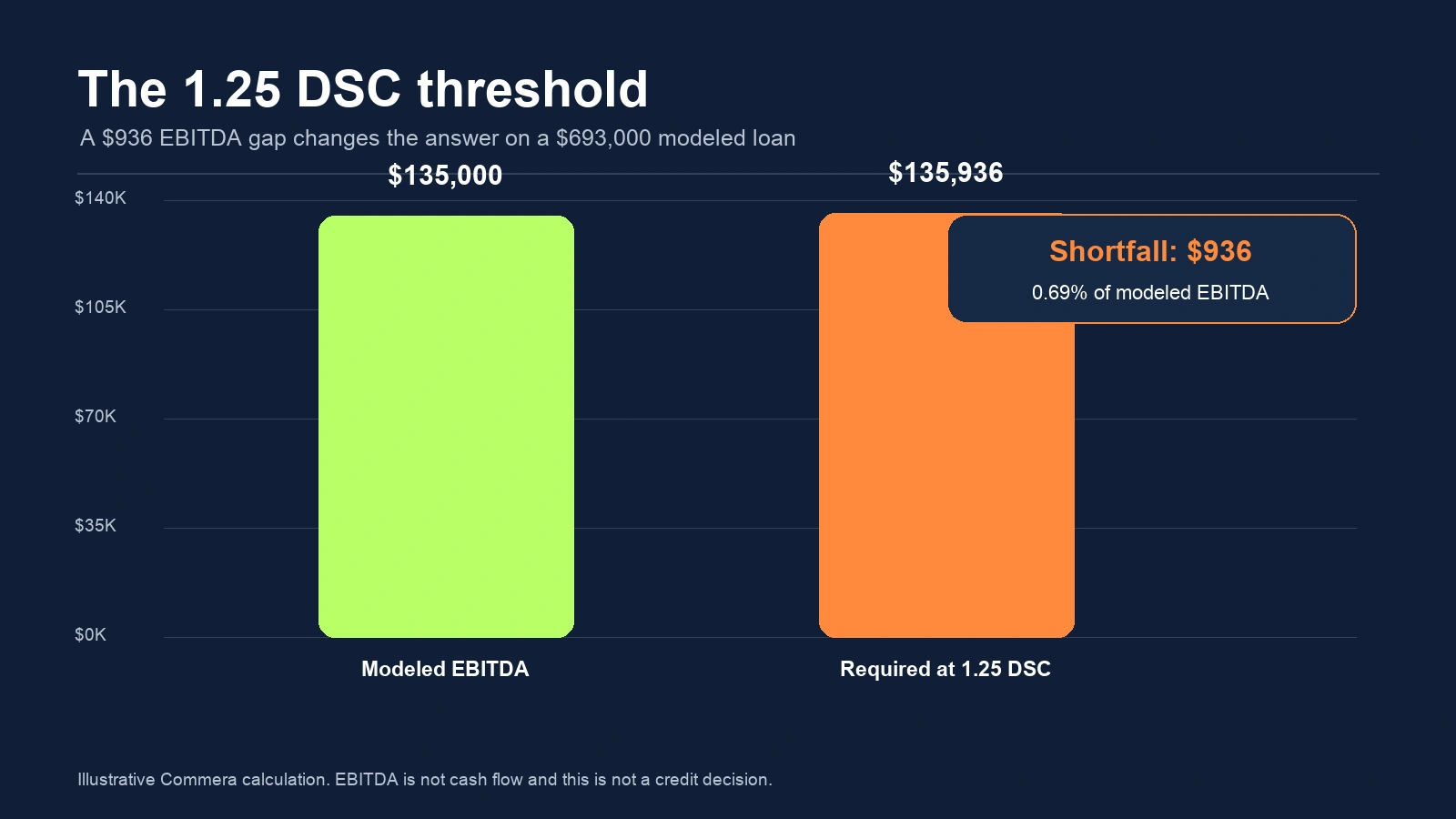
For example, consider a service business with no real estate in the sale and seller's discretionary earnings of $210,000. For example, assume a market-rate manager costs $75,000, leaving $135,000 of EBITDA available for debt service.
| Line | Illustrative figure |
|---|---|
| Purchase price | $750,000 |
| Working capital and buyer deal costs | $20,000 |
| Total project cost | $770,000 |
| Equity injection at 10% | $77,000 |
| Buyer cash | $38,500 |
| Seller note on full standby | $38,500 |
| 7(a) principal | $693,000 |
| Note rate | 9.75% variable |
| Amortization | 120 months, no balloon |
| Factor rate | Not applicable to this modeled amortizing term loan |
| Monthly payment | $9,062.38 |
| Daily or weekly payment | Not applicable; the model uses monthly payments |
| Annual debt service | $108,748.53 |
| Total repayment over 120 payments | $1,087,485.33 |
| Interest over 120 payments | $394,485.33 |
| Estimated APR if the upfront fee is paid at closing | About 10.29% |
| SBA upfront fee, 3% of the $519,750 portion covered by the SBA guaranty | $15,592.50 |
| EBITDA available for debt service | $135,000 |
| Debt service coverage | 1.24 |
The arithmetic is reproducible:
- $750,000 purchase price plus $20,000 of working capital and costs equals $770,000 of total project cost.
- 10% of $770,000 is a $77,000 injection.
- $38,500 of buyer cash plus a $38,500 full-standby seller note equals the required $77,000.
- $770,000 minus $77,000 leaves $693,000 of 7(a) principal.
- At 9.75% nominal annual interest over 120 monthly payments, the monthly payment is $9,062.38 and annual debt service is $108,748.53.
- $135,000 divided by $108,748.53 gives 1.24 DSC.
This example clears a 1.15 threshold but misses a 1.25 threshold. At 1.25 DSC, the business would need $135,936 of supportable EBITDA. That is a $935.67 shortfall, equal to about 0.69% of actual EBITDA. At the same rate and term, the maximum principal supported by $135,000 of EBITDA at 1.25 DSC is about $688,230. The buyer would need to reduce principal by about $4,770, normally by adding eligible equity or negotiating a lower project cost.
Use Commera's funding calculator to test another principal, rate, and term. This example is an illustrative calculation dated September 11, 2026, not an offer. Rates and terms vary by lender and are subject to underwriting.
Business valuation uses the lender's report
For an SBA-financed acquisition, the business valuation is commissioned by and prepared for the lender. The lender cannot rely on a valuation commissioned by the buyer or seller in place of the required independent report.
Under SOP 50 10 8.1, the lender must commission an independent valuation from a Qualified Source holding one of five credentials: ASA, CBA, ABV, CVA, or BCA. The lender must compare financial information used by the appraiser with the seller's validated tax information.
The valuation must support the purchase price regardless of the financing mix. When the agreed price exceeds the supported value, the debt cannot simply expand to cover the difference. Additional eligible equity is required, and any limited equity source must comply with the full-standby and aggregate source limits.
Market data can provide context but does not replace the lender's valuation. The BizBuySell Q2 2026 report records 2,117 transactions, a 10% year-over-year decline, a median sale price of $349,250, and an average cash-flow multiple of 2.7. Service businesses represented 40% of reported transactions and had a median 155 days on market.
Through September 30, 2026, SOP 50 10 8 may permit a lender-performed valuation when the financed amount minus appraised real estate and equipment is $250,000 or less, subject to the SOP's exceptions. Buyers should confirm which valuation rule applies to the date and structure of their application.
What the lender evaluates and what the parties provide
A lender must determine whether the buyer can operate the acquired business and whether repayment is supported. SBA does not publish a universal minimum credit score, time-in-business threshold, or revenue minimum for change-of-ownership loans. A lender may impose its own credit standards, so buyers should ask about those requirements before paying for third-party diligence.
Individuals owning 20% or more of the applicant must provide an unlimited personal guaranty under SBA Form 148. The lender may require guaranties from additional owners or parties under SBA rules and its credit policy.
For the acquired business, the lender's analysis must use the three most recent year-end historical financial records at the highest reporting level available, plus the current interim period and the comparable prior-year period. Applicable tax information must be validated against IRS transcripts.
The seller's file commonly includes:
- The required year-end historical financial records
- Current interim financial records and the comparable prior-year period
- A current debt schedule, including shareholder debt
- Tax information needed for IRS transcript validation
- Organizational, license, contract, and ownership records relevant to diligence
The buyer's file commonly includes:
- The signed letter of intent and later the purchase and sale agreement
- Required personal and business financial information
- Tax information needed for transcript validation
- A resume or other evidence of relevant management and industry experience
- The proposed ownership structure and equity-source documentation
Document timing varies by lender, seller readiness, valuation scope, and whether a Quality of Earnings report is required.
What changes on October 1, 2026
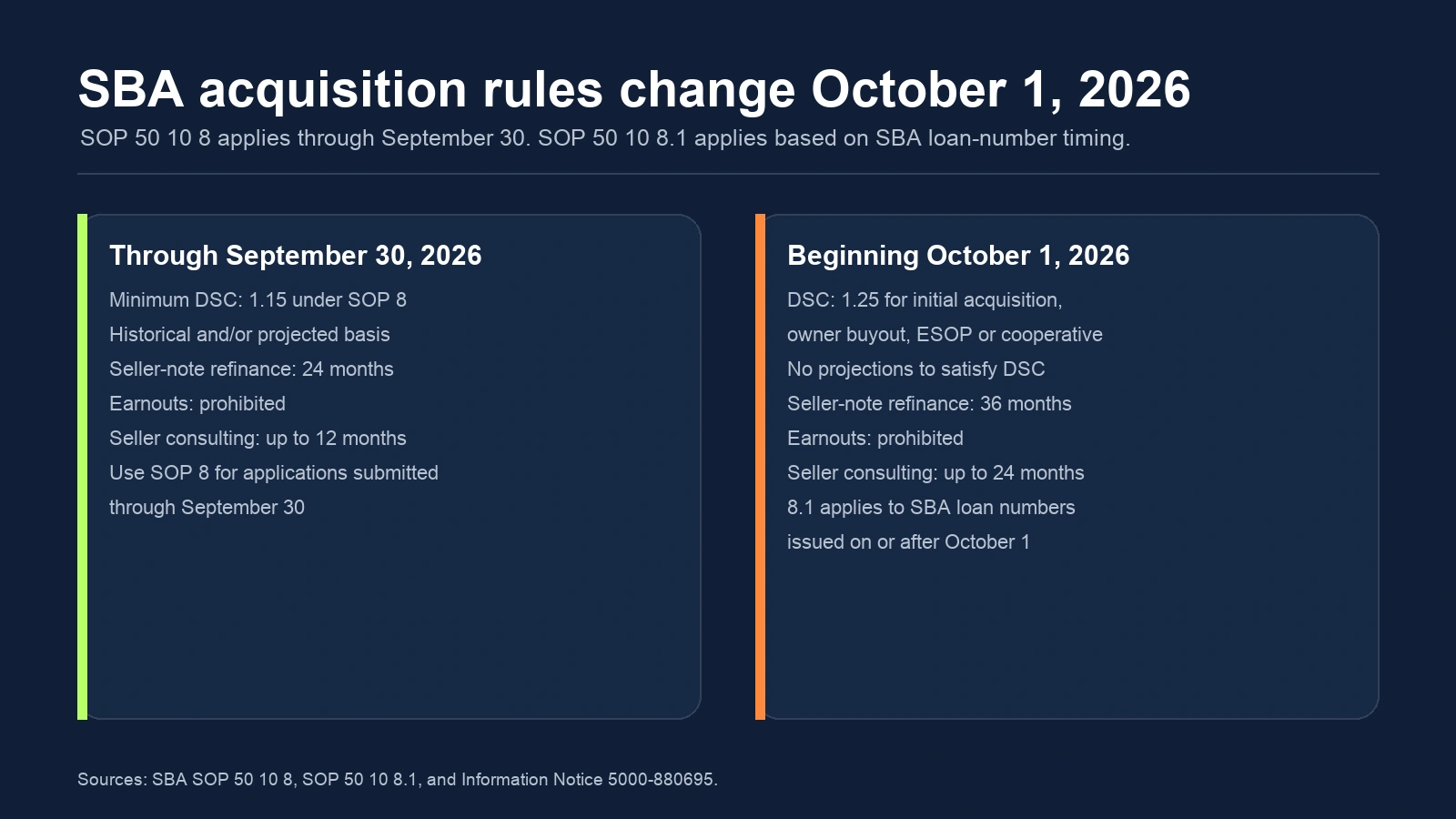
The SBA implementation notice says SOP 50 10 8.1 applies to applications issued an SBA loan number on or after October 1, 2026, while SOP 50 10 8.0 remains applicable to applications submitted through September 30, 2026. The official notice PDF states the transition rule directly.
| Change | Through September 30, 2026 | From October 1, 2026 |
|---|---|---|
| DSC floor for Initial Acquisition | 1.15:1 under the SOP 50 10 8 method | 1.25:1 under Appendix 15 |
| DSC basis | Operating cash flow divided by debt service, historical and/or projected | Historical EBITDA divided by combined post-transaction debt service, using the last fiscal year-end or a two-year average on a historical or adjusted basis |
| Quality of Earnings | Not required by the cited change-of-ownership rule | Required for Initial Acquisition and Business Expansion when Business Purchase Price is at least $3 million |
| Seller after closing | Generally no officer, director, stockholder, or employee role; consulting allowed for up to 12 months, subject to stated exceptions | Same general role prohibition; consulting allowed for up to 24 months, subject to stated exceptions |
| Earnouts | Prohibited | Prohibited; buyer rebates remain allowed but must be applied to 7(a) principal |
| Seller-note refinance period | 24-month minimum for an eligible seller-financed note | 36-month minimum for an eligible seller-financed note |
SOP 50 10 8.1 raises DSC for several acquisition categories, removes reliance on projections to satisfy DSC, adds specified financial-due-diligence rules, requires rebates to reduce principal, and extends the usual seller consulting limit from 12 to 24 months.
Quality of Earnings for larger transactions
Beginning October 1, 2026, an SBA-required QoE must examine customer concentration and contract continuity for Initial Acquisition and Business Expansion transactions with a Business Purchase Price of at least $3 million. The threshold is measured using Business Purchase Price before buyer equity, seller debt, or other financing.
The report must be prepared for the lender. Appendix 15 requires a Cash Proof that reconciles bank statements with the income statement and tax return for the trailing 12-month period and the last two fiscal years. The adjusted earnings determined by the report must be used in the applicable DSC analysis.
The primary policy text is available in the SOP 50 10 8.1 direct download. The rules applicable through September 30, 2026 appear in the SOP 50 10 8 technical-update download.
When a business acquisition loan may be the wrong tool
A financing structure cannot repair every transaction. Common problems include:
Coverage below the applicable floor
If post-transaction cash flow does not satisfy the required DSC standard, the buyer may need a lower price, more eligible equity, less debt, or stronger supportable earnings. A seller note counts toward the injection only when it meets the full-standby and source rules.
Operating continuity depends on the seller
If customer relationships, operating knowledge, or technical expertise are concentrated in the seller, the valuation may not capture the full transition risk. From October 1, 2026, the usual permitted seller consulting period is up to 24 months, subject to stated exceptions. The buyer still needs a credible operating transition.
Customer concentration or weak contract continuity
Revenue can disappear after closing when customers can leave easily or important contracts do not transfer. Beginning October 1, 2026, an SBA-required QoE must examine customer concentration and contract continuity for covered Initial Acquisition and Business Expansion transactions with a Business Purchase Price of at least $3 million.
Price above supported value
The lender's valuation must support the purchase price. A gap requires eligible equity rather than a larger SBA loan.
A buyer whose transaction satisfies the applicable historical coverage standard and has documented eligible equity can compare programs through Commera's business loan options or apply for a funding review. If the deal works only on projections, review the price and financing mix before the October 1 rules apply. A short-term advance does not solve weak acquisition coverage. Commera's MCA versus SBA loan guide explains the difference, while its analysis of SBA lending trends from FY2020 to FY2025 provides broader program context.
How much do I need to put down to buy a business?
For an SBA 7(a) Initial Acquisition under SOP 50 10 8.1, the minimum is 10% of total project cost, and it cannot be reduced or eliminated. Total project cost can include working capital and eligible deal costs, so the required amount may exceed 10% of the advertised purchase price.
Can the seller's note count as my down payment?
Partly. Eligible seller debt can count toward the SBA equity injection only if it is subordinated and on full standby, with no principal or interest paid for the life of the 7(a) loan. Limited equity sources collectively may provide no more than half of the required injection. The balance must come from eligible unlimited sources such as unborrowed cash, a qualifying personal loan repayable outside business cash flow, or a qualifying grant. A note that starts receiving payments during the 7(a) loan term does not satisfy full standby.
What credit score do I need for a business acquisition loan?
SBA does not publish one universal minimum credit score for change-of-ownership loans. Lenders apply their own credit policies, which may vary by institution, industry, and transaction. The lender must still establish the buyer's ability to operate the business and the business's ability to repay the loan.
How long does an SBA acquisition loan take?
SBA does not establish one completion timeline. Timing depends on the lender, seller records, IRS transcript validation, valuation, transaction complexity, and any required Quality of Earnings work. Ask the lender for a transaction-specific schedule rather than relying on a universal estimate.
What is DSC, and what number does SBA require?
Under SOP 50 10 8 through September 30, 2026, DSC is operating cash flow divided by debt service, with a 1.15 minimum on a historical and/or projected basis and 1:1 globally. Under Appendix 15 of SOP 50 10 8.1, historical DSC for change-of-ownership transactions is EBITDA divided by combined post-transaction debt service. From October 1, 2026, the minimum is 1.25 for Initial Acquisition, Owner Buyout, and ESOP and Cooperative transactions, and 1.15 for Business Expansion.
What happens if the business is priced above the valuation?
The buyer must cover the unsupported amount with eligible equity. The valuation must support the purchase price regardless of the debt structure. Any limited equity source used for the gap remains subject to full-standby and aggregate source limits.
Can I buy a business with no money down?
Not through an SBA 7(a) Initial Acquisition under SOP 50 10 8.1. Its 10% minimum equity injection cannot be reduced or eliminated. Qualifying Business Expansion and Owner Buyout transactions may receive a reduction only when the lender documents the conditions required by the SOP.
Can I use a business acquisition loan to buy out my partner?
Yes. SOP 50 10 8.1 treats a qualifying transaction as an Owner Buyout. Its equity requirement is based on the purchase price stated in the sale agreement rather than total project cost. Beginning October 1, 2026, its DSC floor is 1.25, and the Appendix 15 QoE requirement does not apply to this transaction category.
Sources
- SBA, SOP 50 10 lender and development company loan programs
- SBA, SOP 50 10 8.1, effective October 1, 2026, direct download
- SBA, SOP 50 10 8 technical updates, effective June 1, 2025, direct download
- SBA implementation notice for the revised SOP
- SBA implementation notice, official PDF
- SBA fiscal-year 2026 fee notice
- SBA FY 2026 7(a) fee notice, official PDF
- SBA fiscal-year 2027 fee notice
- SBA FY 2027 7(a) fee notice, official PDF
- SBA 7(a) loan program
- SBA information for lenders
- SBA Form 148, Unconditional Guarantee
- Federal Reserve H.15 Selected Interest Rates
- BizBuySell Insight Report
- 26 U.S.C. Section 197, official U.S. Code)
- 26 U.S.C. Section 197, Cornell Law School
- IRS Instructions for Form 8594
- Google Search documentation on removal of the FAQ rich-result feature