
Car Wash Financing: Buy, Build or Upgrade
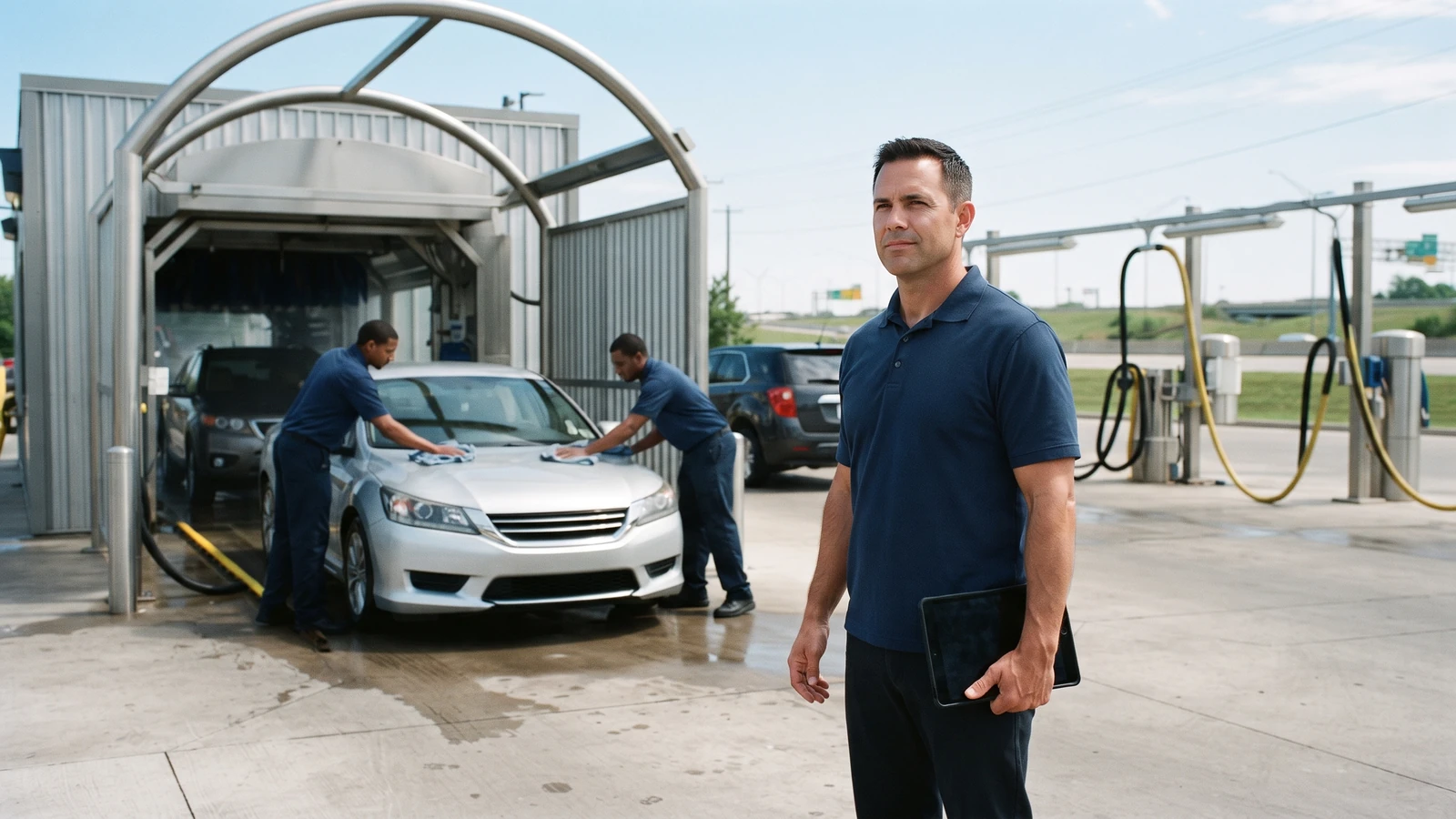
*A car wash owner monitoring a running express tunnel - the operating point every financing route in this article leads back to.*
How we calculated the examples: Every payment table uses the stated principal, APR, and term with standard monthly amortization. Project structures apply the cited SBA percentages to the stated illustrative project cost. Fees are shown separately.
The short answer on car wash financing
Car wash financing is debt that pays for one of three things: an operating wash you buy, a site you build, or equipment you replace. Each case has its own product and its own minimum down payment.
Buying an operating wash usually runs through SBA 7(a). The minimum buyer injection is 10% of total project costs. SBA says it cannot be reduced or eliminated on an initial acquisition (SOP 50 10 8.1, Appendix 15).
Building a new site usually runs through SBA 504. SBA lists car wash businesses as Limited or Special Purpose Property. So the borrower share moves from 10% to 15%, and to 20% for a new business. Equipment on a wash you already own is financed against the equipment, with illustrative down payments of 0% to 20% on our own page.
Commera is a broker, not a lender. We compare offers from our lender partners. That includes the term products on our business loans page that buyers use to acquire a wash.
Three ways to finance a car wash, side by side
Financing a car wash is three transactions wearing one name. On the two SBA rows the injection is a share of total project cost. On the equipment row it is a share of the supplier quote.
| Scenario | Product | Minimum injection | Maximum term (years) | Collateral | Lender orders |
|---|---|---|---|---|---|
| Buy an operating wash | SBA 7(a), max $5,000,000 | 10% | 25 real estate, 10 goodwill, blended on a mixed deal | Real estate, equipment, guaranty | Valuation from a Qualified Source, environmental report |
| Build a new site | SBA 504, gross debenture capped at $5,000,000 | 15%, or 20% for a new business | 10, 20 or 25 | Project real estate | Appraisal by an industry-experienced appraiser |
| Upgrade equipment | Equipment financing, or 7(a) | 0% to 20% of the supplier quote on our page (illustrative) | 7 on our calculator, 10 on 7(a), 15 if the IRS asset class supports it | The equipment | Supplier quote, recent financials |
Rows one and two follow SOP 50 10 8.1, the SBA lender manual effective October 1, 2026. SOP 50 10 8 runs through September 30, 2026, with the same injection and maturity rules. The one new requirement among the rules in this article is the Quality of Earnings report below.
Buying an operating car wash: the 10% rule
A buyer of an operating wash brings at least 10% of total project costs. SBA calls it an Initial Acquisition, and the manual says the requirement cannot be reduced or eliminated. A lender may soften it on an owner buyout or an expansion. On a first purchase, no.
Where the money comes from matters too. Unlimited sources include cash that is not borrowed, plus grants. Limited sources together may provide no more than half of the required injection.
A seller note counts as equity only on full standby. That means no principal and no interest for the life of the 7(a) loan, on SBA Form 155 or a lender equivalent.
The lender orders the business valuation, and one prepared for the buyer or the seller cannot be used. It has to support the price, and any gap is covered by more buyer equity. From October 1, 2026, a price of $3 million or more also requires a Quality of Earnings report under SBA SOP 50 10 8.1.
Term depends on what you buy. Goodwill and working capital cap at 10 years. Real estate reaches 25. On a mixed deal the maturity is blended on the weighted average use of proceeds, then rounded to a whole year.
One Standard 7(a) loan tops out at $5,000,000, per SBA. The purchase note, standby agreement and closing sequence sit in our business acquisition loan guide.
Building a new site: why SBA calls a car wash "special purpose"
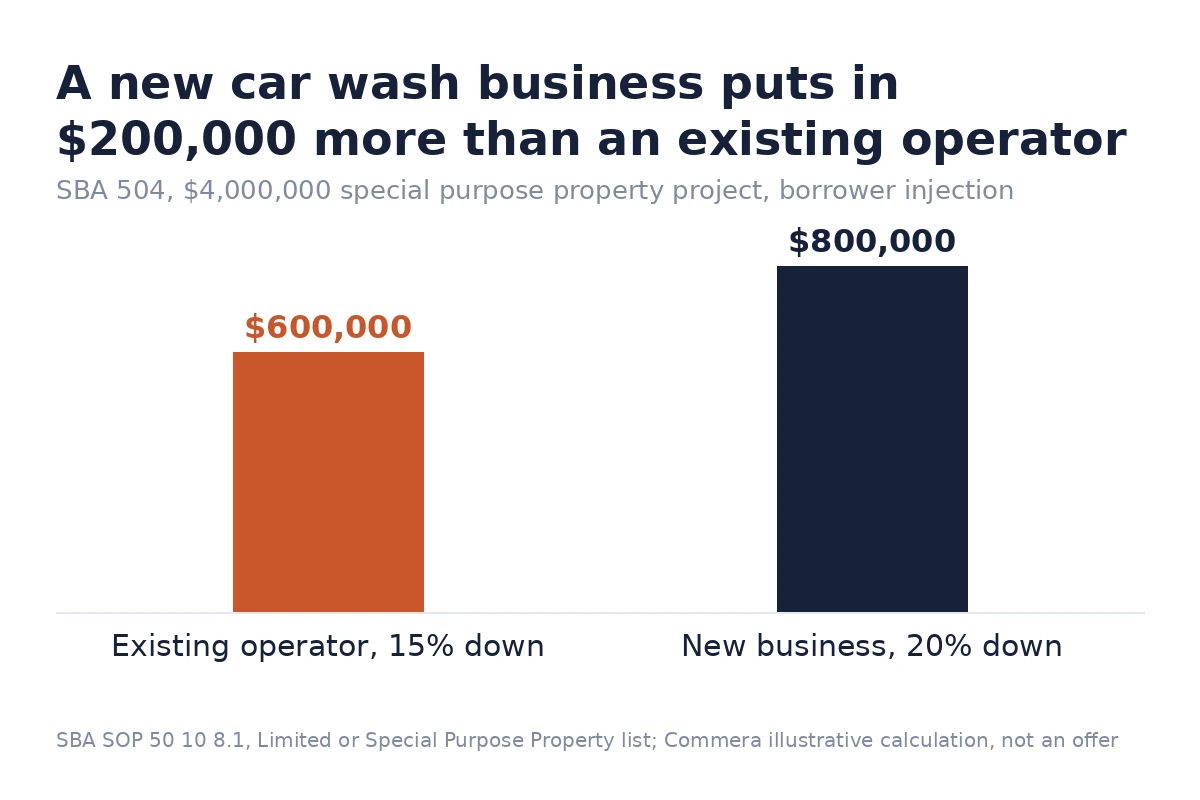
*On a $4 million special-purpose car wash project, a new business puts in $200,000 more than an existing operator - 20% versus 15%.*
SBA 504 normally splits a project 50/40/10: bank, CDC debenture, borrower. A car wash does not get that split. SOP 50 10 8.1 puts "Car wash businesses" on the Limited or Special Purpose Property list.
SBA defines that term as a limited-market property whose design restricts its utility to the use it was built for. The listing moves the structure to 50/35/15. A new business puts in 20%, and the debenture drops to 30%. Here is a $4,000,000 project, a Commera illustrative calculation on the published structure:
| Borrower profile | Bank, 50% | CDC debenture | Borrower injection |
|---|---|---|---|
| Existing operator, special purpose property | $2,000,000 | 35% = $1,400,000 | 15% = $600,000 |
| New business, special purpose property | $2,000,000 | 30% = $1,200,000 | 20% = $800,000 |
The gross debenture is capped at $5,000,000 outstanding for a business and its affiliates. The sba.gov 504 page also shows $5.5 million, but that ceiling belongs to energy public policy projects and small manufacturers. For a wash, work to $5 million.
Maturities are 10, 20 or 25 years, based on the useful life of what is financed. 504 cannot be blended the way 7(a) can. If the collateral is special purpose property, the appraiser must be experienced in that industry, per SBA. Order the appraisal early.
What the build itself costs is a separate question. For program mechanics, see how SBA loans work.
Upgrading equipment without touching the building
A conveyor, dryers, a reclaim system or a payment terminal is financed against the equipment, not the property. Our equipment page shows a 12 to 84 month calculator, a model APR of 11.9%, and down payments of 0% to 20%. Those figures are illustrative, not an offer.
American car wash manufacturers do not publish equipment prices, and we found no usable public price list. So this article carries no "a tunnel costs X" number. Your supplier quote drives your file. Get it first.
Take a $250,000 quote, your number rather than ours, at our 11.9% model APR. This is a Commera illustrative calculation:
| Term | Principal | Illustrative APR | Monthly payment | Total of all payments |
|---|---|---|---|---|
| 60 months | $250,000 | 11.9% | $5,548.49 | $332,909.21 |
| 84 months | $250,000 | 11.9% | $4,399.82 | $369,585.28 |
The longer term cuts the payment by $1,148.67 and adds $36,676.07 in cost, equal to 14.67% of the $250,000 principal. Self service car wash financing for bay equipment works the same way at smaller tickets. A 7(a) loan can fund equipment too, up to 10 years, or 15 when the IRS asset class useful life supports it.
Sale-leaseback on equipment you already own is a fourth route. Injection ranges by asset type sit in our equipment financing down payments guide.
Two tax rules apply here. For tax year 2026, Section 179 expensing caps at $2,560,000 and phases down past $4,090,000 of property placed in service (IRS Rev. Proc. 2025-32, § 4.24).
Bonus depreciation of 100% is permanent for property acquired after January 19, 2025, per IRS Notice 2026-11, announced January 14, 2026. Consult a tax advisor before counting on either one.
Worked example: a $1.4M express wash purchase
Here is a full car wash loan on illustrative numbers. The deal is a $1,400,000 express tunnel, $1,000,000 of it real estate and $400,000 business and equipment. Every figure is a Commera illustrative calculation, not an offer and not a market price. Total project cost here equals the purchase price: this illustration adds no closing costs and no working capital, and a real file adds both, which raises the dollar injection.
| Line | Value |
|---|---|
| Purchase price (illustrative) | $1,400,000 |
| Buyer injection, 10% of total project costs | $140,000 |
| Loan amount (principal) | $1,260,000 |
| Blended term | (1,000,000 × 25 + 400,000 × 10) / 1,400,000 = 20.71, rounded to 21 years, 252 payments |
| Rate | Prime 7.00% plus the 3.00% maximum spread = 10.00% |
| Monthly payment | $11,979.83 |
| Total of 252 payments | $3,018,916.68, of which $1,758,916.68 is interest |
| Upfront guaranty fee, statutory maximum | $33,075 |
The base rate is Prime at 7.00% as of September 18, 2026, per the Federal Reserve H.15 release of September 21, 2026. The 3.00% spread is the SBA maximum above $350,000, not a rate anyone has offered you. Prime moves, and a variable-rate payment moves with it. Commera is a broker, not a lender.
At a 75% guaranty the SBA-covered portion is $945,000. The SBA upfront fee chart in SOP 50 10 8.1, which implements 13 CFR § 120.220, caps the upfront fee at 3.5% of the first $1,000,000 of the SBA-covered portion, which is $33,075.
SBA can also set a different fee for a fiscal year by Information Notice, so confirm the current figure before you budget it. To rerun the math on your own price, use our funding calculator.
What lenders check on a car wash file
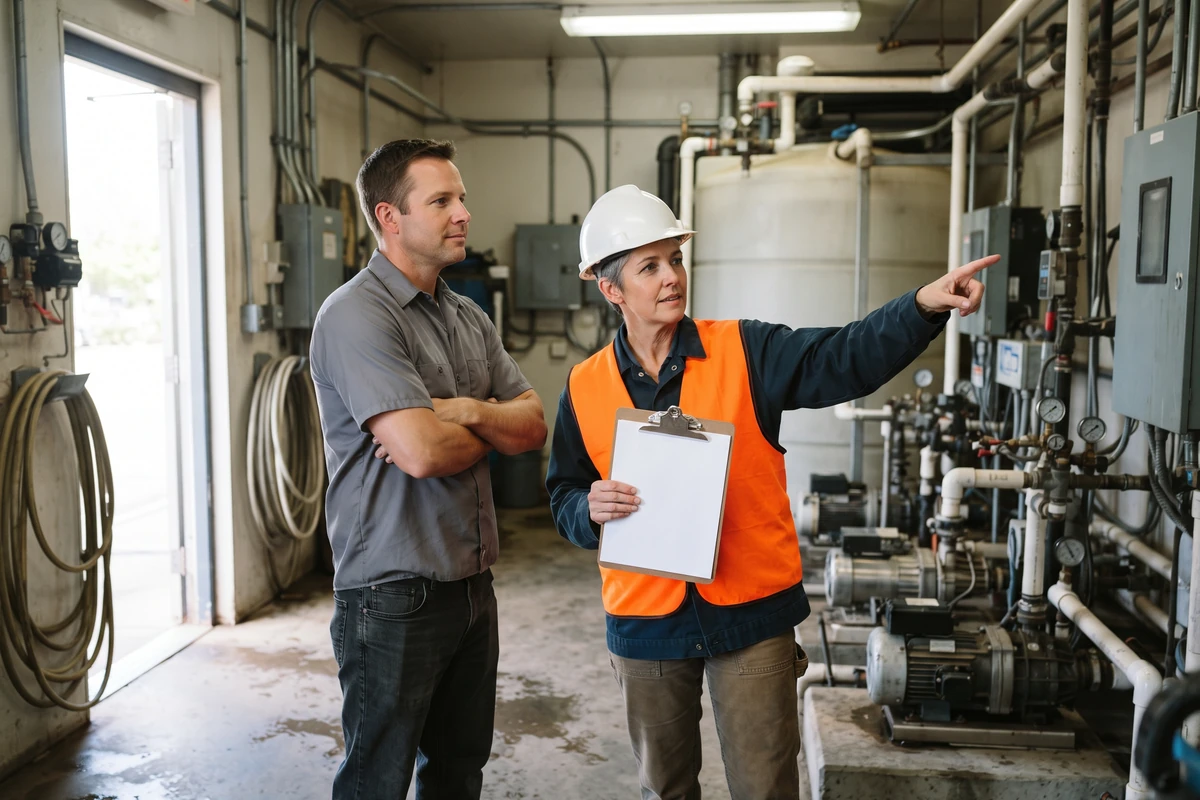
*The environmental investigation is the slowest item in a car wash lender file, and it starts on site.*
Three items set the timeline on a wash: the environmental investigation, the appraisal and the guaranty fee. Start with the environmental report. It takes the longest.
SBA's general rule is strict. A NAICS match to an environmentally sensitive industry in Appendix 6 means the investigation must begin with a Phase I, regardless of the loan amount. Car washes sit in NAICS 811192, inside group 8111.
The carve-out is written inside the Appendix 6 entry itself. It is a separate statement from that general rule, not an exception read into it. The 8111 entry reads "except for 'car wash only' facilities, for which a Transaction Screen is an acceptable starting point" per SBA. A car-wash-only site can therefore start with a Transaction Screen under ASTM E1528-22 rather than a Phase I under ASTM E1527-21.
If the environmental professional concludes that further investigation is warranted, the lender must obtain a Phase I anyway. A site that also does repair or detailing reads as outside the carve-out.
The appraisal is the second slow item, because special purpose property needs an industry-experienced appraiser. The third is the guaranty fee, which the lender may pass to you at closing. Your file also carries the lender-ordered valuation, tax returns and the seller's financials. A pre-qualification review takes two minutes with no hard credit pull, and written options can come back within 24 hours, though timing varies by profile and underwriting.
When refinancing what you already own beats new debt
Sometimes the lowest-cost capital is already on your balance sheet. Car wash business financing does not have to mean a purchase.
Seller debt from a change of ownership becomes eligible for refinancing after 36 months in place and current, per SOP 50 10 8.1. Equipment paper written at 24 or 36 months can be restretched to longer terms, which lowers the payment and raises total interest. Owned real estate can be refinanced on amortization up to 25 years.
None of these routes carries a promised rate. Price them against your current payments.
Which route fits your deal
If you are buying an operating wash with real estate, plan on SBA 7(a), 10% down you cannot negotiate away, and a blended term. If you are building, plan on SBA 504 at 15% down, or 20% as a new business, and start the appraiser search early. If you only need equipment, skip both and price your supplier quote as equipment financing.
Frequently asked questions
Can you buy a car wash with an SBA loan? Yes. An SBA loan for car wash purchases means one of two programs. SBA 7(a) is the acquisition product, capped as shown in the table above. SBA 504 finances real estate and long-life assets, not the business itself. The two are separate loans and cannot be blended into one, so a purchase that includes real estate usually runs on 7(a) alone.
How much money do I need down to buy a self-serve car wash? At least 10% of total project costs on an SBA 7(a) initial acquisition, and the lender cannot reduce or eliminate it. Project costs include closing costs and working capital, not only the price. A lender can ask for more. Self-serve deals are smaller, but the percentage is the same.
Can the seller finance my down payment? Partly, and only on strict terms. A seller note counts toward your injection only on full standby, with no principal or interest paid for the life of the 7(a) loan. Seller debt is a limited source, and limited sources cover no more than half of the injection.
Can a startup car wash get financing, or do lenders want an operating site? Both exist, with different math. SBA treats a business operating for one year or less as a start-up, and every 7(a) loan to a start-up needs a 10% injection based on project cost. On the 504 side, a new business contributes 20% instead of 15%.
What is the payment on a $1,000,000 business loan? On an illustrative 10-year 7(a) at the 10.00% maximum rate, a $1,000,000 principal amortizes to $13,215.07 a month and $1,585,808.84 over 120 payments. That is a Commera illustrative calculation at Prime 7.00% plus the 3.00% maximum spread, not an offer.
Do lenders require an environmental report on a car wash? Yes, in some form. The SBA general rule sends any NAICS match in Appendix 6 to a Phase I regardless of loan size. The entry covering car washes carries its own exception: a "car wash only" facility may start with a Transaction Screen. A Phase I follows if the environmental professional says so.
Can I finance new equipment on a wash I already own? Yes, and it is the simplest of the three cases. The equipment secures the loan, so there is no change of ownership file. A 7(a) loan for equipment can run to 10 years, or 15 where the IRS asset class supports it.
What does "special purpose property" mean for my loan? It means SBA treats the building as hard to re-let, so the borrower carries more of the project. SOP 50 10 8.1 names car wash businesses on the Limited or Special Purpose Property list. The label also drives the appraisal, because SBA requires an appraiser experienced in that industry. See the 504 table above.
Can I get car wash financing without a credit review? No, not from a legitimate source. SBA lenders and equipment lenders review credit, and an SBA acquisition file also needs tax returns and a valuation. Offers claiming they skip credit review on six-figure equipment are usually advances with costs disclosed late.
Sources
- SBA SOP 50 10 8.1, effective October 1, 2026 (504 structures, borrower contribution, Limited or Special Purpose Property list, debenture cap and maturities, 7(a) equity injection in Appendix 15, valuation and Quality of Earnings, maturities, maximum loan size and spread, upfront fee chart, Appendix 6 environmental rules) - https://legacy.sba.gov/sites/default/files/2026-08/SOP%2050%2010%208.1%20effective%2010.1.2026_0.docx
- SBA, SOP 50 10 document listing (SOP 50 10 8 in force through September 30, 2026) - https://www.sba.gov/document/sop-50-10-lender-development-company-loan-programs
- SBA Information Notice 5000-880695, issuance of SOP 50 10 8.1 - https://legacy.sba.gov/document/information-notice-5000-880695-issuance-sop-50-10-81
- SBA, 504 loans program page (shows both "up to $5 million" and "The maximum loan amount for a 504 loan is $5.5 million"; the page states no carve-out - the energy public policy project and small manufacturer exception is in SOP 50 10 8.1) - https://www.sba.gov/funding-programs/loans/504-loans
- 13 CFR § 120.220, maximum upfront guaranty fees, cited in SOP 50 10 8.1 - https://www.ecfr.gov/current/title-13/section-120.220
- Federal Reserve H.15 Selected Interest Rates, release of September 21, 2026, bank prime loan 7.00% on September 17 and 18, 2026 - https://www.federalreserve.gov/releases/h15/
- IRS Rev. Proc. 2025-32, § 4.24, Section 179 limits for tax year 2026 - https://www.irs.gov/pub/irs-drop/rp-25-32.pdf
- IRS, guidance on the additional first year depreciation deduction (Notice 2026-11, announced January 14, 2026 in IR-2026-06) - https://www.irs.gov/newsroom/treasury-irs-issue-guidance-on-the-additional-first-year-depreciation-deduction-amended-as-part-of-the-one-big-beautiful-bill