
Overview
Commercial vehicle financing lets a service or delivery business buy several vans or light trucks and pay for them monthly, with the vehicles as collateral. For a small fleet, the real questions are what goes into the amount financed, what each vehicle costs a month and whether to pay for the upfit in cash.
This guide prices out five upfitted vans, then compares financing the upfit with paying for it at signing. It ends with the federal rules that change a fleet budget as it grows.
What is commercial vehicle financing?
Commercial vehicle financing is a loan or lease that a business uses to buy vans, pickups and trucks for work, with the vehicles themselves securing the debt. Per Commera's equipment financing page, the equipment itself is the collateral, so each vehicle secures its share of the debt.
Buying one vehicle for the business is a different question. Our guide to business vehicle financing covers a single vehicle, a loan against a lease, and the tax rules by weight and mileage. This page is about a fleet: several vans or light trucks bought together, often with work equipment built in.
Commera is a broker, not a lender. We compare offers from our lender partners.
What can a commercial vehicle loan cover?
A commercial vehicle loan can cover cargo vans, pickups, service-body trucks and box trucks, new or used. Per Commera's page on equipment financing for commercial vehicles, purchase amounts start from $2,000, terms run up to 60 months, and the page covers both new and used vehicles. Every term is subject to underwriting.
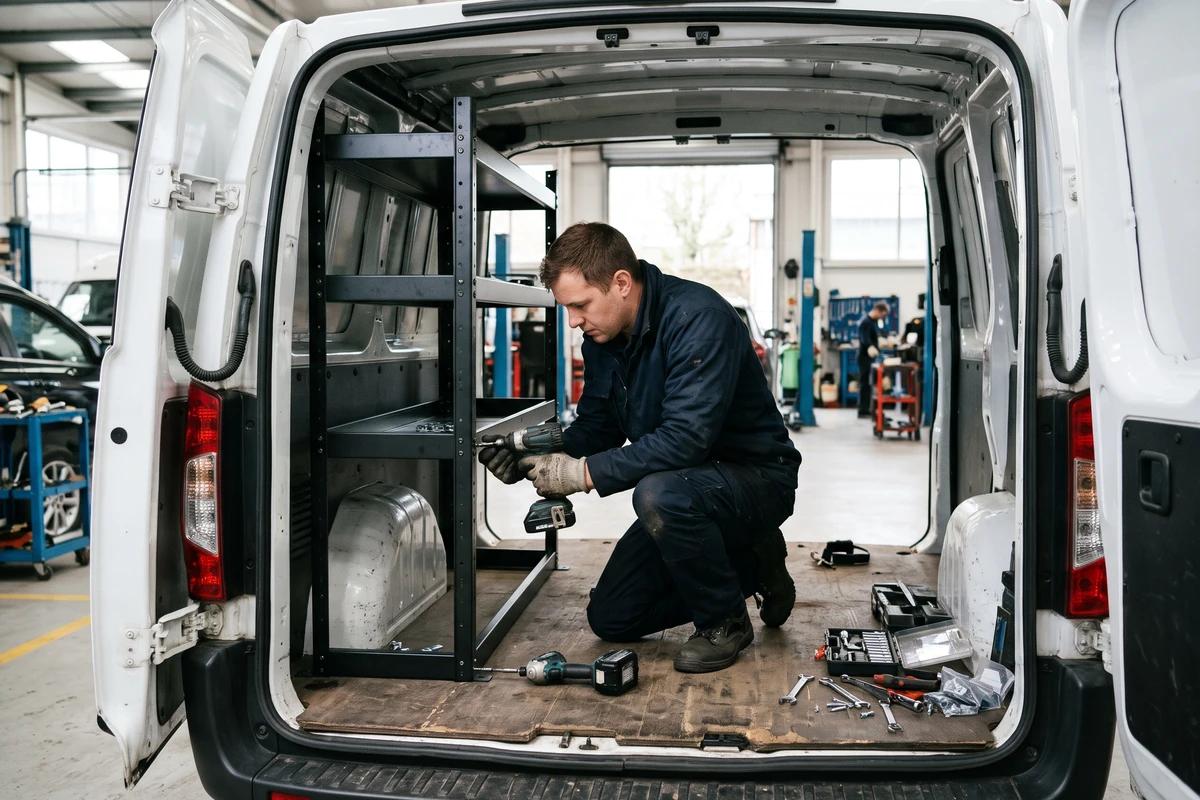
The vehicle price is only part of the bill. Upfit is the work equipment added after the vehicle leaves the factory: shelving, a service body, refrigeration.
Ask each lender in writing whether the upfit goes into the amount financed. Ask how the lender values it, too. A rack system that a lender will not count has to come out of your cash.
Ask the same about sales tax, registration and delivery. A quote that leaves them out makes the payment look smaller than the money you will actually spend.
Used vehicles come with an age limit. Per the FAQ on Commera's equipment financing page, most lenders finance used equipment with age caps, commonly 10 to 15 years at loan maturity, depending on the asset class.
Add the term to a van's current age before you shop. A long term on an older van can push it past the cap.
Worked example: five upfitted vans on one equipment loan
In a Commera illustrative calculation, five upfitted vans at $295,000 on one loan cost a little over a thousand dollars per van each month. That per-vehicle figure is the one to hold against what each van earns.
Methodology: Commera illustrative calculation with hypothetical inputs. It is not an offer and not a real deal. Each van costs $50,000 and its upfit $9,000, and these are assumptions, not market prices.
Per Commera's equipment financing page, the payment estimator defaults to a 20% down payment and uses an 11.9% modeled APR. This example applies that figure as the loan's interest rate, before the fee. The term is the longest that page lists for commercial vehicles. A $500 documentation fee is paid at signing.
Sales tax, registration and insurance are left out. Est. APR is the IRR of the monthly payments against the amount financed minus the fee, times 12.
| Item | Value |
|---|---|
| Vehicles and upfit, $ | 295,000 (5 × 59,000) |
| Down payment 20%, $ | 59,000 |
| Amount financed, $ | 236,000 |
| Rate, % / term | 11.90 / 60 months |
| Monthly payment, $ | 5,237.77 |
| Per vehicle a month, $ | 1,047.55 |
| Total repayment, $ | 314,266.30 |
| Interest, $ | 78,266.30 |
| Cash at signing with fee, $ | 59,500 |
| Est. APR, % | 11.99 |
Source: Commera illustrative calculation, with inputs from Commera's equipment financing page as of November 12, 2026.
The rate and the est. APR are different numbers. The fee paid at signing lifts the est. APR slightly above the rate.
The per-vehicle line is the monthly payment split across five vans.
Five separate loans at the same rate and term would give the same payments and interest. Each loan may carry its own fee, so the cash at signing can differ.
Cash at signing is not only the down payment. It adds the fee, and in a real deal it would add tax and registration as well.
These terms are illustrative and subject to underwriting. A lender prices your file, the vehicles and the upfit on its own terms.
Worked example: financing the upfit or paying cash for it
Paying for the upfit in cash cuts interest by $11,938.93 in a Commera illustrative calculation. It also takes $36,000 more out of the business at signing.
Methodology: Same Commera illustrative calculation and assumptions as the first example. In the second column, the five upfits ($45,000) are paid in cash and only the vans are financed, with the same down payment share. Both columns include the documentation fee at signing. This is not an offer.
| Item | Upfit financed | Upfit paid in cash |
|---|---|---|
| Amount financed, $ | 236,000 | 200,000 |
| Cash at signing with fee, $ | 59,500 | 95,500 |
| Monthly payment, $ | 5,237.77 | 4,438.79 |
| Per vehicle a month, $ | 1,047.55 | 887.76 |
| Total repayment, $ | 314,266.30 | 266,327.37 |
| Interest, $ | 78,266.30 | 66,327.37 |
| Est. APR, % | 11.99 | 12.01 |
Source: Commera illustrative calculation.
Cash costs less in total. Interest falls because the loan is smaller. The est. APR barely moves and even ticks up, because the same fixed fee weighs on a smaller balance.
Financing the upfit keeps that cash in the business. It can cover payroll, fuel and materials while the new vans start earning. That is working capital, and a van loan does not replace it.
So the choice turns on your reserve after signing. Pay cash for the upfit if the business still holds enough to run after that check. Finance it if that cash would leave payroll or materials short. Neither answer fits every fleet.
What changes as a fleet grows?
A growing fleet picks up federal registration and licensing rules, and both change the budget. The thresholds turn on each vehicle's weight rating and the kind of trips it makes.
Per the FMCSA page Do I Need a USDOT Number?, a company that hauls cargo in interstate commerce needs a USDOT Number for any vehicle with a GVWR or GCWR of 10,001 pounds or more. The same page notes that some states require a USDOT Number for intrastate carriers too. Check with your state agency.
Driver licensing has its own line. Per the FMCSA CDL page, a driver needs a Class B CDL for any single vehicle with a GVWR of 26,001 pounds or more. That changes who you can put behind the wheel. Check the GVWR on each quote before you add a heavier truck.
This is a summary of federal rules, not legal advice. Confirm your own case with FMCSA and your state.
Fleet financing usually takes one of two shapes. One is a separate loan for each vehicle, with each title securing its own loan. The other is one line or master agreement that covers a batch of vehicles.
You can also buy in stages. Add vehicles as contracts come in, rather than all at once. Ask each lender how its structure handles selling or paying off one vehicle early.
Tractors for long-haul freight are a different market. See our guide to semi truck financing for them.
Some fleets lease titled vehicles instead of buying them. A TRAC lease is one structure for that, with its own guide. A lease is not a loan; ownership, tax treatment and end-of-term obligations depend on the lease type and the specific contract. Consult a tax advisor.
How do you compare commercial vehicle offers?
Compare commercial vehicle offers vehicle by vehicle, on the same amount and the same term. A smaller monthly payment can hide a longer term, a larger fee or an upfit left out of the quote.
Example: what to ask for each vehicle
- Amount financed. Ask for the amount financed per vehicle, with the upfit, tax and fees itemized line by line.
- Rate, term and est. APR. Get all three in writing for each offer, since the rate alone leaves out the fees.
- Total repayment. Ask for the total of all payments over the term, not only the monthly figure.
- Cash at signing. Write down the down payment and every fee due at signing. Our guide to equipment financing down payments covers that share in more detail.
- Lien and payoff. Read the lien terms, any prepayment penalty and what early payoff of one vehicle costs.
When your numbers are ready, check your funding options with a short form.
Broker disclosure: Commera Finance is a broker, not a direct lender. Financing providers make their own eligibility, underwriting, approval, pricing, and term decisions.
Sources