

The short answer
A home health care business plan is a document that shows how your agency turns caregiver hours into cash, and it doubles as the package a lender reads before it makes a loan. Templates give you headings. Lenders want the numbers behind them.
A lender reading your plan looks for answers to a few hard questions. What does each billed hour earn after payroll? How many hours a month cover your overhead? Is enough cash left to make the loan payment?
A business plan for home care follows the same logic whether you open a non-medical agency or a Medicare-certified one. The payers change, and so does the timing of cash. This guide walks through the plan the way an underwriter reads it:
- Management and coverage: What lenders check first under SBA rules.
- Model: Non-medical home care or Medicare home health.
- Sections: The parts SBA lists plus an appendix, written for home care.
- Margin: Hourly cost math built on federal payroll tax rates.
- Proof: A worked example of break-even hours and the SBA coverage test.
- Cash timing: How payer mix and the funding request fit together.
Commera is a broker, not a lender. We compare offers from our lender partners. For an agency whose payroll runs ahead of collections, that can include a business line of credit once the agency has a track record.
The rules below summarize SBA and IRS rules plus federal Medicaid and Medicare sources as of October 2026. Verify them with your state agency and CMS before you act. This guide is not legal advice.
What a lender reads first in a home care business plan
A lender reads two things first: who will run the agency and whether projected cash flow covers the loan payment. Lenders following SBA's SOP 50 10 8.1, effective October 1, 2026, must document the depth of management experience in the industry and test cash flow against debt service (SBA).
Experience: Put your clinical or agency background near the front. Name your years as a nurse, aide or coordinator. Say who on the team has run payroll and billing before.
Projections: A new agency has no history, so the projection carries the file. Under the SOP, a business with 1 year or less of revenue from operations counts as a start-up. Lenders must see detailed projections with the assumptions behind them.
Coverage: The test is the debt service coverage ratio (DSC). Per the SOP, DSC equals operating cash flow divided by debt service. Operating cash flow means EBITDA. Debt service means the principal and interest due on all business debt, including the new loan.
| SBA loan type | Loan size | DSC required on projections | Projection window |
|---|---|---|---|
| 7(a) Small | $350,000 or less | 1.10 or higher | 12-month projection, coverage within 1 year of funding |
| Standard 7(a) | Over $350,000 | 1.15 or higher, plus 1:1 on a global basis | Coverage within 2 years of funding |
Source: SBA SOP 50 10 8.1, effective October 1, 2026.
Equity: Per SOP 50 10 8.1, a start-up needs an owner equity injection of at least 10% of total project costs. Project costs mean all costs required to become operational, whatever the source of funds. Lines of credit and 504 loans are excluded from that cost base. Your plan has to show where your share comes from.
Home care or home health: which plan are you writing?
Pick the model before you write a single projection. Non-medical home care and Medicare home health have different licenses, payers and cash timing, so they need different plans.
Non-medical home care answers to your state license, where your state requires one. It bills private-pay families or Medicaid waiver programs. The plan centers on caregiver wages and the hourly rate.
Medicare home health delivers skilled care and carries a capital test. Under 42 CFR 489.28, a new agency must prove initial reserve operating funds, and at least 50% of them cannot be borrowed. That reserve becomes a line in the budget and a line in the funding request.
A business plan for care home operators covers a different model, where residents live on site. This guide covers care delivered in the client's own home.
The license steps, the Medicare survey and aide training are covered in our guide on how to start a home care agency. Here the question is narrower. Which numbers does the plan need, and where do they come from?
A business plan for non-medical home care is the simpler place to start. If you plan to add Medicare later, build the plan with a separate payer column so the second model slots in.
The 9 sections of a home care agency business plan
A home care agency business plan follows the traditional plan sections SBA lists, from the executive summary to financial projections, plus an appendix for proof. Per SBA, a traditional plan suits owners who plan to request financing from traditional sources, and it can run dozens of pages.
| Section (SBA) | What to write for home care | What the lender checks |
|---|---|---|
| Executive summary | Model, service area, payers, amount requested | Whether the ask matches the projections |
| Company description | Ownership, license status, why this county | A license or a clear path to one |
| Market analysis | Local demand, competitors, referral sources | A source behind every number |
| Organization and management | Owner background, administrator, clinical supervisor | Depth of management experience in the industry |
| Service or product line | Services, visit minimums, hourly rates by payer | Rates that match survey data or the state fee schedule |
| Marketing and sales | Referral plan, hours per client, client ramp by month | Whether the ramp supports the revenue line |
| Funding request | Amount, use of funds, equity source | Equity and a clear use of every dollar |
| Financial projections | Hourly margin, overhead, break-even, cash flow | Debt service coverage on stated assumptions |
| Appendix (added to the SBA list) | License, insurance quotes, resumes, lease | Proof behind the claims |
Source: section names per SBA, except the appendix, which Commera adds. The lender column is our summary, with management depth and projected debt service coverage taken from SOP 50 10 8.1.
Traditional or lean: Per SBA, a lean startup plan is typically one page. Use the lean version as your own monthly checklist. Give the lender the traditional plan with full projections.
Market analysis: numbers you can cite
Market analysis in a home care plan needs two kinds of numbers. One kind is national data a lender can check in a minute. The other is local data from your own county.
Demand: Per the Bureau of Labor Statistics, employment of home health and personal care aides is projected to grow 18% from 2025 to 2035, much faster than the average for all occupations. Cite that number once and move on. Lenders do not need a page of demographics.
Price: Per CareScout, the national median rate for non-medical caregiver services was $35 an hour in 2025, up from $34 in 2024. A national median is a starting point, not your rate. Check what agencies near you charge before you set yours.
Local payers: If you plan to bill Medicaid, your state's fee schedule sets the waiver rate. Quote it from the state source, not from a template.
Referral sources: Name the people who send clients: hospital discharge planners, senior centers, elder law attorneys, physician offices. Say how you will reach each one in the first quarter.
Startup budgets also differ a lot by model. Compare startup costs by healthcare model before you fix the size of your own project.
Services, staffing and operations
The staffing section holds your largest cost: caregiver wages. Per the BLS, home health and personal care aides earned a median $17.21 an hour in May 2025.
Treat the median as a floor for the wage line, not as your offer. Local agencies compete for the same aides. Price the wage line to retain them, not at the legal minimum.
Services: List what you deliver and how you sell it. Personal care, companionship, respite and overnight shifts each need a rate and a visit minimum. Write the minimum hours per visit into the plan, because short visits raise your cost per billed hour.
Office staff: No federal ratio sets how many caregivers one scheduler can handle. Treat the coordinator count as your own assumption, state it, and explain it.
Operations: Two federal rules get one line each in the plan. According to the Department of Labor, agency caregivers are owed minimum wage and overtime. Per Medicaid.gov guidance, Medicaid personal care visits in the home need electronic visit verification (EVV). The startup guide linked above covers both in detail.
Unbilled hours: Training hours and travel between clients cost wages without producing revenue. Show them as their own line so the margin is honest.
Marketing and client acquisition
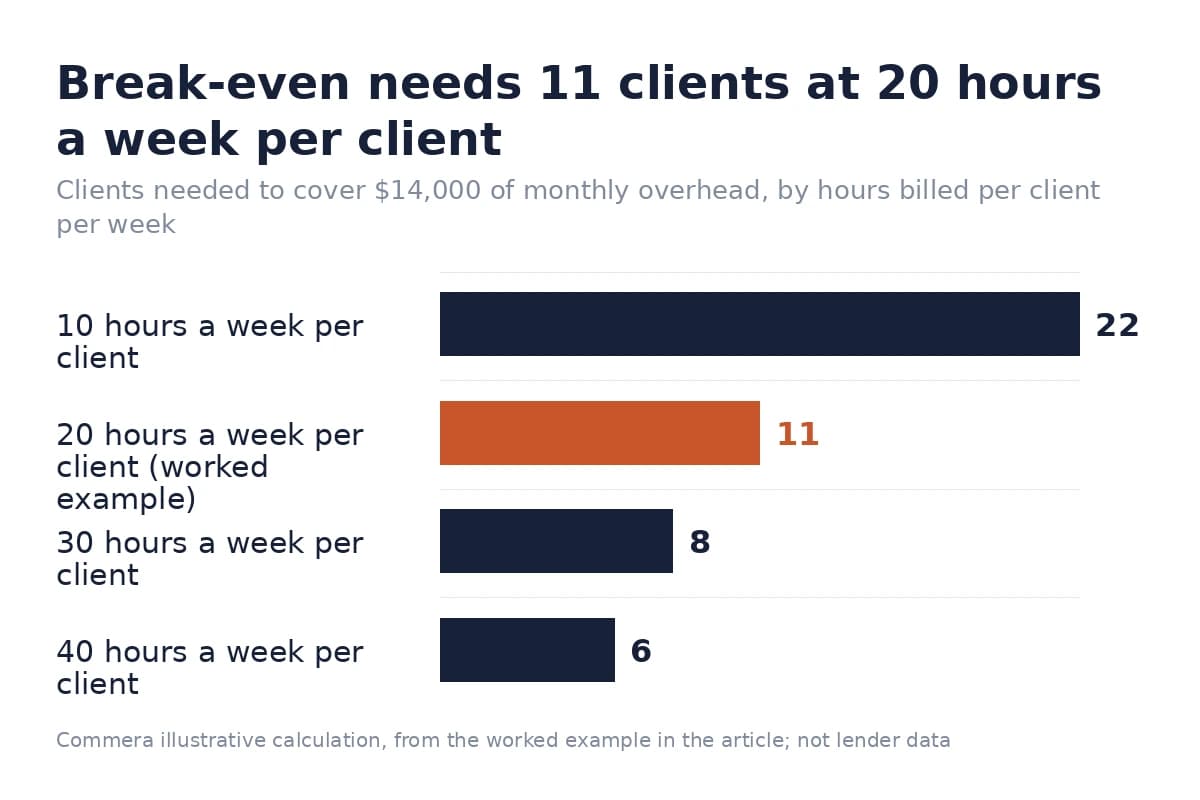
The key marketing assumption is hours per client per week, because revenue equals billed hours times rate. Per Commera's illustrative calculation, a client at 20 hours a week bills about 87 hours a month (20 × 52 ÷ 12).
That number drives everything else. In the worked example below, about 13 clients at 20 hours a week clear the coverage test for a small SBA loan.
| Hours per client per week | Clients to break even | Note |
|---|---|---|
| 10 | 22 | Short visits, more clients to find |
| 20 | 11 | The worked example below |
| 30 | 8 | Fewer clients, more risk if one leaves |
| 40 | 6 | Live-in style schedules |
Source: Commera illustrative calculation, using the overhead and hourly margin from the worked example, rounded up to whole clients.
So the marketing plan has one job. Show how you reach the break-even client count, and by which month.
Ramp: Lay out each month: referral contacts, assessments, clients started. A lender compares your month 6 client count with the break-even line. If the ramp crosses that line late in year one, the plan must fund the months before it.
Losses: Private-pay clients can stop on short notice. Show the attrition you expect and how many new clients replace it.
Financial projections: hourly margin math for a home health care business plan
Financial projections in a home health care business plan start with one line: what a billed hour costs you. Per SBA, the projection should cover five years, with the first year broken out monthly or quarterly.
| Line, one billed hour | Basis | Source | Dollars per hour |
|---|---|---|---|
| Rate billed to the family | National median, non-medical caregiver | CareScout, 2025 | 35.00 |
| Caregiver wage | National median, May 2025 | BLS | 17.21 |
| Employer FICA | 6.2% Social Security plus 1.45% Medicare = 7.65% of wages | IRS Topic 751 | 1.32 |
| SUTA, FUTA, workers' comp | Assumed 7% of wages, check your state | Assumption | 1.20 |
| Full cost of a caregiver hour | Wage plus the two lines above | 19.73 | |
| Margin per billed hour | Rate minus full cost | 15.27 (43.6%) |
Source: Commera illustrative calculation. Rates per IRS and BLS, prices per CareScout, as of October 2026.
Payroll taxes: Per IRS Topic 751, the employer pays 6.2% for Social Security and 1.45% for Medicare on wages. Per IRS Topic 759, FUTA is 6.0% on the first $7,000 of each employee's wages. The maximum 5.4% credit for state unemployment tax brings FUTA down to 0.6%, per the same IRS page.
State costs: State unemployment tax and workers' compensation vary by state. The 7% line in the illustrative table above is an assumption, not a rate. Replace it with your state's rate and a real insurance quote.
What the margin pays for: The margin is not profit. It pays the office, the owner and the loan. The next section shows how many hours it takes.
Worked example: break-even hours and the SBA coverage test
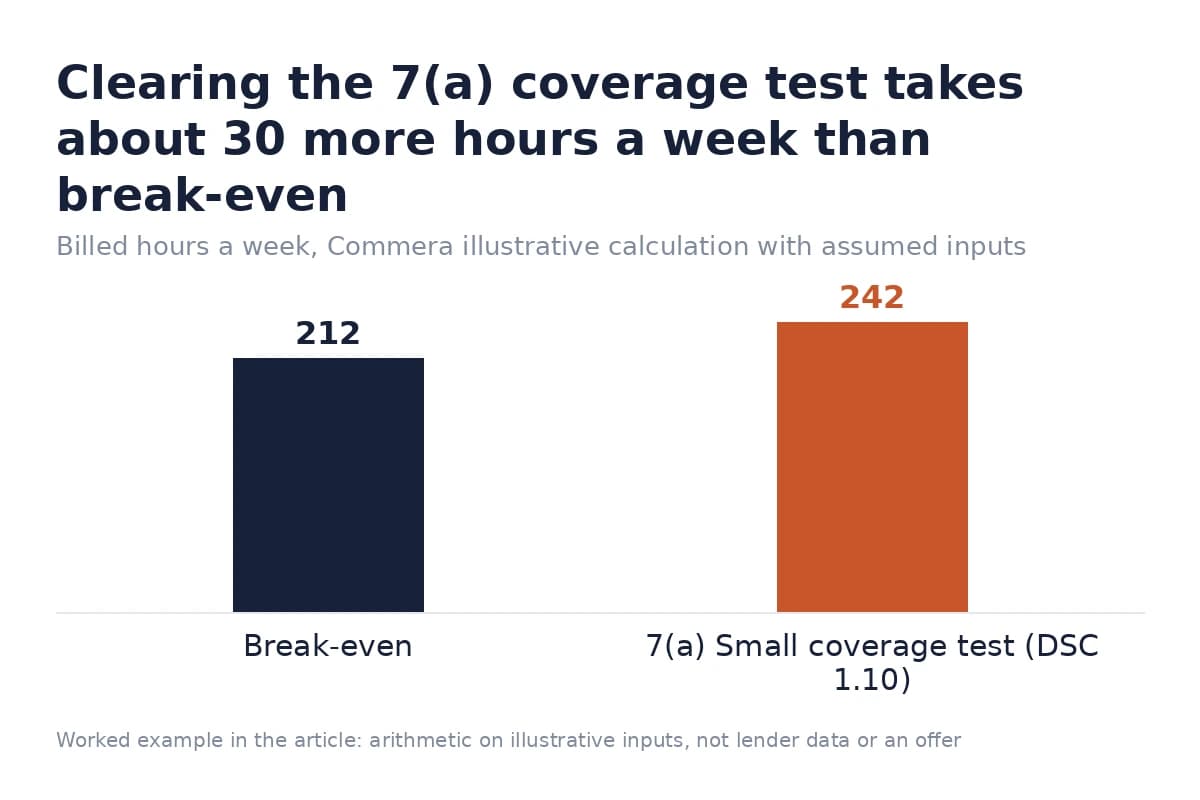
In this illustrative calculation, an agency with $14,000 of monthly overhead breaks even at about 212 billed hours a week. It clears the 7(a) Small coverage test at about 242 hours a week.
Methodology: Commera illustrative calculation with assumed inputs, not lender data and not an offer. It uses the margin from the hourly table above and $14,000 a month of overhead for a coordinator, owner salary, rent, insurance, software and marketing. The project costs $150,000, funded with $15,000 of owner equity and a $135,000 loan at an assumed 10.5% over 10 years. The rate is an assumption, not an SBA rate or a quote, and weeks convert to months at 52 ÷ 12.
Step 1: break-even: $14,000 ÷ $15.27 = 916.8 billed hours a month. That is 211.6 hours a week. At 20 hours a week per client, it takes 10.6 clients, so about 11.
Step 2: the loan payment: The illustrative loan carries these terms.
| Five figures, illustrative 10-year loan | Value |
|---|---|
| Principal | $135,000.00 |
| Interest rate (assumed) | 10.5% a year, fixed |
| Monthly payment | $1,821.62 |
| Total repayment, 120 payments | $218,594.69, of which $83,594.69 is interest |
| Estimated APR | 10.5%, assuming zero fees |
Source: Commera illustrative calculation, not an offer. Real terms are set by financing partners and are subject to underwriting.
A factor rate does not apply to an amortizing loan. Total repayment divided by principal is 1.62 here. Factor rates do not represent APR.
Step 3: the coverage test: Under the 7(a) Small rule of 1.10, operating cash flow must reach 1.10 × $1,821.62 = $2,003.78 a month, per this illustrative calculation. Add the overhead, and the margin must reach $16,003.78. Divided by $15.27, that is 1,048.1 hours a month.
In weekly terms, per this illustrative calculation, that is 241.9 hours, or about 13 clients at 20 hours. At the Standard 7(a) level of 1.15, the bar rises to 1,054.0 hours a month.
Step 4: a healthier month: At 300 billed hours a week, or 1,300 a month, margin after overhead is $5,851, per this illustrative calculation. DSC is then 3.21.
What it means: The gap between break-even and the coverage test is about 30 hours a week. That is one or two clients. A lender reads your client ramp against exactly that line.
To test a different rate, wage or overhead, run your own numbers in the funding calculator. Then replace every assumption in the methodology with your own.
How payer mix changes the plan
Payer mix decides when cash arrives. A plan that shows rates without timing fails the lender's first follow-up question.
| Payer | When cash arrives | What the plan must show |
|---|---|---|
| Private pay | On your own invoice terms | Billing policy, deposits, cancellation risk |
| Medicaid waiver | Agency claims may take up to 12 months from receipt (42 CFR 447.45) | Payroll carried until claims pay, EVV, the 80/20 rule |
| Medicare home health | One payment unit for each 30-day period, final payment after the final claim (42 CFR 484.205) | Medicare certification, reserve funds, billing cycle |
Source: eCFR 42 CFR 447.45, 484.205, 489.28 and 441.302, as of October 8, 2026, and Medicaid.gov EVV guidance.
Medicaid timing: Under 42 CFR 447.45(d), the fast payment standards cover practitioner claims only. Agency claims fall under the longer limit in the table. Ask your state or managed care plan for its real payment cycle and build payroll around it.
Medicare timing: Under 42 CFR 484.205, Medicare pays home health in 30-day periods. The final payment for each period follows the final claim. Your projection should show care delivered well before the money lands.
The 80/20 rule: Under 42 CFR 441.302(k), states must ensure that providers spend 80% of Medicaid payments for homemaker, home health aide and personal care services on direct care worker compensation. Compensation covers wages, benefits and the employer share of payroll taxes.
Per the same rule, it applies from July 9, 2030, six years after the July 9, 2024 rule date. States may set a separate level for small providers and grant hardship exemptions. The rule is in effect as of October 2026, so check eCFR before you finalize the plan.
What it does to margin: A Medicaid column cannot copy the private-pay margin from the hourly table. By our illustrative calculation, the 80% floor leaves at most 20% of those Medicaid payments for overhead and profit. Model that column separately.
The funding request and use of funds
The funding request states how much you need, what each dollar buys and where your equity comes from. Per SBA, it should explain how much funding you need over the next five years and what you will use it for.
Equity: Lenders following SOP 50 10 8.1 look for start-up equity of at least 10% of total project costs. In the illustrative project above, that is the $15,000 of owner equity. Show the bank statement or gift letter behind it.
Use of funds: Break the ask into lines a lender can check:
- License and insurance: State fees, liability and workers' compensation quotes.
- Office and systems: Lease, scheduling, EVV and billing software.
- Recruiting and training: Hiring costs and paid orientation hours.
- Marketing: The referral plan from the marketing section.
- Working capital: Payroll for the months before collections catch up.
SBA 7(a): Per SBA, the 7(a) maximum is $5 million, and most 7(a) term loans are repaid monthly from business cash flow. For the mechanics, read how SBA loans work before you meet a lender.
Lines of credit: A working capital line is harder at the start. Per SBA, the 7(a) Working Capital Pilot line suits businesses with at least one year of operating history. So plan to fund the first payroll gap from equity and the working capital part of a term loan. A line of credit for the gap between payroll and collections comes once the agency has a record.
When a loan is the wrong call: If your ramp never reaches the coverage line in year one, a loan makes the plan worse. Fix the rate, the overhead or the hours per client first.
When the plan, projections and equity proof are ready, a pre-qualification shows which products fit your file. Terms and timing vary by provider and are subject to underwriting.
If your projection clears the coverage test within the first year and your equity is in the bank, take the plan to an SBA lender. If it does not, cut overhead or raise hours per client and rerun the numbers before you borrow.
Broker disclosure: Commera Finance is a broker, not a direct lender. Financing providers make their own eligibility, underwriting, approval, pricing, and term decisions.
Sources
- U.S. Small Business Administration, Write your business plan, accessed October 13, 2026
- U.S. Small Business Administration, SOP 50 10 8.1, Lender and Development Company Loan Programs, effective October 1, 2026
- U.S. Small Business Administration, 7(a) loans, accessed October 13, 2026
- IRS, Topic no. 751, Social Security and Medicare withholding rates, accessed October 13, 2026
- IRS, Topic no. 759, Form 940, FUTA tax return, accessed October 13, 2026
- U.S. Bureau of Labor Statistics, Occupational Outlook Handbook, Home Health and Personal Care Aides, accessed October 13, 2026
- U.S. Department of Labor, Wage and Hour Division, Domestic Service Final Rule FAQs, accessed October 13, 2026
- Medicaid.gov, Electronic Visit Verification FAQ, Section 12006 of the 21st Century Cures Act, May 16, 2018
- CareScout, Cost of Care Survey, accessed October 13, 2026
- eCFR, 42 CFR 489.28, Special capitalization requirements for HHAs, up to date as of October 8, 2026
- eCFR, 42 CFR 447.45, Timely claims payment, up to date as of October 8, 2026
- eCFR, 42 CFR 484.205, Home health prospective payment system, up to date as of October 8, 2026
- eCFR, 42 CFR 441.302, State assurances, up to date as of October 8, 2026