

The short answer
How to start a home care agency comes down to two decisions: which license you need, and how you will pay caregivers before the first claim is paid. Get the license right, then fund the gap between payroll and payment.
A home care agency is a business that sends trained caregivers into clients' homes to help with daily living, such as bathing, dressing, meals and medication reminders. A home health agency is a different business that delivers skilled nursing or therapy and can bill Medicare only after federal certification.
If you are working out how to start a home care company, the two decisions break into five steps:
- License. Choose non-medical home care, licensed by your state where the state requires it, or Medicare home health, which also needs CMS certification.
- Cash. Budget payroll for every week before the first payment arrives, not only the office and the license fee.
- Payers. Decide your mix of private pay, Medicaid waiver and Medicare.
- Systems. Set up overtime payroll and electronic visit verification (EVV) before the first Medicaid visit.
- Financing. Line up working capital before you sign the first client, not after a payroll runs late.
Commera is a broker, not a lender. We compare offers from our lender partners. For an agency waiting on Medicaid or private-pay invoices, that can mean comparing receivables financing with a line of credit.
The rules below summarize federal and state sources as of October 2026. Verify them with your state agency and CMS before you act, because this guide is not legal advice.
Home care vs home health: how to start a home care agency on the right license
Home care and home health need different licenses, different staff and different payers. To bill Medicare, a home health agency must meet the Conditions of Participation in 42 CFR 484, per CMS. Non-medical home care answers to your state.
| Question | Non-medical home care | Medicare home health |
|---|---|---|
| Who licenses | State agency, where the state requires a license | State license where required, plus CMS certification after a survey |
| Who pays | Private-pay families, Medicaid waiver programs | Medicare, plus other payers |
| Core staff | Caregivers or home care aides, trained to state rules | Registered nurses, therapists, home health aides |
| Aide training, federal | Set by your state | At least 75 hours, then a competency evaluation |
| Federal cash test | None | Three months of operating funds, at least 50% not borrowed |
| Federal rules that still apply | Overtime, EVV for Medicaid visits | Conditions of Participation, CMS-855A enrollment |
Source: CMS, eCFR 42 CFR 484.80 and 489.28, U.S. Department of Labor and Medicaid.gov EVV guidance, as of October 2026.
If you are asking how to start a home care agency for clients who need help with daily living, you are on the non-medical side. If you are a nurse planning skilled visits under a physician's plan, the Medicare path fits. Pick one before you rent an office, because the license decides your staff, your payers and your cash needs.
How to start a home health agency: the Medicare path
To start a home health agency that bills Medicare, you need a state license where required, a CMS-855A enrollment, a record of patients served, a passed survey and proof of reserve cash. Each step has its own rule.
Enrollment. You file form CMS-855A with your Medicare Administrative Contractor (MAC). Per the Federal Register, the provider enrollment application fee for calendar year 2026 is $750.
Patients before the survey. According to the CMS State Operations Manual, chapter 2, the agency must have provided skilled services to at least 10 patients before the survey. They do not have to be Medicare patients. Per the same manual, at least 7 must be receiving care on the day of the survey.
So you deliver care before Medicare pays you for anyone, which is the first cash problem.
Survey. Per the same CMS manual, the initial survey is done by the state survey agency or by an accrediting organization that CMS has approved. In Minnesota, per the Minnesota Department of Health, new agencies go to an accrediting organization, and the MAC's letter on your 855A is not the final approval.
Aides. Under 42 CFR 484.80, a home health aide needs at least 75 hours of training. Per the eCFR text, that includes at least 16 hours of classroom training before at least 16 hours of supervised practical training under a registered nurse. An aide works only after passing a competency evaluation.
Buying instead of building. Buying a certified agency is not a shortcut. Under 42 CFR 424.550(b), billing privileges generally do not transfer after a change in majority ownership within 36 months, with some exceptions.
State licensing for non-medical home care
Non-medical home care is licensed state by state. The agency, the fee and the training rules all depend on where you operate. Three large states show how different the process can be.
| State | Licensing body | License | What stands out |
|---|---|---|---|
| California | Department of Social Services (CDSS) | Home Care Organization (HCO) | Aides listed on the Home Care Aide Registry, unannounced visits |
| Texas | Health and Human Services Commission (HHSC) | HCSSA, Personal Assistance Services category | Computer-based training before you apply, plus a fee |
| New York | Department of Health | Licensed Home Care Services Agency (LHCSA) | Certificate of Need review, PHHPC approval |
Source: state agency pages listed below, as of October 2026.
California. Per the California Department of Social Services, CDSS licenses Home Care Organizations and maintains the Home Care Aide Registry. It also makes unannounced visits.
Texas. Per Texas HHSC, a home and community support services agency (HCSSA) needs a state license. Non-medical care falls under the Personal Assistance Services category. You complete computer-based training before you apply and pay a licensing fee.
New York. Per the New York State Department of Health, a new LHCSA goes through Certificate of Need review and needs approval from the Public Health and Health Planning Council (PHHPC).
Other states run their own process, so find your state's licensing agency before you sign a lease or hire anyone. For the wider budget beyond the license, see our guide on how to start a healthcare business.
Startup costs: the cash rules nobody puts in the budget
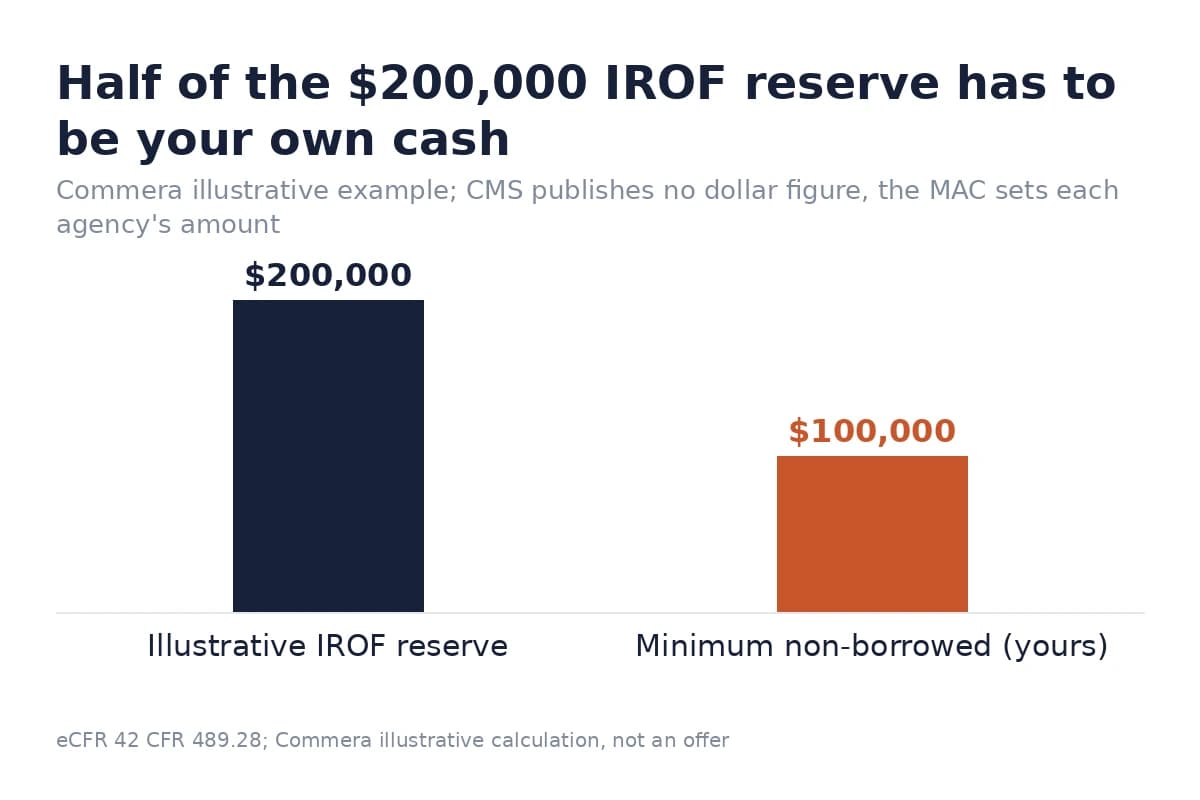
The largest startup cost for a Medicare home health agency is often not the license. It is the initial reserve operating funds (IROF). Under 42 CFR 489.28, that means enough money to run the agency for its first three months after billing privileges.
How the number is set. Per the eCFR text, the MAC uses cost data from at least three comparable agencies. It multiplies their average cost per visit by your projected visits for the same period. Medicare receivables you expect to collect do not count toward the reserve.
Who supplies the money. According to 42 CFR 489.28, at least 50% of the reserve must be non-borrowed funds, including money the owner invests. The rest can come from a loan or a line of credit from an unrelated lender.
The letter of credit. If you use a line, the same rule requires a letter of credit from the lender. Read how a business line of credit works before you ask a bank for that letter.
If you fall short. Per the same section, an agency that cannot prove the reserve can be denied billing privileges, or lose them.
CMS publishes no dollar amount, because the MAC computes the reserve for each agency. Here is the logic in a Commera illustrative calculation. If the MAC set your IROF at $200,000, at least $100,000 would have to be your own money.
Non-medical agencies face no such federal reserve test, but they face the same payroll gap, as the next section shows.
Payroll comes before payment
Caregivers get paid every week or two, and payers do not move that fast. Medicare and Medicaid both pay after the care is delivered and billed, on schedules that federal rules set. That timing gap is the real startup cost.
Overtime. Under 29 CFR 552.109, as of October 8, 2026, third-party employers such as agencies cannot claim the companionship or live-in exemptions. According to the Department of Labor, agency caregivers are owed minimum wage and overtime.
A change is possible. Per the Federal Register, the DOL proposed on July 2, 2025, to restore the exemptions for agencies (90 FR 28976). It is a proposal, not a rule, so budget overtime until a final rule says otherwise.
Medicare billing. Under 42 CFR 484.205, an agency files a Notice of Admission (NOA) within 5 calendar days after the start of care. Per the same rule, a late NOA cuts the 30-day payment by 1/30 for each late day. The agency receives one payment for each 30-day period after it submits the final claim.
Medicaid timing. Under 42 CFR 447.45(d), states must pay 90% of clean claims within 30 days and 99% within 90 days. Per the eCFR text, those standards cover practitioner claims only. All other claims, including agency claims, may take up to 12 months from receipt.
EVV. Per Medicaid.gov guidance, electronic visit verification is required for Medicaid personal care and home health services that involve an in-home visit. That includes waiver programs and managed care. Choose a system your state accepts before the first visit.
Hiring. Per the Bureau of Labor Statistics, home health and personal care aides earned a median $17.21 an hour, or $35,800 a year, in May 2025. The same source projects 18% employment growth from 2025 to 2035. Every agency near you hires from the same pool, so budget for the wage that keeps caregivers, not the legal minimum.
Worked example: 200 caregiver hours a week on Medicaid
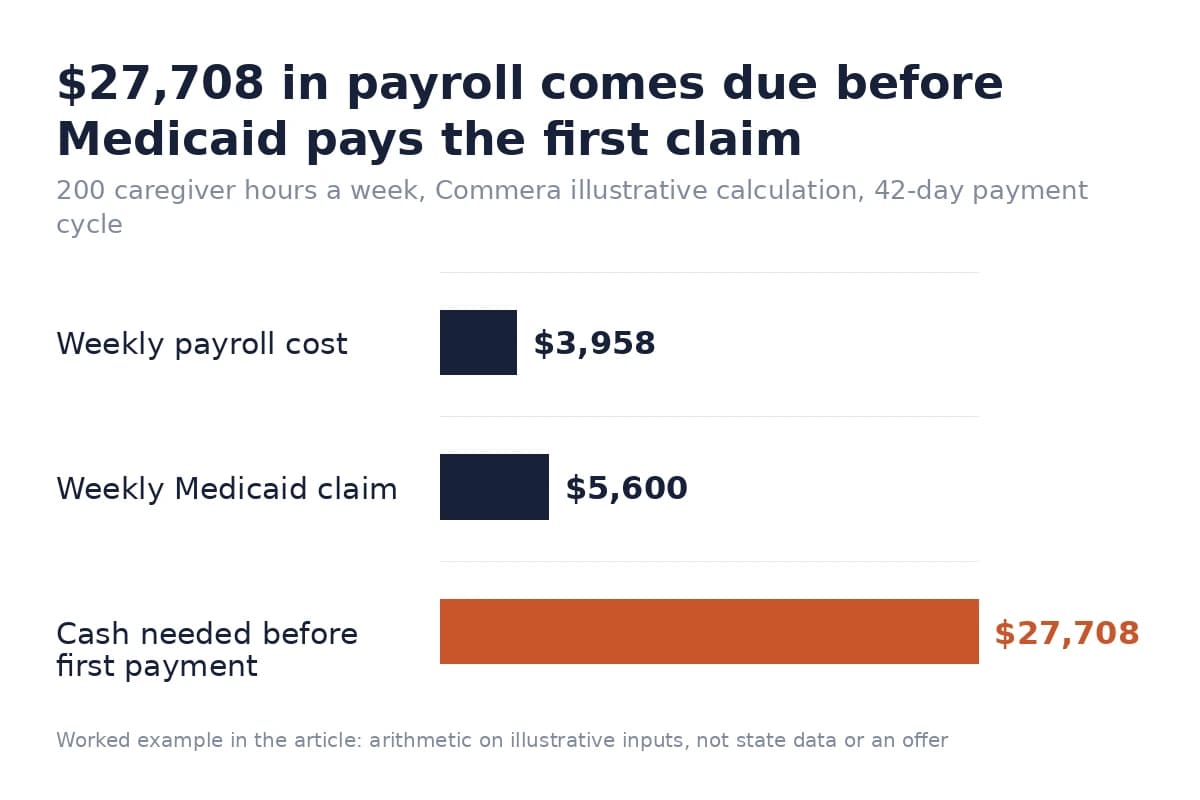
In this illustrative case, an agency billing 200 Medicaid waiver hours a week meets 7 payrolls, or $27,708.10, before the first state payment arrives. The numbers below show where that figure comes from.
Methodology: Commera illustrative calculation with assumed inputs, not state data. Assume 10 Medicaid waiver clients at 20 hours a week each and a state rate of $28.00 an hour (replace it with your state's fee schedule). Caregivers earn $17.21 an hour (the BLS median), payroll taxes and insurance add 15%, and the agency bills weekly and is paid 42 days after each claim. This is not an offer and not a real agency.
| Line, one week | Calculation | Amount ($) |
|---|---|---|
| Billable hours | 10 clients × 20 hours | 200 |
| Caregiver wages | 200 × 17.21 | 3,442.00 |
| Payroll taxes and insurance | 15% of wages | 516.30 |
| Total payroll cost | wages plus 15% | 3,958.30 |
| Medicaid claim | 200 × 28.00 | 5,600.00 |
| Left after payroll | 5,600.00 minus 3,958.30 | 1,641.70 (29.3%) |
Source: illustrative calculation, wage median per BLS.
The $1,641.70 is not profit, per this illustrative case. It has to cover the office, the scheduling coordinator and the owner.
The gap. In this illustrative case, the first claim is paid 42 days after it is filed. By then the agency has met 7 weekly payrolls: the week of service plus 6 weeks of waiting. That is 7 × $3,958.30 = $27,708.10 in payroll alone, before rent.
Closing it with factoring. Receivables financing advances part of a claim before the payer settles it. Per Commera's receivables financing page, the illustrative advance is about 85% and the fee runs 1% to 3% for each 30 days. The example below takes the midpoint, 2%.
| Five figures, factoring one weekly claim | Value |
|---|---|
| Principal (advance, 85% of $5,600.00) | $4,760.00 |
| Fee rate (2% for each 30 days × 42/30) | 2.8% of the claim, or $156.80 |
| Total repayment, from the state payment | $4,916.80 |
| Payment | one deduction on day 42 |
| Estimated APR (156.80 ÷ 4,760.00 × 365/42) | about 28.6% |
Source: illustrative calculation, not an offer. Per this illustrative case, the agency keeps the remaining $683.20 of the claim.
A factoring fee is not an APR. The estimated APR above is an illustrative calculation, and real terms are set by financing partners. One week of factoring also does not close a seven-week gap. You would factor several weekly claims, and each one carries its own fee.
If you have read about staffing firms, payroll funding works the same way: the invoice carries the payroll until the payer settles. Run your own fee schedule through the table, then check what your agency may qualify for.
Payer mix: private pay, Medicaid waiver, Medicare
Private pay is the cash you collect fastest. Medicaid waiver brings volume at your state's rate, and Medicare brings skilled-care revenue only after certification. Plan the mix around how long you can carry payroll.
| Payer | Hourly rate or payment | How fast money arrives | What you need first |
|---|---|---|---|
| Private pay | Median $35 an hour (2025) | On your own invoice terms | State license where required |
| Medicaid waiver | Your state's fee schedule | Up to 12 months allowed for agency claims | Medicaid enrollment, EVV |
| Medicare home health | One payment for each 30-day period | After the final claim | CMS certification, CMS-855A, IROF |
Source: CareScout Cost of Care, eCFR 42 CFR 447.45 and 484.205, as of October 2026.
Per CareScout, families paid a median $35 an hour for a non-medical caregiver in 2025, up from $34 in 2024. The same survey puts skilled nursing at home at a median $90 an hour.
That hourly price is what a family pays, not what you keep. Per BLS, the median aide wage is about half of it. The spread has to cover payroll taxes, insurance, scheduling and the office.
Private pay also carries risk, because a family can cancel with little notice. Medicaid volume is steadier but slower. With thin cash, start with more private pay and add Medicaid once payroll is covered.
What to have ready before you apply for financing
Receivables financing needs receivables. A financing provider will want proof that your claims get paid: a license, payer enrollment and a billing record. Before the first claim, there is nothing to advance against.
Put these in one folder:
- License. Your state license or approval letter, and CMS certification if you run home health.
- Payer enrollment. Medicaid provider enrollment, waiver contracts and any Medicare billing privileges.
- Claims. An aging report from your billing system, showing what is billed and what is paid.
- Payroll. Payroll records with overtime calculated under federal rules.
- EVV. Visit records for every Medicaid visit.
- Bank statements. Recent business bank statements.
- Insurance. Certificates for general and professional liability and workers' compensation.
- Reserve proof. For the Medicare path, account statements for the IROF and, if you use a line, the lender's letter of credit.
When the folder is complete, a pre-qualification shows which products fit your file. Terms and timing vary by provider and are subject to underwriting.
If you already bill Medicaid or private-pay clients and payroll outruns collections, compare receivables financing on your claims. If you have not filed your first claim yet, fund the first months with owner cash and, on the Medicare path, a line of credit that meets the IROF letter-of-credit rule. Revisit financing once claims exist.
Broker disclosure: Commera Finance is a broker, not a direct lender. Financing providers make their own eligibility, underwriting, approval, pricing, and term decisions.
Sources
- CMS, Home Health Agencies Conditions of Participation, 42 CFR 484, accessed October 13, 2026
- eCFR, 42 CFR 484.80, Home health aide services, up to date as of October 8, 2026
- CMS, State Operations Manual, Chapter 2, The Certification Process, accessed October 13, 2026
- Minnesota Department of Health, Initial Medicare certification for home health agencies, accessed October 13, 2026
- Federal Register, Provider Enrollment Application Fee Amount for Calendar Year 2026, December 3, 2025
- eCFR, 42 CFR 489.28, Special capitalization requirements for HHAs, up to date as of October 8, 2026
- eCFR, 42 CFR 424.550, Prohibitions on the sale or transfer of billing privileges, up to date as of October 8, 2026
- eCFR, 42 CFR 484.205, Home health prospective payment system, up to date as of October 8, 2026
- eCFR, 42 CFR 447.45, Timely claims payment, up to date as of October 8, 2026
- Medicaid.gov, Electronic Visit Verification FAQ, Section 12006 of the 21st Century Cures Act, May 16, 2018
- eCFR, 29 CFR 552.109, Third party employment, up to date as of October 8, 2026
- U.S. Department of Labor, Wage and Hour Division, Domestic Service Final Rule FAQs, accessed October 13, 2026
- Federal Register, proposed rule on the domestic service exemptions, 90 FR 28976, July 2, 2025
- U.S. Bureau of Labor Statistics, Occupational Outlook Handbook, Home Health and Personal Care Aides, accessed October 13, 2026
- CareScout, Cost of Care Survey, accessed October 13, 2026
- California Department of Social Services, Home Care Services, accessed October 13, 2026
- Texas Health and Human Services, How to Become a Licensed HCSSA Provider, accessed October 13, 2026
- New York State Department of Health, Licensed Home Care Services Agencies, accessed October 13, 2026