
How to Find a Business to Buy: 7 Channels
*A first-time buyer pauses outside an operating storefront with the financial paper trail that decides whether a lender will underwrite it.*
How we calculated the examples: The screening table uses the stated price, equity injection, principal, APR, and term with standard monthly amortization. Coverage divides adjusted annual earnings by annual debt service. Market multiples remain tied to the cited survey.
The short answer
Buyers find deals in seven places: marketplaces, brokers, direct outreach to owners, their professional network, franchise resales, trade groups and distributors, plus SBA resource partners. The channel decides how fast you see a listing. The seller's paperwork decides whether anyone will finance it.
So the practical answer to how to find a business to buy, and to how to buy a business, is a screen, not a search. You want a financial trail: filed tax returns, seller numbers that match IRS transcripts, three closed years, and earnings that cover the new loan payment.
An off market business acquisition is a purchase of a company that was never publicly listed, where the buyer reaches the owner directly or through a contact.
Commera is a broker, not a lender. We compare offers from our lender partners. That includes business loans for buying a business.
Why buying beats starting, and when it doesn't
An operating business comes with what a startup cannot produce: a paper record. For an Initial Acquisition the lender must satisfy debt service coverage of 1.25:1, using the last fiscal year-end or an average of the last two.
That rule sits in SOP 50 10 8.1, Appendix 15, effective October 1, 2026. The same Appendix is blunt about forecasts: the lender must evaluate your projections but may not rely on them to meet coverage. A business plan does not buy you coverage.
Buying loses its edge in two cases. The first is a business whose earnings walk out with the owner, shown in the worked example below. The second is a concept nobody runs in your market yet.
One self-check first: the lender's credit memo must describe your industry experience and who runs daily onsite operations, per the SBA Appendix.
Where to find businesses for sale: 7 channels
The seven channels differ in one thing: how much verified paper you get, and how early. Marketplaces give volume and seller-built summaries. Networks and direct outreach give access before competition arrives, and few documents until you earn them.
| Channel | What you can check before you call | Paperwork you usually see first | Effort per lead |
|---|---|---|---|
| Online marketplaces | Asking price, stated SDE, region, industry | Teaser, NDA, seller-built summary | Low, high volume |
| Business brokers direct | Current and quiet inventory | Memorandum, returns on request | Medium |
| Direct outreach to owners | Almost nothing public | None. You build the file yourself | High |
| CPAs, attorneys, bankers, suppliers | The owner's situation, often before listing | Whatever the accountant keeps | Medium, slow to start |
| Franchise resales | Unit economics and brand standards | Resale package, franchisor approval | Medium |
| Trade associations and distributors | Who is slowing down in your industry | None. Conversation first | Medium |
| SBA resource partners | Local referrals, free counseling | None. Preparation help | Low |
Two caveats. For a franchise resale the brand must sit in the SBA Franchise Directory, and SBA does not lend directly, so its Resource Partners only help you prepare.
Industry mix shifts with deal size. Restaurants and personal services cluster at the smallest end, construction and engineering appear from $500,000 through $5 million, and manufacturing sits above that, per the IBBA and M&A Source Market Pulse survey of 255 advisors, Q2 2026.
What "financeable" means before you fall in love with a listing
Four conditions decide whether a listing can be financed at all. Check them before you spend a weekend on the numbers.
Federal tax returns are filed. An applicant that has not filed required federal returns is not eligible for SBA assistance.
The seller's numbers match IRS transcripts. For a change of ownership the lender must verify the seller's data, and discrepancies get reconciled before first disbursement.
Three closed years exist, plus interim statements. The SBA analysis uses the three most recent year-end figures and the comparable interim period from last year.
An independent valuation supports the price. The lender orders it from a Qualified Source, per Appendix 15, Para. C.1.a. At a $3 million purchase price or more, a Quality of Earnings report is required too.
A listing that fails any of these is a financing problem, not a negotiation problem. Structure sits in our guide to the loan to buy a business. One number to remember: at Initial Acquisition the 10% buyer equity injection cannot be reduced or eliminated, per SBA rules.
Listings an SBA loan will never touch
Some businesses are ineligible by rule, whatever the numbers look like. These come from SBA rules under 13 CFR § 120.110, not lender preference.
Passive real estate rental, where the owner does not occupy or use the assets.
Salon suites and ghost kitchens, outside narrow exceptions.
Land leased for cell towers, billboards, solar or wind. The company operating the tower stays eligible.
Standalone charging stations with no on-site operator.
Lending and factoring businesses.
Pawn shops, unless over 50% of prior-year revenue came from merchandise sales, per SBA rules.
Businesses taking more than one-third of prior-year gross revenue from legal gambling.
Marijuana-related businesses, even where state law allows them.
Multi-level marketing.
Management agreements deserve a look. If a management company holds sole discretion over operations, the buyer becomes an ineligible passive business. Program mechanics sit in our explainer on how SBA loans work.
How to read a listing like a lender
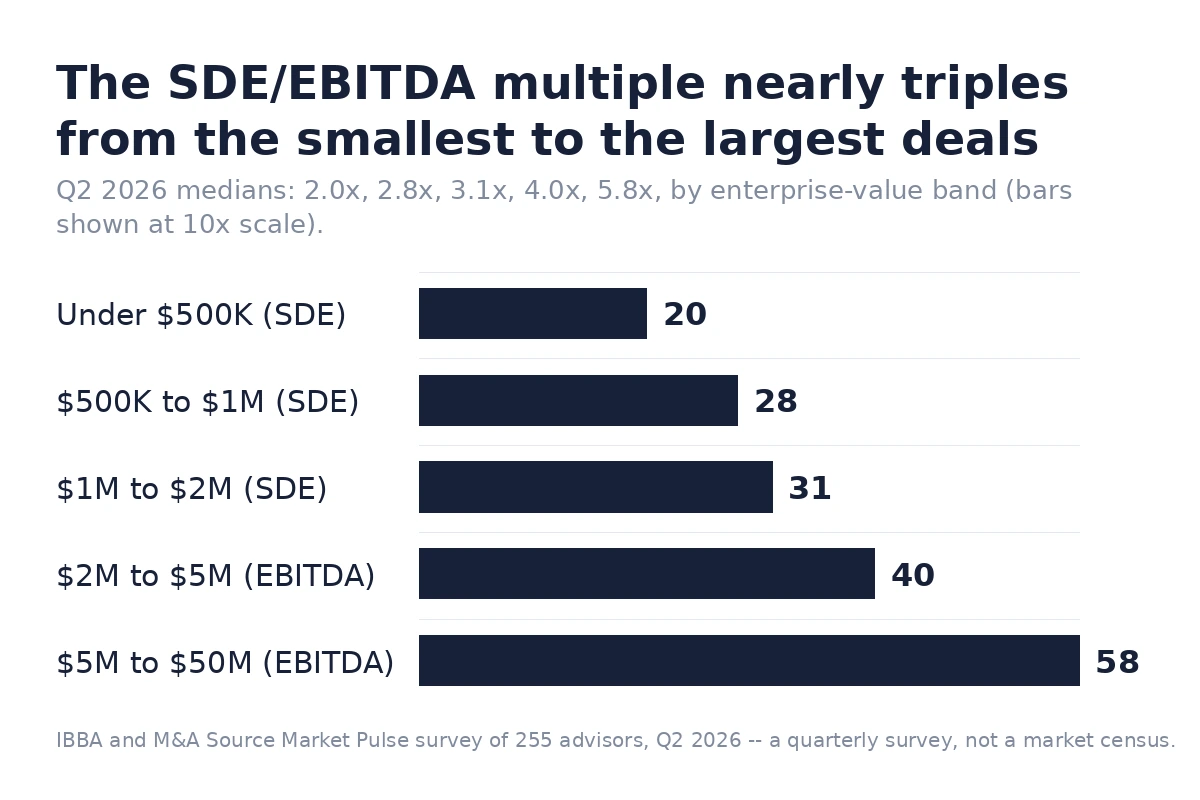
*Q2 2026 median multiples run from 2.0x SDE on deals under $500K to 5.8x EBITDA on deals from $5M to $50M, per the IBBA and M&A Source Market Pulse survey.*
Read three fields in this order: earnings definition, add-backs, then price against the market multiple. Listings under roughly $2 million quote SDE, which includes one owner's salary and perks. Larger deals quote EBITDA, which does not, per Market Pulse Q2 2026.
| Enterprise value band | Q2 2026 median multiple | Applied to |
|---|---|---|
| Under $500K | 2.0x | SDE |
| $500K to $1M | 2.8x | SDE |
| $1M to $2M | 3.1x | SDE |
| $2M to $5M | 4.0x | EBITDA |
| $5M to $50M | 5.8x | EBITDA |
Source: IBBA and M&A Source Market Pulse survey of 255 advisors who closed 181 deals, Q2 2026.
Now attack the add-backs. Every add-back claims a cost will not repeat under you. The lender must justify each adjustment in writing, per SBA rules. Add-backs you cannot defend in one sentence vanish during underwriting.
Sellers received 83% to 92% of transaction value in cash at close, per Market Pulse Q2 2026, and seller financing covered under 10% of most deals. Plan around cash, not around the seller carrying you.
Worked example: screening two listings in ten minutes
*Illustrative: two similar-looking storefront listings can carry very different numbers once the owner's replacement cost is priced in.*
Two listings look identical: same asking price, same advertised SDE. The difference is the cost of replacing the owner.
| Line | Listing A | Listing B |
|---|---|---|
| Asking price | $900,000 | $900,000 |
| SDE as advertised | $260,000 | $260,000 |
| Buyer equity at 10% | $90,000 | $90,000 |
| Loan principal | $810,000 | $810,000 |
| Illustrative rate and term | 10.5%, 120 months | 10.5%, 120 months |
| Monthly payment | $10,929.73 | $10,929.73 |
| Annual debt service | $131,156.82 | $131,156.82 |
| Total repayment over 120 payments | $1,311,568 | $1,311,568 |
| Estimated APR, illustrative | 10.5% | 10.5% |
| Factor rate | Not applicable | Not applicable |
| Daily or weekly payment | Not applicable, monthly payment shown above | Not applicable, monthly payment shown above |
| Market pay for a manager | $85,000 | $110,000 |
| Adjusted earnings | $175,000 | $150,000 |
| Coverage vs the 1.25 minimum | 1.33, clears | 1.14, short |
Commera illustrative calculation. The rate and term are model inputs, not an offer.
Commera is a broker and does not set rates. Lender partners underwrite and price every offer. Fees and closing costs are excluded.
At 1.25 coverage the deal needs $163,946 of adjusted earnings, by the same illustrative math. Listing A has $175,000 and clears. Listing B pays a working manager, lands at $150,000, and falls short by $13,946 at the same price. You can check what your profile qualifies for before you call the broker.
The first call: the documents that decide everything
Ask for seven things on the first call. A seller who cannot produce the first three in a week is telling you how the next six months will go.
- Federal tax returns for the last three years.
- Current interim statements plus the same period last year.
- Written consent to verify seller data against IRS transcripts.
- The lease, with remaining term and assignment language.
- Licenses, and whether they transfer to a new owner.
- Revenue concentration by customer, plus the owner's real weekly duties.
- Willingness to exit the business completely.
The last point is a rule. At Initial Acquisition the seller may not stay on as an officer, director, stockholder or employee, and may consult for no more than 24 months in total.
The lender must also make a site visit to the business being acquired, with alternative verification allowed for online businesses. Even a small purchase gets full underwriting, because change of ownership deals cannot use streamlined SBA 7(a) Small standards at $350,000 and below. Run pre-qualification alongside document collection.
Off-market vs on-market: which fits your timeline
On-market is faster to start and harder to win. Off-market is slower and less contested. Main Street deals took a median of six to 10 months from engagement to close, and lower middle market deals averaged 11 to 12 months, per the IBBA and M&A Source survey of 255 advisors, Q2 2026.
Competition scales with price, per the same survey. Deals over $5 million drew at least three offers in 87% of cases, and 33% drew 10 or more. Deals under $500,000 often attract one or two.
Retirement drives most sales. It explained nearly two-thirds or more of reported sales between $500,000 and $50 million, peaking at 72% in the $1 million to $2 million band, per the survey. Below $500,000 it accounted for 45%.
The useful part for an off-market hunt: 60% to 90% of sellers had done under a year of exit planning, or none, per the same source. Their books are not ready. Your first job is patience.
How to find a business to buy: which path fits you
If you have industry experience and cash in the low six figures, work brokers and marketplaces inside that sector. Screen every listing against the four financeable conditions, and ask for tax returns before a tour.
If the listings in your budget are all owner-dependent service shops, go off-market through your CPA, banker and suppliers. Expect a year, not a quarter.
If what you want is really an asset purchase or an expansion of what you run, an acquisition loan is the wrong tool. Compare other types of small business financing first.
Frequently asked questions
Where do people actually find small businesses for sale? Most first-time buyers start on marketplaces, then work brokers in one industry. Deals that never reach a listing site come through accountants, bankers, suppliers and trade groups. Both routes work. They differ in competition, in paperwork quality and in timing.
How do I find a small business to buy under $1.5 million? To decide how to find a small business to buy in that range, filter by industry first, not by price. That band is Main Street territory, where construction, engineering and personal services trade most often, per the Market Pulse survey of 255 advisors, Q2 2026. Then apply the four financeable conditions above before you tour.
Where do I find owners who want to retire but haven't listed yet? Through people who already see their books: CPAs, bankers, insurance agents and main suppliers. Retirement is the primary reason owners sell, and most had done under a year of exit planning. Expect unpolished financials, no memorandum, and a longer runway.
Is it better to work with a business broker or contact owners directly? Brokers are faster and more competitive. Direct outreach is slower and quieter. A brokered deal arrives with a memorandum and usually with returns on request. A direct approach means you build the file yourself. Running both is the honest answer.
Can I buy a business for $10,000? Rarely anything with employees or history. At that price you are buying equipment, a client list or a job, not cash flow. SBA change of ownership underwriting still applies at small sizes, since these deals cannot use streamlined standards at any amount.
How much is a business worth with $1,000,000 in sales? Revenue does not set value. Multiples apply to SDE or EBITDA, not to sales, so that top line supports a wide range of prices. The table above gives Q2 2026 medians by band, per the Market Pulse survey. The lender orders its own valuation.
How long does it take to buy a business? Main Street deals ran a median of six to 10 months from engagement to close, and lower middle market deals averaged 11 to 12 months, per the IBBA and M&A Source survey of 255 advisors, Q2 2026. Your timeline depends on document quality and on underwriting.
Do I need industry experience to get financing? It is not a formal bar, but it is underwritten. The lender's credit memo must describe your industry experience, your management team and who handles daily onsite operations. Buying inside a sector you know makes that section easy to write.
Sources
- SBA, 7(a) loans overview (changes of ownership as an eligible use, $5 million maximum, Resource Partners, SBA does not lend directly): https://www.sba.gov/loans/7a-loans/
- SBA SOP 50 10 8.1, effective October 1, 2026, Appendix 15 "7(a) Changes of Ownership" (10% equity at Initial Acquisition, 1.25:1 coverage, three closed years plus interim statements, projections excluded, Para. C.1.a valuation by a Qualified Source, Quality of Earnings at $3 million and above, seller exit and the 24-month consulting cap, site visit, add-back justification): https://legacy.sba.gov/sites/default/files/2026-08/SOP%2050%2010%208.1%20effective%2010.1.2026_0.docx
- SBA SOP 50 10 8.1, Section A, Ch. 5, Para. B, IRS Tax Transcript/Verification of Financial Information (unfiled returns, seller verification, reconciliation before first disbursement): same document
- SBA SOP 50 10 8.1, Section A, Ch. 1, Para. E, Types of Ineligible Businesses, with 13 CFR § 120.110 references: same document
- SBA SOP 50 10 8.1, Section B, Ch. 2, 7(a) Small & SBA Express (change of ownership cannot be financed using 7(a) Small standards): same document
- SBA Franchise Directory: https://legacy.sba.gov/document/support-sba-franchise-directory
- IBBA and M&A Source, Market Pulse Survey Q2 2026, survey of 255 advisors who closed 181 transactions, fielded July 1-15, 2026 (timelines, cash at close, seller financing share, offer counts, seller motivations, exit preparation, sector mix): https://www.prnewswire.com/news-releases/the-market-pulse-survey-q2-2026-reports-the-latest-trends-in-business-sales-up-to-50m-302858664.html
- Market Pulse Q2 2026 Highlights PDF (business value multiples by segment, SDE below $2M and EBITDA above): https://www.ibba.org/wp-content/uploads/2026/08/mp-highlights-q2-2026.pdf