
Laundromat Financing: Buy, Replace, Remodel
*A laundromat owner checks in on his self-service store while a row of large-capacity washers and dryers runs behind him.*
How we calculated the examples: Every payment table uses the stated principal, APR, and term with standard monthly amortization. Equipment totals multiply the listed unit price by quantity. Fees are shown separately from principal and interest.
The short answer
Laundromat financing is the set of loans used to buy an operating coin laundry, to replace its washers and dryers, or to rebuild the space they sit in. Three cases, three different products.
Buying an operating store usually runs through an SBA 7(a) change of ownership loan. The minimum equity injection is 10% of total project cost, and SOP 50 10 8.1 says it cannot be reduced or eliminated on a first acquisition. Replacing the fleet is equipment financing, priced against the machines themselves.
One ceiling surprises most buyers. If no real estate is in the deal, the SBA 7(a) term stops at 10 years. Goodwill, equipment and working capital all sit under that limit.
Financing a laundromat also turns on the lease. For a 7(a) loan the lease term should equal or exceed the loan term.
Commera is a broker, not a lender. We compare offers from our lender partners. On machine purchases that means equipment financing quotes placed side by side.
Three ways to pay for a laundromat, side by side
The product follows the scenario. Buy a store and you are in SBA territory. Buy machines and you are in equipment territory.
| Scenario | Product | Money down | Maximum term | Collateral | What the lender checks |
|---|---|---|---|---|---|
| Buy an operating store, leased space | SBA 7(a) change of ownership | 10% of total project cost, cannot be reduced | 10 years | Business assets, personal guaranty | Business valuation, debt service, lease term |
| Buy the store and the building | SBA 7(a) with real estate, or 504 | 10%, or 15% for a new business under 504 | Up to 25 years on the real estate share, blended | Real estate, equipment | Appraisal, valuation, CDC credit memo |
| Replace the machines only | Equipment financing | 0% to 20%, illustrative range on our site | Set by the lender against useful life | The machines | Time in business, cash flow, credit |
| Remodel leased space | 7(a) leasehold improvements | 10% inside a change of ownership | 10 years, plus up to 12 months to finish the work | Leasehold, equipment | Lease term, landlord's waiver |
Two alternatives sit outside that table. A seller note can carry part of the price under the standby rules below. A line of credit covers a short gap at a higher cost than a term loan.
Pick the product before you pick the lender. An acquisition file does not convert later.
What the machines actually cost
*Sizing a machine purchase means checking a fleet like this one, capacity class by capacity class, against fresh shipping boxes of replacements.*
Published per machine prices are rare in this industry. One US distributor, Midwest Laundries of Chicago, lists add to cart prices on rebuilt store machines. Every figure below is that distributor's price as of September 22, 2026, not a national average.
| Rebuilt washer-extractor | Listed price, one distributor, Sept 22, 2026 |
|---|---|
| 20 lb | $2,900 |
| 30 lb | $2,600 to $3,600 |
| 40 lb | $3,800 to $4,800 |
| 45 lb | $3,600 |
| 60 lb | $6,200 to $6,800 |
| 62 lb | $4,000 to $4,900 |
| 75 lb | $6,500 |
| 80 lb | $8,500 |
| 100 lb | $10,800 |
Rebuilt dryers as of September 22, 2026 run $2,800 to $4,500 for a 30 lb stack and $5,200 to $6,200 for a 45 lb stack. A standard rear load coin changer lists at $5,265.
The same distributor lists a new Speed Queen coin line as of September 22, 2026: top load washer $1,796, 22 lb front load washer $2,837, stack washer and dryer $4,744, coin dryers $1,387 to $1,542. Those are multi-housing units. They are not the 40 lb to 80 lb class a busy store runs on.
Installation adds $110 per machine on that price list. A five-year parts warranty adds $155. Delivery is $95 for one machine and free from two.
New vended machines in the 30 lb to 80 lb class have no public list price. As of September 22, 2026, Speed Queen, Huebsch and Dexter published specification sheets only, and every other distributor we checked asks for a quote request. Get your own written quote before you size a loan.
Useful life sets the loan term. The Coin Laundry Association industry overview, accessed September 22, 2026, puts front load washers of 18 lb to 50 lb and dryers of 30 lb to 60 lb at 10 to 15 years. Top load washers of 12 lb to 14 lb get 5 to 8 years. Heating systems and coin changers get 10 to 15.
Buying an operating laundromat: the 10% that cannot be waived
Ten percent is the floor, and it does not move. SBA SOP 50 10 8.1 sets the minimum equity injection for an Initial Acquisition at 10% and states that it cannot be reduced or eliminated. A business operating for a year or less counts as a start-up under SBA rules. Every 7(a) start-up loan carries 10% of project cost.
Where the money comes from matters as well. SBA names Limited Equity Injection Sources. Together they may provide no more than half of the required injection.
Seller financing for laundromat deals has one path into that injection. Seller debt subordinated to the lender and on full standby may count as equity, per SOP 50 10 8.1. Full standby means no payments of principal or interest during the 7(a) term, documented on SBA Form 155 or the lender's equivalent. Such seller debt becomes eligible for refinancing after 36 months in place and current.
A seller note outside standby lives by a different rule. Interest-only purchase debt that is not on full standby must amortize in 10 years or less under SBA rules. Total debt supporting the change of ownership, seller paper included, is limited to the business valuation amount. Our business acquisition loan guide walks the same rules across industries.
Why laundromat financing caps out at ten years
Without real estate, a laundromat deal is goodwill, equipment and working capital. SBA SOP 50 10 8.1 caps working capital, inventory and intangible assets, goodwill included, at 10 years. Equipment generally stops at 10 years as well, and reaches 15 only when the IRS asset class useful life supports the term.
Leasehold improvements carry their own limit. The cap is 10 years, plus a reasonable period to finish the work, and in no case more than 12 months.
Real estate changes the arithmetic. SBA real estate loans run up to 25 years, and a mixed deal gets a blended term on a weighted average basis.
Now the lease. Under SBA SOP 50 10 8.1, the 7(a) lease term, including renewal options exercisable only by the borrower, should equal or exceed the loan term. For 504 loans it must. The lender should also obtain an assignment of lease and a landlord's waiver, and where it cannot, that "should" becomes a "must".
The paperwork triggers when $500,000 or 30% of loan proceeds, whichever is less, goes to leasehold improvements. Coin laundry leases run 10 to 25 years, per the Coin Laundry Association overview accessed September 22, 2026. Check yours against the loan term before you sign a letter of intent.
SBA loan for laundromat buyers: what the file has to show
The maximum Standard 7(a) loan is $5,000,000. Rates are capped, not fixed. SBA maximum variable spreads over the base rate run 6.5% at $50,000 and under, 6.0% from $50,001 to $250,000, 4.5% from $250,001 to $350,000, and 3.0% above $350,001. The bank prime loan rate was 7.00% as of September 18, 2026, per the Federal Reserve H.15 release dated September 21, 2026.
The valuation belongs to the lender under SBA rules. A valuation prepared for the buyer or the seller cannot be used. Pay above the valuation and the difference comes out of your pocket. From October 1, 2026, a purchase price at or above $3 million also requires a Quality of Earnings report.
Then the SBA upfront guaranty fee. Under 13 CFR § 120.220 the statutory maximum is 3% of the SBA-covered portion from $150,001 to $700,000. From $700,001 to $5,000,000 it is 3.5% of the SBA-covered portion up to $1,000,000, plus 3.75% above that.
SBA can set a different figure for a fiscal year by Information Notice. Confirm the current number before you budget it. The lender is permitted to pass that cost to the borrower.
If the building comes with the store, ask about 504. Coin laundries are not named on the SBA example list of Limited or Special Purpose Property, and car washes are. That list is explicitly not all-inclusive, and the CDC still has to address the question in its credit memorandum and explain its conclusion. A standard 504 structure is 50% third party lender, 40% debenture, 10% borrower, moving to 50/35/15 for a new business.
New to the program? Start with how SBA loans work. Then run a pre-qualification before a seller's broker asks for proof of funds.
Replacing the fleet without an SBA file
Laundromat equipment financing is a straight equipment loan against the washers and dryers you are buying. No business valuation, no change of ownership file, no landlord's waiver. It is the normal route when you already own the store and the original fleet has stopped paying its way.
Terms on our own site are illustrative, not an offer. The calculator runs 12 to 84 months at a model APR of 11.9%, with 0% to 20% down. Real pricing depends on the lender, the machines and your file.
Match the term to useful life. Front loaders and 30 lb to 60 lb dryers get 10 to 15 years from the Coin Laundry Association, so an 84-month loan finishes inside the life of the asset. Top load washers get 5 to 8 years there, and an 84-month loan can outlive them. Injection ranges by asset type sit in our equipment financing down payments guide.
Leasing is the other structure. A lease keeps upfront cash lower and hands you a buyout question at the end. Compare totals, not monthly payments. Add any buyout to the lease side of that comparison.
Two tax rules apply. For tax year 2026, Section 179 expensing caps at $2,560,000 and phases down past $4,090,000 of property placed in service, per IRS Rev. Proc. 2025-32, § 4.24.
Bonus depreciation of 100% is permanent for property acquired after January 19, 2025, per IRS Notice 2026-11. Consult a tax advisor before you count on either.
Worked examples: a $350,000 store and a 20-machine swap
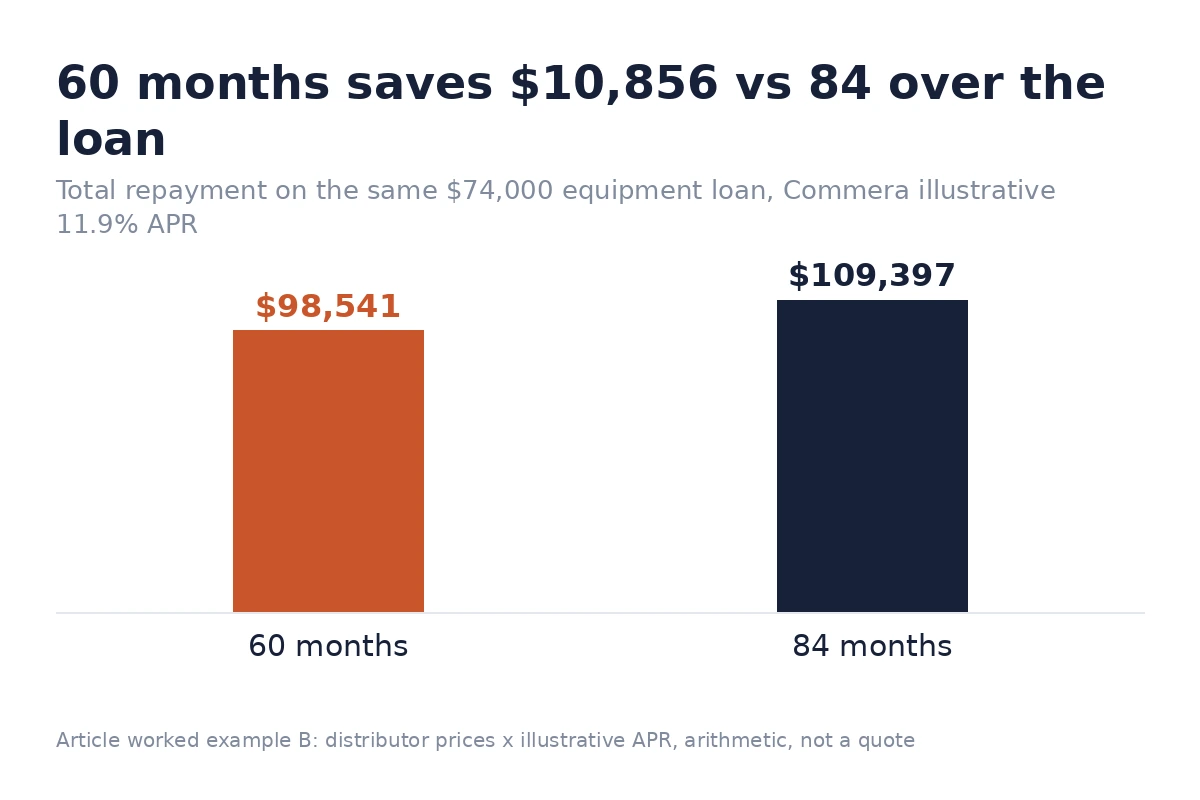
*On the same $74,000 equipment loan, stretching the term from 60 to 84 months adds $10,856 in total cost even as the monthly payment drops.*
Both examples below are Commera illustrative calculations. They are not offers, and the amounts are invented to show the mechanics.
Example A. Buying a $350,000 laundromat in leased space, illustrative.
| Line | Value |
|---|---|
| Purchase price (illustrative) | $350,000 |
| Buyer injection, 10% minimum | $35,000 |
| Loan amount (principal) | $315,000 |
| Term | 10 years, 120 payments, no real estate in the deal |
| Rate | Prime 7.00% plus the 4.50% maximum spread = 11.50% |
| Monthly payment | $4,428.76 |
| Total of 120 payments | $531,450.78, of which $216,450.78 is interest |
| Upfront guaranty fee, statutory maximum | $7,087.50 |
At a 75% guaranty the SBA-covered portion is $236,250, and 3% of that is $7,087.50 under 13 CFR § 120.220. The 4.50% spread is the SBA maximum for a loan of $250,001 to $350,000, not a rate anyone has quoted you. This is a variable rate tied to Prime, and the payment moves when Prime moves. Commera is a broker, not a lender.
Example B. Replacing 20 machines, illustrative.
Ten rebuilt 30 lb washers at $3,600 and ten rebuilt 30 lb stack dryers at $3,800 come to $74,000 at the distributor prices listed above as of September 22, 2026.
| Term | Principal | Illustrative APR | Monthly payment | Total of all payments |
|---|---|---|---|---|
| 60 months | $74,000 | 11.9% | $1,642.35 | $98,541.13 |
| 84 months | $74,000 | 11.9% | $1,302.35 | $109,397.24 |
The longer term cuts the payment by $340.00 and adds $10,856.11 in cost. Against a 10 to 15 year useful life for this class of machine, 84 months fits. On 12 lb to 14 lb top loaders at 5 to 8 years, it does not. To rerun this on your own quote, use our funding calculator.
The environmental question nobody asks until closing
Coin-operated laundries sit in NAICS 812310, inside group 8123. Group 8123 appears in Appendix 6 of SBA SOP 50 10 8.1, the list of environmentally sensitive industries. Two separate statements follow, and they are easy to blur together.
First, the general rule. Where there is a NAICS code match to an industry identified in Appendix 6, the environmental investigation must begin with a Phase I, regardless of the loan amount.
Second, the SBA entry in Appendix 6 carries a qualifier inside the line itself. It reads: "8123 LAUNDRY & DRY CLEANING SERVICES (if dry cleaning operations have ever existed on site)". The qualifier belongs to that entry, not to the general rule.
So the practical question is about the address, not the business. Ask the seller and the landlord in writing whether dry cleaning ever operated there. Tell your lender early. A Phase I adds weeks to a closing that has none of it budgeted.
If you are buying an operating store, line up the lease, the valuation and the site history before you sign a letter of intent. If you already own the store and only the machines are finished, skip the SBA file and price equipment financing against the useful life of what you are buying.
How hard is it to get a loan for a laundromat?
It is a normal SBA change of ownership file, not a special case. The hard parts are the fixed 10% injection, a lease that outlasts the loan, and a lender-ordered valuation that supports the price. Credit and cash flow still decide the outcome.
Can I finance laundromat equipment?
Yes. An equipment loan against the washers and dryers is the standard route when you already own the store, and the machines serve as collateral. A 7(a) loan can fund equipment too, up to 10 years, or 15 when the IRS asset class useful life supports the term.
Can you finance a laundromat like a house?
No, not when the space is leased. A leased store is a business purchase, so the loan is sized on cash flow and a business valuation rather than an appraisal of a building. Buying the real estate changes that, and its share can stretch to 25 years under SBA rules.
What down payment do lenders want to buy a laundromat?
For an SBA 7(a) first acquisition, 10% of total project cost, and SOP 50 10 8.1 says it cannot be reduced or eliminated. Certain limited sources supply no more than half of that injection. A 504 project asks 10% from an established business and 15% from a new one.
Can the seller finance part of the purchase?
Yes, and the treatment depends on standby. Seller debt subordinated to the lender and on full standby, meaning no principal or interest during the 7(a) term, may count toward equity. That note can be refinanced after 36 months in place and current. Outside standby, interest-only seller debt amortizes in 10 years or less.
What do lenders require to finance commercial laundry machines?
A written quote or invoice from the distributor, your financials and bank statements, and the machines as collateral. Rebuilt equipment is financeable, though the age of the units affects term and advance rate. Expect lease questions when machines are bolted into space you do not own.
What are the SBA loan laundromat requirements?
The same as any 7(a) file, plus three that bite in this industry. The lease has to equal or exceed the loan term, the valuation has to support the price, and a NAICS match in Appendix 6 sends the environmental review to a Phase I where dry cleaning has ever operated on site.
Can I get laundromat financing with bad credit?
Sometimes, at a price. SBA files are the hardest path with damaged credit, since the lender still documents repayment ability and character. Equipment financing on a smaller ticket is more realistic, usually with a larger down payment and a shorter term.
Will the government give me money to buy a laundromat?
No. SBA guarantees part of a loan made by a bank or a licensed nonbank lender, and it does not hand out money for a purchase. The guaranty is what lets a lender approve a goodwill-heavy deal it would otherwise decline.
Sources
- SBA, SOP 50 10 8.1, effective October 1, 2026: equity injection, maturities, lease requirements, rate caps, valuation, Quality of Earnings, Appendix 6 and Limited or Special Purpose Property. https://legacy.sba.gov/document/sop-50-10-lender-development-company-loan-programs
- 13 CFR § 120.220, statutory maximum SBA upfront guaranty fee.
- Federal Reserve, H.15 Selected Interest Rates, bank prime loan rate as of September 18, 2026, release dated September 21, 2026. https://www.federalreserve.gov/releases/h15/
- Coin Laundry Association, industry overview, accessed September 22, 2026: useful life of coin laundry equipment and typical lease length. https://laundryassociation.org/for-investors/industry-overview/
- Midwest Laundries, rebuilt commercial washers, prices as listed September 22, 2026. https://midwestlaundries.com/collections/rebuilt-commercial-washers
- Midwest Laundries, rebuilt commercial dryers, prices as listed September 22, 2026. https://midwestlaundries.com/collections/rebuilt-commercial-dryers
- Midwest Laundries, Speed Queen coin-operated front load washer product page, prices as listed September 22, 2026. https://midwestlaundries.com/products/speed-queen-coin-operated-frontload-washer-sfnncasp115tw01
- IRS Rev. Proc. 2025-32, § 4.24, Section 179 limits for tax year 2026. https://www.irs.gov/pub/irs-drop/rp-25-32.pdf
- IRS Notice 2026-11, 100% additional first year depreciation. https://www.irs.gov/newsroom/treasury-irs-issue-guidance-on-the-additional-first-year-depreciation-deduction-amended-as-part-of-the-one-big-beautiful-bill