

The short answer
An SBA franchise loan is an SBA 7(a) or 504 loan that a private lender makes to a franchisee whose brand is listed in the SBA Franchise Directory. The SBA does not hand you the money. It backs part of the loan, and the lender makes the credit decision. Some lenders call the same product a franchise SBA loan.
For a first unit in leased space, the usual SBA loan for franchises is a Standard 7(a). Per SBA SOP 50 10 8.1, a start-up puts in at least 10% of total project cost. For a franchise, that means the whole Item 7 budget in your FDD, not just the franchise fee.
The lender also reads the franchisor's numbers. SBA SOP 50 10 8.1, effective October 1, 2026, requires it to review failed franchisees and the franchisor's cash flow projections. Your file is judged on the brand as much as on you.
Commera is a broker, not a lender. We compare offers from our lender partners. Our business loans page covers the SBA 7(a) and 504 programs, and the rules below apply whichever lender writes your credit memo.
Is your brand in the SBA Franchise Directory?
If your brand meets the FTC definition of a franchise, it must be on the SBA Franchise Directory to get SBA financing. That rule comes from SOP 50 10 8.1. No listing means no SBA loan, however strong your credit is.
Check the Directory before you pay anything. A Commera count of the SBA Franchise Directory file dated September 29, 2026 shows 3,425 entries. Of those, 2,402 are marked as meeting the FTC definition of a franchise, per the same SBA file. These are entries, not unique companies.
Brand not listed? The franchisor, not you, sends the franchise agreement, the FDD and the other required documents to franchise@sba.gov for an eligibility review. Ask the franchisor where that request stands. Then build your timeline around the answer.
Two structures fail even when the brand is listed.
Master franchise. A Franchise Development Agreement, where you collect royalties from units other franchisees run, is ineligible. Area development rights, where you own and operate the extra units yourself, can be eligible.
Franchisor as manager. If the management company is the franchisor or its affiliate, the franchisee is ineligible.
One more point the SBA makes itself. On its Franchise Directory page, the agency states: "Placement of a franchise brand in the Directory is not an endorsement or approval of the brand and does not ensure the success of the business."
The listing opens the door. It does not vouch for the deal.
7(a) or 504: which SBA franchise loan fits your unit
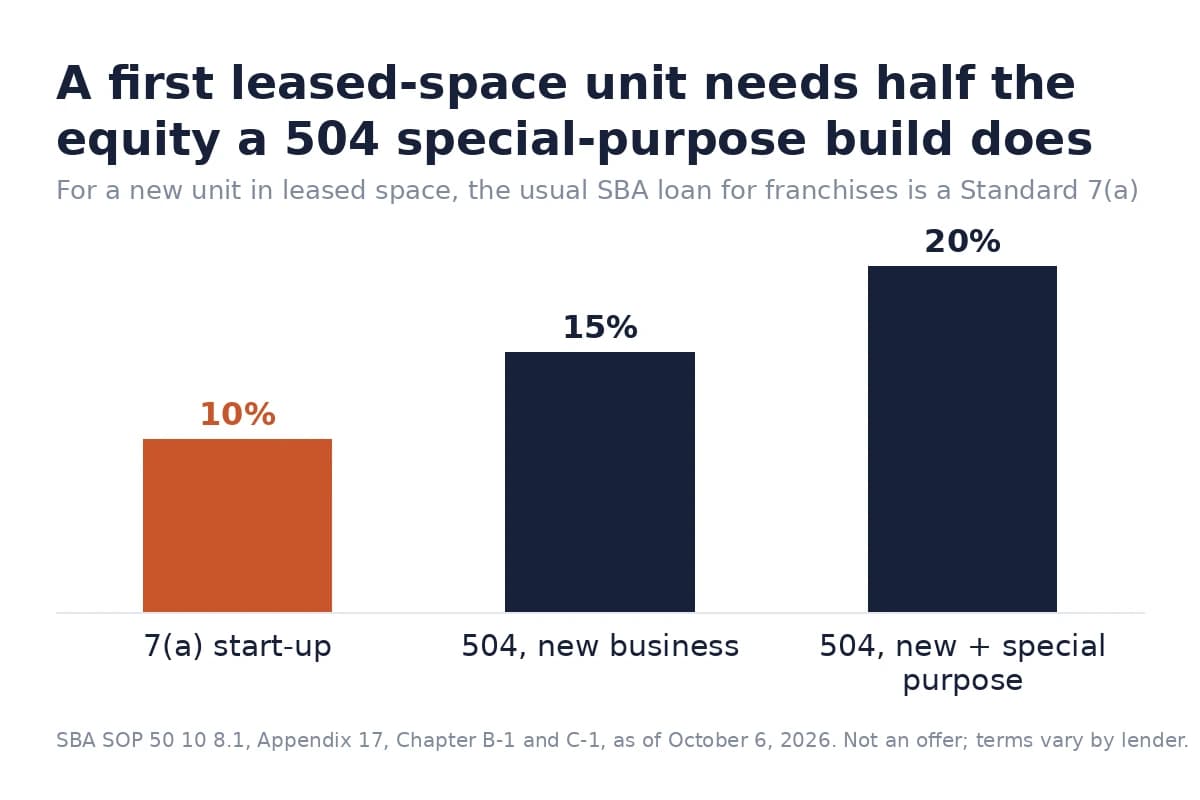
For a first franchise unit in leased space, an SBA 7(a) loan fits. It pays for the build-out, equipment, the franchise fee, inventory and working capital in one loan. The 504 program fits a different deal: you are buying or building the property, and a new business must put in a larger share.
| Program | Loan size | What it pays for in a franchise | Max term | Start-up equity | Max variable rate | Upfront fee, FY2027 |
|---|---|---|---|---|---|---|
| Standard 7(a) | Over $350,000, up to $5,000,000 | Franchise fee, build-out, equipment, inventory, working capital, real estate | 10 yrs for working capital and intangibles, 10 yrs for equipment (up to 15), 10 yrs for leasehold improvements (plus up to 12 mo), 25 yrs for real estate | 10% of total project cost | Prime + 3.0 | 3% of the SBA share up to $700,000 loan size, 3.5% to 3.75% above |
| 7(a) Small | Up to $350,000 | The same uses on a smaller unit | Same limits as Standard 7(a) | 10% of total project cost | Prime + 4.5 to Prime + 6.5, by loan size | 2% of the SBA share up to $150,000 loan size, 3% above |
| 504 | Set by the project | Fixed assets, such as buying or building the property | See the SBA 504 page | 15% for a new business, 20% if the building is special purpose | See the SBA 504 page | See the SBA 504 page |
Sources: SBA SOP 50 10 8.1, Appendix 17 and Chapters B-1 and C-1, SBA Information Notice 5000-881797, and the SBA 504 page, as of October 6, 2026.
Two numbers shape every 7(a) quote. Per SOP 50 10 8.1, the SBA backs 85% of loans up to $150,000 and 75% of larger ones, with a cap of $3.75 million per business. The upfront fee is charged on that SBA share, not on the full loan. Info Notice 5000-881797 also sets a 0% fee for loans up to $700,000 to manufacturers, food supply chain businesses and businesses in rural areas.
The rate cap moves with Prime. The bank prime rate was 7.00% on October 1 and 2, 2026, per Federal Reserve H.15. With the Prime + 3.0 cap in SOP 50 10 8.1, that puts the variable ceiling on a Standard 7(a) at 10.00%. For the full program mechanics, see how SBA loans work.
What the lender reads in your FDD
The lender reads your Franchise Disclosure Document as a credit file. It looks at what the unit costs, what the franchisor finances, how units perform and how many have closed. SOP 50 10 8.1 requires the lender to review "number of failed franchisees and cash flow projections provided by the franchisor".
| FDD item (16 CFR 436.5) | What it discloses | What the lender does with it |
|---|---|---|
| Item 5 | Initial fees | Checks the franchise fee inside your budget |
| Item 6 | Other fees, such as royalties and advertising | Subtracts them from your projected cash flow |
| Item 7 | "YOUR ESTIMATED INITIAL INVESTMENT", including "Additional funds" for at least 3 months | Sets total project cost and your 10% |
| Item 10 | Financing the franchisor offers | Checks for other debt in the deal |
| Item 19 | Financial performance representations, which are optional | Tests your projections against real units |
| Item 20 | Outlets opened, closed and transferred over 3 years | Counts failed units |
| Item 21 | The franchisor's audited financial statements | Judges whether the franchisor can support you |
Source: FTC Franchise Rule, 16 CFR 436.5, for the FDD items, and SBA SOP 50 10 8.1 for the 10% equity rule.
Item 19 is optional under 16 CFR 436.5, so a franchisor is not required to publish one. Without it, your projections stand alone, and the lender will push harder on every assumption.
Timing works in your favor. Under 16 CFR 436.2(a), the franchisor must give you the FDD at least 14 calendar-days before you sign a binding agreement or pay. Use that window to get a lender's read. The legal terms are a separate job, so consult a franchise attorney.
The 10% equity injection: what counts and what doesn't
A franchise start-up must inject at least 10% of total project cost under SOP 50 10 8.1. Per the same SOP, the SBA treats a business with one year or less of revenue as a start-up. Total project cost means all costs to become operational, so for a franchise the base is the full Item 7, including additional funds.
| Source of the 10% | Counts under SOP 50 10 8.1? | Condition |
|---|---|---|
| Cash that is not borrowed | Yes | From savings or the business account |
| Personal loan, including a HELOC | Yes | Repaid from a source other than the business |
| Grant | Yes | No repayment or clawback during the life of the 7(a) loan |
| Debt on full standby | Yes | No principal or interest paid for the term of the 7(a) loan |
| Prepaid project expenses | Yes | Verified with paid invoices or canceled checks |
| Training, consulting, agent commissions | No | Not eligible as equity |
The franchise fee you already paid is a gray area. Ask your lender whether it counts as an eligible prepaid expense before you plan around it.
Home equity is the common gap filler. A HELOC is a personal loan, so the repayment test applies: the lender wants to see it serviced from income other than the new unit, such as a spouse's salary. Read more on using home equity before you draw on it.
The 504 program asks for more. Under SBA SOP 50 10 8.1, every 504 borrower contributes at least 10%, a new business at least 15%, and a new business with a special-purpose building at least 20%.
Worked example: one new unit with a $600,000 Item 7
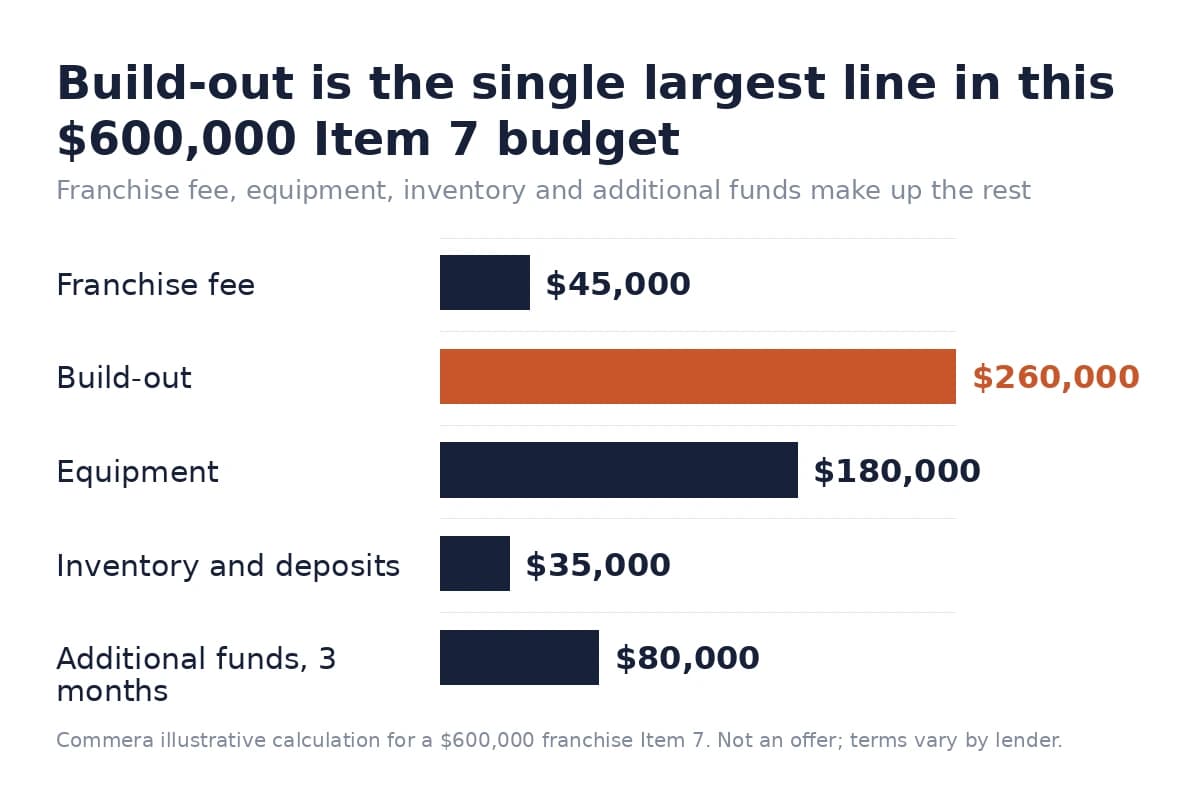
In a Commera illustrative calculation, a $600,000 Item 7 means $60,000 of your own money and a $540,000 Standard 7(a) loan. At the SBA rate ceiling as of October 6, 2026, the same illustrative calculation gives a payment of $7,136.14 a month. It is not an offer.
Methodology: Illustrative calculation with assumed figures: a first unit in leased space, a hypothetical $600,000 Item 7 and a 10% injection. The loan is a Standard 7(a) at the SOP 50 10 8.1 rate ceiling, with Prime at 7.00% per Federal Reserve H.15. The term is 120 months with level monthly payments, plus the FY2027 upfront fee per Information Notice 5000-881797. This is not a loan offer and not a real deal.
The unit is a first location in leased space. Its Item 7 breaks down like this:
| Item 7 line | Amount |
|---|---|
| Franchise fee | $45,000 |
| Build-out | $260,000 |
| Equipment | $180,000 |
| Inventory and deposits | $35,000 |
| Additional funds, 3 months | $80,000 |
| Total project cost | $600,000 |
The financing follows from that total:
| Figure | Amount |
|---|---|
| Equity injection, 10% of $600,000 | $60,000 |
| Principal, Standard 7(a) | $540,000 |
| SBA share, 75% of $540,000 | $405,000 |
| Upfront fee, 3% of $405,000, paid from your funds | $12,150 |
| Rate, Prime 7.00% + 3.0, variable | 10.00% |
| Term | 120 months |
| Monthly payment | $7,136.14 |
| Annual debt service | $85,633.68 |
| Total repayment, 120 payments | $856,336.77 |
| Interest over the term | $316,336.77 |
| Estimated APR, with the upfront fee | about 10.55% |
The 10.00% is the SBA ceiling for a loan this size as of October 6, 2026, per SBA SOP 50 10 8.1 and Federal Reserve H.15. Your lender can price below it. The rate is variable, so the payment moves with Prime.
Commera is a broker and does not set rates. The total repayment uses the unrounded payment. Without the fee, the illustrative APR equals the 10.00% rate.
In this illustrative case, your cash at closing is $72,150: the $60,000 injection plus the $12,150 fee.
Now the test that decides the file. SBA SOP 50 10 8.1 asks a start-up to project debt service coverage of 1.15 within 2 years. In this illustrative calculation, 1.15 × $85,633.68 means the unit needs about $98,479 a year of cash flow for debt service by year two.
Compare the illustrative $98,479 with Item 19. Then compare it with the closures in Item 20. If typical units clear it easily, the deal has room.
If they barely clear it, the lender will see that too. To see where your own numbers land first, check what your profile qualifies for.
Who qualifies: ownership, guaranties and your house
Per SBA SOP 50 10 8.1, from October 1, 2026, 100% of the owners and guarantors must be U.S. Citizens or U.S. Nationals who live in the United States.
Lawful Permanent Residents are now listed as Ineligible Persons, a change from SOP 50 10 8, which allowed them.
Personal guaranty. Per SBA SOP 50 10 8.1, anyone who owns 20% or more must sign an unlimited personal guaranty. For a first unit, that usually means you, and any partner above that line.
Your house. The house enters only when collateral runs short. Per SOP 50 10 8.1, Appendix 19, if business assets do not fully secure the loan, the lender must take available equity in personal real estate solely owned by owners of 20% or more, co-borrowers and guarantors except Supplemental Guarantors. Under the same appendix, the SBA does not require that lien when the equity is less than 25% of the property's market value.
Credit score. SOP 50 10 8.1 sets no minimum credit score for a Standard 7(a). Any floor you hear comes from the lender's own policy, so ask each lender for it.
Cash flow. On top of the unit's own coverage test from the worked example, SOP 50 10 8.1 requires 1:1 coverage on a global basis.
Documents and timeline
A lender needs the franchise documents, your budget, your projections and proof of your equity. Per SOP 50 10 8.1, the franchise agreement must be signed before the first 7(a) disbursement. Timing runs from the FDD delivery to the day funds move.
| Document | Why the lender needs it |
|---|---|
| FDD | Credit review of the brand, Items 5 to 21 |
| Franchise agreement and every other document the franchisor requires you to sign | Must be executed before the first 7(a) disbursement |
| Item 7 budget, line by line, with landlord and contractor quotes | Sets total project cost |
| Projections with assumptions | Must pass the coverage test in the worked example |
| Proof of the 10%: bank statements, paid invoices, standby or grant paperwork | Verifies the source of equity |
| Ownership details for every owner and guarantor | Citizenship and the 20% guaranty line |
| Personal tax returns and bank statements | As the lender requests |
On timing, Commera's business loans page illustrates SBA 7(a) at 30 to 90 days. Every timeline is subject to underwriting and varies by lender.
Sequence matters. Get the FDD, get a lender's view before you sign, sign the agreement, then close. A short pre-qualification with no hard credit pull lets Commera compare offers from lender partners for your file before you commit.
New unit or an existing franchise location?
Buying an existing franchise unit changes the underwriting. Under the SBA 10% rule, a unit with more than a year of revenue is no longer a start-up. A purchase is a change of ownership, with its own equity rules and coverage tests.
The lender then reads that unit's actual results instead of the franchisor's projections. Item 20 transfer data tells you how often units in the system change hands. The Directory check still applies to the brand.
The rest of the mechanics, from valuation to seller notes, belong to a loan to buy an existing business.
Which path fits your deal
If your brand is on the Directory and your equity injection is in place → get two or three lender reads before you sign the franchise agreement.
If your brand is not on the Directory → ask the franchisor to apply for a listing, and do not sign until it is confirmed.
If your projections fail the coverage test in the worked example → cut the build-out, raise the equity or pick a different unit before you apply.
If any owner is not a U.S. Citizen or U.S. National → restructure ownership before you apply, as set out in the qualification section above.
If SBA does not fit at all → non-SBA franchise financing, such as ROBS, franchisor financing or leasing, is a separate set of tools with its own costs.
Broker disclosure: Commera Finance is a broker, not a direct lender. Financing providers make their own eligibility, underwriting, approval, pricing, and term decisions.
Sources
- SBA, SOP 50 10 8.1, effective October 1, 2026
- SBA, Support: SBA Franchise Directory, and Franchise Directory file dated September 29, 2026, counts by Commera
- SBA Information Notice 5000-881797, FY 2027 7(a) Program Fees, effective October 1, 2026
- Federal Reserve, H.15 Selected Interest Rates, bank prime loan rate
- FTC Franchise Rule, 16 CFR Part 436, sections 436.2(a) and 436.5
- SBA, 504 loans
- SBA, Lender Match