
Overview
A working capital loan covers the time between paying operating costs and collecting customer cash. A business might use one to buy inventory, make payroll while invoices are open, or prepare for a seasonal rush.
The right structure depends on whether the gap repeats. A revolving line may fit a recurring cycle. A term loan may fit a fixed project. The wrong match can turn a short gap into long term debt.
That is why working capital financing should match the operating cycle. A working capital line of credit may fit a repeatable gap, while fixed-use working capital loans may fit a defined need.
Keep the use case separate from nearby products. A business debt consolidation loan replaces existing obligations. The phrase business loans no personal guarantee describes a requested guaranty structure, not the operating purpose of a working capital facility.
What a working capital loan funds
Working capital is cash tied up in normal operations. A lender may review receivables, inventory, payables, bank activity, margins, and how quickly assets turn back into cash. The OCC handbook describes receivables and inventory financing as credit secured by working assets and repaid as inventory sells and customers pay.
Common uses include:
- inventory for a documented sales increase
- payroll, freight, or materials for work in progress
- a temporary delay in customer payments
- launch costs for a known location or product
- a cash buffer while an operating change takes effect
It is a poor fit for owner distributions, a product that loses money with no repair plan, or a permanent deficit. Debt cannot fix weak unit economics.
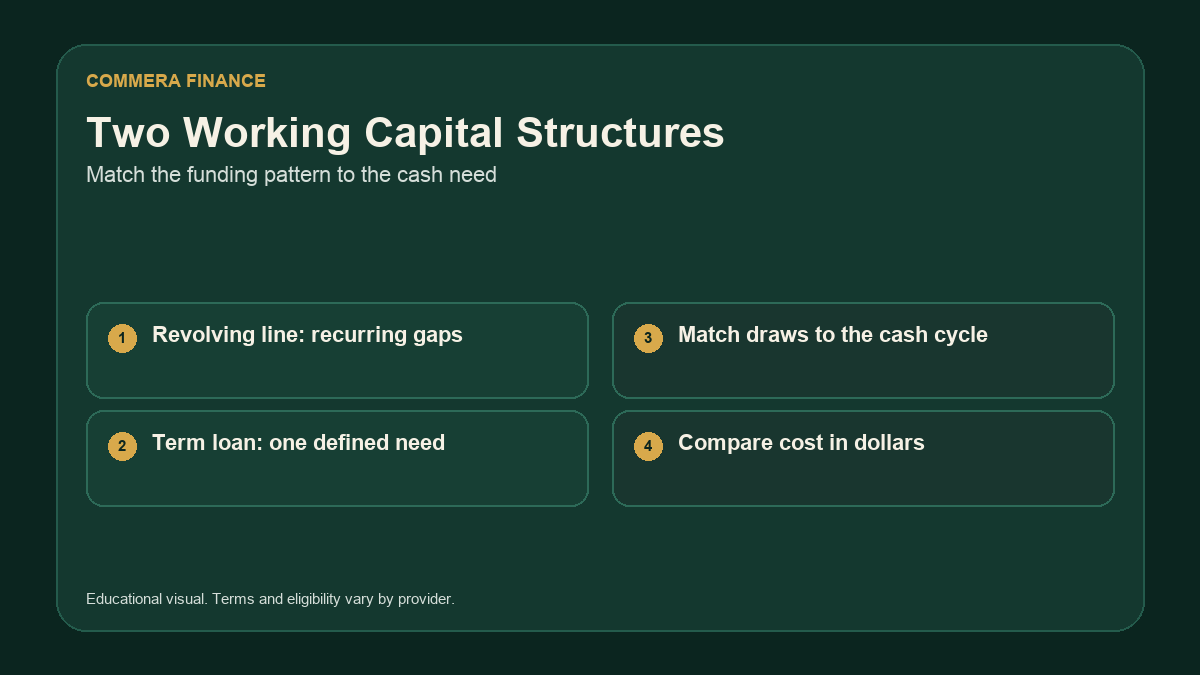
*A line can match a repeating cycle, while a term loan can match a fixed use.*
Line of credit or term loan
Both products may be called working capital loans, but they work differently.
| Feature | Revolving line | Term loan |
|---|---|---|
| Funding | Draw, repay, and draw again up to the limit | One advance at closing |
| Common fit | Repeating timing gaps | One defined need |
| Interest base | Usually the amount drawn | Outstanding principal |
| Paydown | Flexible, subject to the agreement | Scheduled payments |
| Main risk | The balance never falls | Payments outlast the funded benefit |
A revolver usually funds short term assets, with inventory sales and receivable collections paying down advances. The OCC explains this cycle. FDIC commercial lending guidance also describes lines that fund seasonal growth in inventory and receivables and stresses a clear repayment source. The SBA Working CAPLine works in a similar cycle, although collateral monitoring may add lender fees, as noted in the SBA lender program guide.
A term loan forces steady principal reduction. That can help when a fixed investment produces cash over time. But a three-year loan is a poor match for a forty-five-day collection delay because payments continue after the invoices are paid.
SBA program benchmarks, not an individual offer
Published program limits provide context, but they do not predict a lender's decision:
- According to the SBA 7(a) overview, the overall program maximum is $5 million.
- According to the SBA 7(a) Working Capital Pilot table, that pilot offers lines up to $5 million.
- According to the same SBA Working Capital Pilot table, its published maximum maturity is 60 months.
- According to that SBA table, the published federal risk share is 85 percent for $150,000 or less and 75 percent above $150,000.
Actual amount, price, maturity, collateral, and reporting duties depend on the program and underwriting. Compare a term structure with a business line of credit when the cash gap repeats.
Size the need around the cash cycle

The cash conversion cycle estimates how long operating cash stays tied up:
CCC = inventory days + collection days - supplier payment days
This is a model. Annual averages may hide weekly cash spikes, late accounts, old stock, tax payments, and minimum cash needs. Use current records, then compare the result with a thirteen-week cash forecast.
Worked example
Methodology: This author calculation uses only the stated illustrative assumptions. It is not an observed applicant result or a recommended loan amount.
For example, assume a distributor reports $1,825,000 in annual cost of goods sold, $2,920,000 in annual credit sales, 42 inventory days, 38 collection days, 25 supplier payment days, and a desired $40,000 cash buffer.
| Illustrative cash-cycle component | Calculation | Result |
|---|---|---|
| Inventory investment | $1,825,000 / 365 x 42 | $210,000 |
| Receivables investment | $2,920,000 / 365 x 38 | $304,000 |
| Supplier financing | $1,825,000 / 365 x 25 | $125,000 |
| Operating cash need | $210,000 + $304,000 - $125,000 | $389,000 |
| Total with stated buffer | $389,000 + $40,000 | $429,000 |
| Cash conversion cycle | 42 + 38 - 25 | 55 days |
For example, the $429,000 result is a starting estimate, not a recommended loan amount. Subtract cash already available and reconcile the result to the forecast.
For example, delaying collections from 38 to 53 days changes receivables to $2,920,000 divided by 365 times 53, or $424,000. The delay adds $120,000 to the modeled need, producing a stress-case estimate of $549,000.
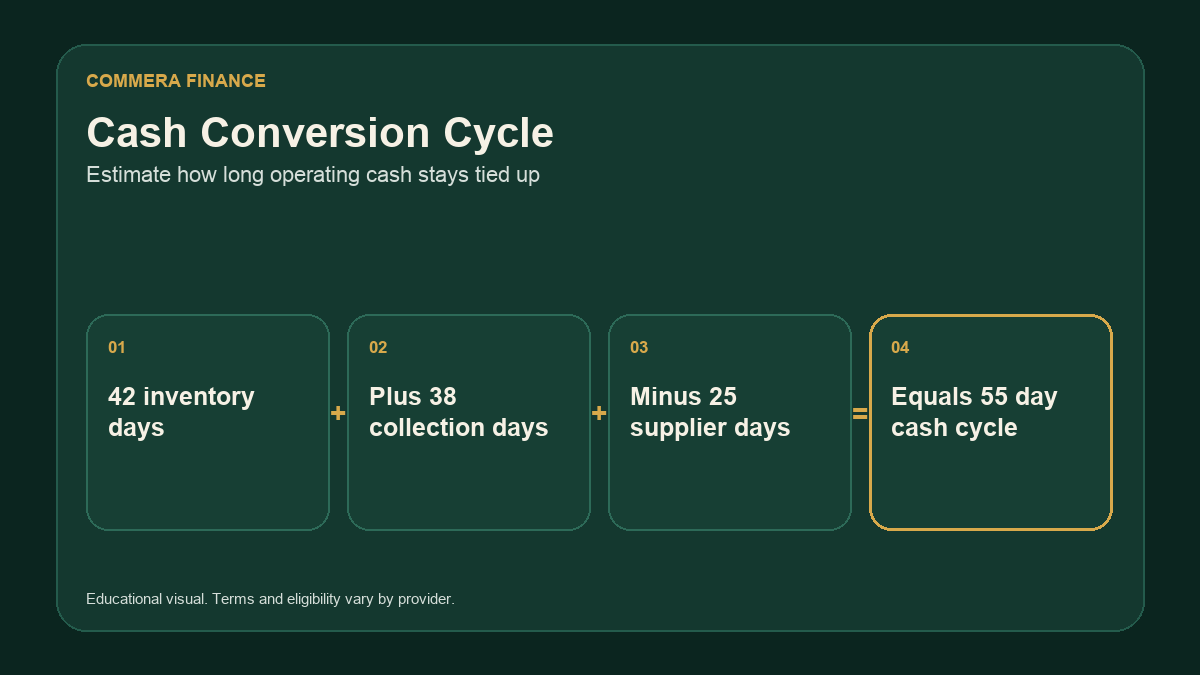
*Use current operating data and test the result against a thirteen-week cash forecast.*
Match each planned draw to a purchase, invoice, or payroll date, then show the collection event expected to reduce principal. If the forecast cannot show that path, pause before comparing offers.
What does a working capital loan cost?
There is no universal rate. Cost varies with the product, lender, collateral, risk, term, draw pattern, and fees. Compare offers in dollars and dates.
For a line, ask for the interest index and margin, rate change rules, origination and renewal fees, unused line fees, monitoring charges, minimum draw rules, default pricing, and termination terms. Confirm whether customer payments must enter a lockbox.
For a term loan, request the payment schedule, total payments under the stated assumptions, fees withheld from proceeds, and prepayment terms. For example, if an illustrative approved amount is $100,000 but $4,000 is withheld, usable proceeds are $96,000.
SBA 7(a) rates are negotiated and subject to program maximums where they apply. Most working capital maturities are ten years or less, according to the SBA program comparison. The SBA guaranty protects the lender on the SBA-backed portion. The borrower still owes the debt.
Do not treat a monthly rate, factor rate, and annual percentage as the same unit. Ask for cash received, every payment, payment frequency, and total dollars paid. The FTC has alleged that some merchant cash advance providers collected more than represented and misstated terms, as described in this FTC case summary. Read the contract and debit authorization.
Who may qualify?
Approval is lender specific. There is no marketwide minimum score, revenue, or time in business. Lenders commonly review:
- cash flow and repayment capacity
- business and owner credit where applicable
- operating history and management experience
- margins, revenue stability, and customer concentration
- existing debt, liens, and collateral
- receivable aging and inventory quality
- the purpose and timing of the request
- guarantees and owner equity
SBA lender lifecycle guidance says lenders may consider credit history, cash flow, equity, and collateral and must find reasonable assurance of repayment. The Federal Reserve's July 2025 survey found that modest net shares of banks tightened some terms for small firm commercial credit during that quarter, including collateral requirements, line sizes, maturities, and covenants (Federal Reserve SLOOS). That finding describes one survey period, not the likely result of one application.
Build the file around the cash gap. Include financial statements, tax returns, aging reports, a debt schedule, and a thirteen-week forecast. Reconcile every report to the same date.
Match the structure to the job
Use this sequence:
- Name where cash is trapped.
- Mark when cash leaves and what event brings it back.
- Decide whether the need repeats.
- Delay collections and raise costs in the model.
- Confirm repayment without assuming a record month.
- Compare usable proceeds and total dollars paid.
- Review liens, guarantees, and reporting duties.
SBA CAPLines are designed for short term and cyclical needs, while standard 7(a) term loans may fund permanent working capital (SBA lender resources). Ask which structure is actually being offered.
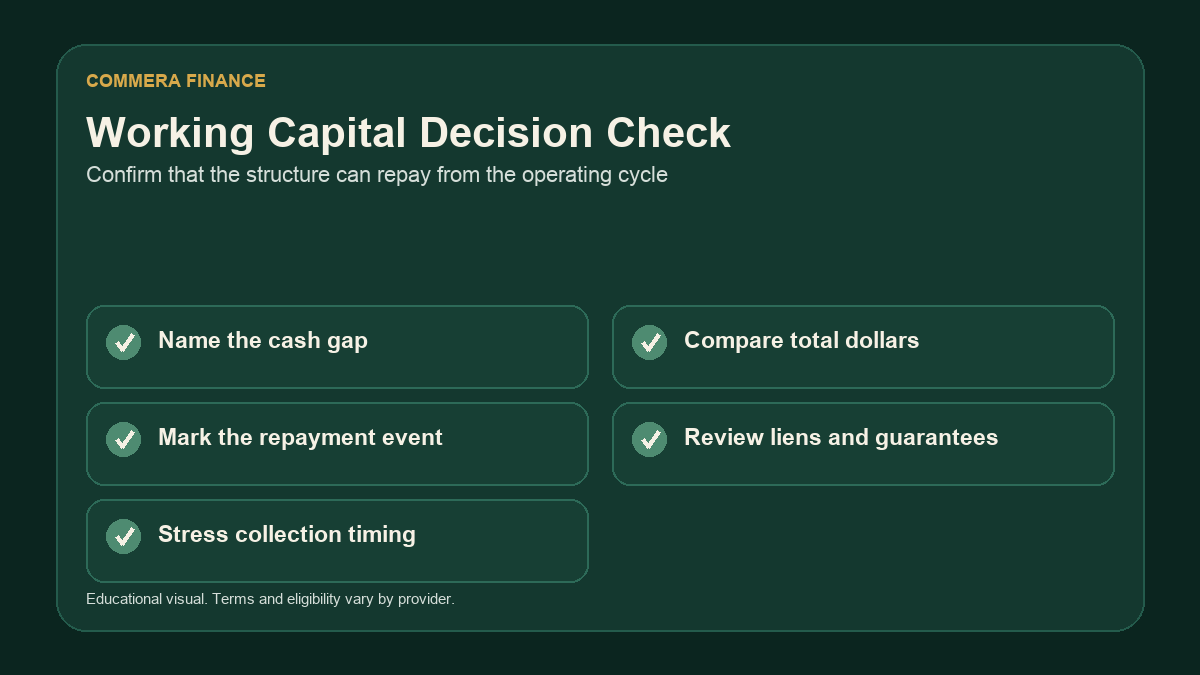
*A supportable request connects every draw to a clear operating use and repayment event.*
Watch for a balance that never falls
For example, suppose a distributor draws $250,000 for holiday stock. Sales arrive more slowly than expected, and margin is lower. Collections cover suppliers and payroll, so for example, the line falls only to $240,000 before the next buying season. A temporary cycle has become permanent leverage.
The OCC handbook warns that permanent working capital left in a revolver may need conversion to amortizing debt. A base forecast that never shows a meaningful paydown is not a seasonal plan.
Before a final application, rehearse one full draw. Record the draw date, net proceeds, asset created, collection date, and expected low balance. Run the same test with a thirty-day customer delay. A funding readiness audit can use that forecast and the supporting reports, while the lender still controls approval and terms.
Is every working capital loan a line of credit?
No. The phrase describes the use of funds. The product may be a revolver, a term loan, or another structure.
Can a lender take collateral on a product called unsecured?
Possibly. Review the note, security agreement, UCC authorization, and guaranty. The signed terms control.
What is a cleanup period?
It requires the line balance to fall to zero or another stated level for a set time. It tests whether collections really retire the seasonal borrowing.
What should the review show at the end?
It should show when cash leaves, what operating asset is created, how cash returns, and the projected low balance after collection. That calendar is more useful than the loan label.
Broker disclosure: Commera Finance is a broker, not a direct lender. Financing providers make their own eligibility, underwriting, approval, pricing, and term decisions.