

What is a debt service coverage ratio?
A debt service coverage ratio is a lender's measure that compares a business's operating cash flow with the principal and interest it must pay on all business debt. Per SBA SOP 50 10 8.1, the ratio is operating cash flow divided by debt service.
DSCR = operating cash flow ÷ annual debt service
The SBA defines both parts. Under the same SOP, operating cash flow is EBITDA: earnings before interest, taxes, depreciation, and amortization. Debt service is the future required principal and interest on all business debt, including the new loan.
That last part matters most. The lender does not test the new loan alone, but the new payment on top of everything you already owe.
A ratio above one means cash flow covers the payments with room left over, and a ratio below one means it does not.
The SBA rules in effect since October 1, 2026, per SOP 50 10 8.1, are the clearest public version of this test. For how the program itself works, see our guide to SBA loans.
Commera is a broker, not a lender. We compare offers from our lender partners.
How to calculate DSCR step by step
To calculate DSCR, divide one year of operating cash flow by one year of debt payments. Measure both the way the lender will. Five steps get you there.
1. Start with EBITDA. Take net income from your tax return or income statement. Add back interest, taxes, depreciation, and amortization. Per SBA SOP 50 10 8.1, an existing business supplies three years of historical financials plus an interim statement.
2. Adjust for items you can document. Under the same SOP, the lender must justify each addition or subtraction to cash flow. The SOP lists unfunded capital expenditures, non-recurring income, distributions, S-corp tax distributions, rent payments, and owner's draw.
Each adjustment moves the ratio: a documented one-time cost added back raises it, and owner's draw taken out lowers it. How distributions are taxed is a separate question, so consult a tax advisor.
3. List every business debt. Include equipment loans, vehicle notes, lines of credit, and loans from shareholders. The SBA asks for a current debt schedule that includes shareholder debt, per SOP 50 10 8.1.
For 7(a) Small loans, the same SOP has the lender review two months of bank statements. The goal is to confirm that every debt made it into the calculation. A payment on the statement that is missing from your schedule will raise questions.
4. Annualize the payments, including the new loan. Multiply each monthly payment by 12. For the new loan, use the full amortizing payment on its scheduled term, not an interest-only or deferral period.
5. Divide. Adjusted EBITDA divided by total annual debt service is your DSCR. Run it on the last full year first, then again with the new payment added.
What DSCR lenders look for on a business loan
Lenders look for a DSCR at or above a floor. On SBA loans, that floor is written into SBA SOP 50 10 8.1, and it changes with the loan type.
| Loan type | Minimum DSC, ratio | Cash flow basis |
|---|---|---|
| Standard 7(a), loans over $350,000 | 1.15 | Historical and/or projected |
| Standard 7(a), global basis | 1.00 | Business, owners, and affiliates together |
| 7(a) Small, except change of ownership | 1.10 | Historical or projected |
| Start-up or projections, Standard 7(a) | 1.15 within 2 years of funding | Projected |
| Change of ownership: Initial Acquisition | 1.25 | Last fiscal year-end or 2-year average |
| Change of ownership: Business Expansion | 1.15 | Last fiscal year-end or 2-year average |
| Change of ownership: Owner Buyout | 1.25 | Last fiscal year-end or 2-year average |
Source: SBA SOP 50 10 8.1, Chapters B-1 and B-2 and Appendix 15, effective October 1, 2026.
Global DSC is the wider test. It looks at the owners' personal income and debts and at any affiliated business, alongside the applicant. A weak affiliate can pull the global number down even when the business itself clears its floor.
Buying a business has its own floors because the lender reads the seller's results. Per SOP 50 10 8.1, historical DSC on a purchase is EBITDA divided by combined debt service after the transaction. The deal mechanics are in our guide to a business acquisition loan.
Banks lending outside the SBA program set floors by their own credit policy. Ask each lender which floor applies to your file and which cash flow figure it starts from.
A DSCR above the floor meets the SBA minimum. It is not an approval.
Worked example: how a line of credit or an MCA changes your DSCR
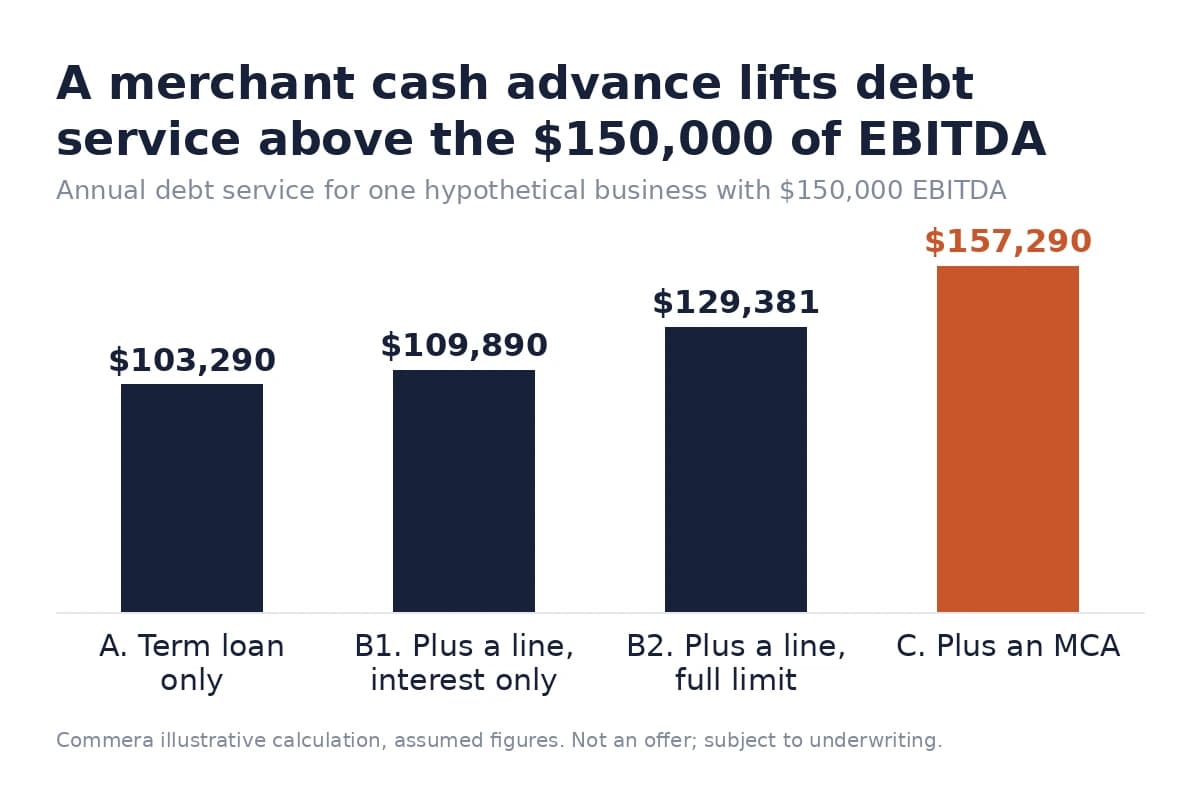
A line of credit or a merchant cash advance can move DSCR more than the term loan itself. It depends on how the lender counts it. In a Commera illustrative calculation, the same business drops from a comfortable margin to below one.
Methodology: Commera illustrative calculation with assumed figures, not a loan offer and not a real deal. One hypothetical business has EBITDA of $150,000 a year and pays $2,000 a month on equipment. Scenario A adds a Standard 7(a) loan at 10.00%, which is Prime of 7.00% on October 22, 2026, per Federal Reserve H.15, plus the 3.0 maximum spread under SBA SOP 50 10 8.1.
Scenarios B1 and B2 add a revolving line with no draw or maintenance fees, an assumption. Scenario C adds a merchant cash advance repaid in full within the next 12 months. Amounts, payments, and fees for each product are in the disclosure table below. All terms are subject to underwriting.
| Scenario | What the lender adds | Annual debt service, $ | DSCR, ratio |
|---|---|---|---|
| A. Term loan only | Existing equipment payment plus the new 7(a) payment | 103,290.44 | 1.45 |
| B1. A plus a line, interest on the drawn balance | Interest-only minimum on the line | 109,890.44 | 1.36 |
| B2. A plus a line, full limit amortized | Limit treated as a 60-month loan at 11.00%: $26,090.91 a year | 129,381.35 | 1.16 |
| C. A plus an MCA | Every advance payment due in the next 12 months | 157,290.44 | 0.95 |
Each product in the example has its own terms, and the table shows them side by side.
| Disclosure item | Term loan, Scenario A | Line of credit, B1 and B2 | MCA, Scenario C |
|---|---|---|---|
| Amount or limit, $ | 500,000 | 100,000 limit, 60,000 drawn | 40,000 |
| Price | 10.00% variable rate | 11.00% on the drawn balance | Factor rate 1.35 |
| Term | 120 months | Revolving | 126 business days |
| Payment, $ | 6,607.54 a month | 550 a month, interest only | 428.57 each business day |
| Total repayment, $ | 792,904.42 | Depends on draws and repayment | 54,000 |
| Fees, $ | SBA upfront fee 11,250 | 0 draw and maintenance fees, assumed | None included |
| Est. APR | About 10.55% | About 11.0% | About 126% |
The rate on the term loan is not its APR. The $11,250 fee is 3% of the SBA share of $375,000, per SBA Information Notice 5000-881797. That share is 75% of the loan for loans over $150,000, per SOP 50 10 8.1.
In this illustrative calculation, the est. APRs are internal rates of return on the payment dates. The term loan APR treats the fee as deducted from the $500,000 at closing.
The line APR equals its rate because this illustrative example assumes no fees. The MCA APR runs across 126 daily payments, annualized on 252 business days. Factor rates do not represent APR.
Scenario A clears the Standard 7(a) floor with room. Cash flow covers every payment, and a cushion is left over for a slow month.
The line of credit splits on lender method. One lender counts only interest on the drawn balance, while another treats the whole limit as a 60-month loan. Same business, same line: 1.36 or 1.16.
Read how a business line of credit is priced before you open one ahead of an application.
The MCA pushes the ratio below one. A merchant cash advance is repaid fast, so its whole repayment lands inside one year of debt service. In this illustrative calculation, counted as the $54,000 actually due in the next 12 months, DSCR is 0.95.
Some lenders annualize the daily payment instead. In the illustrative case, $428.57 × 252 business days is $108,000, twice what is really owed in that year, and DSCR falls to 0.71. The method depends on the lender, so ask which one it uses.
How much can your business borrow at a given DSCR?
The most your business can borrow at a given DSCR is the payment its cash flow carries at the floor, turned back into a loan amount. Work it backward from the formula.
Maximum new annual debt service = EBITDA ÷ DSCR floor minus current annual debt service
Then convert that annual payment into a loan amount at the rate and term you expect. The table uses the same hypothetical business: EBITDA of $150,000 and $24,000 a year of existing payments. In this Commera illustrative calculation, the new loan has the same rate and 120-month term as Scenario A.
| DSCR floor, ratio | Max total debt service, $ a year | Max new debt service, $ a year | Max new loan, $ |
|---|---|---|---|
| 1.10 | 136,363.64 | 112,363.64 | About 708,557 |
| 1.15 | 130,434.78 | 106,434.78 | About 671,170 |
| 1.25 | 120,000.00 | 96,000.00 | About 605,369 |
Read the first row with care. Per SOP 50 10 8.1, Standard 7(a) covers loans over $350,000, and its floor is the one in the second row. A loan of about $708,557 is tested at that higher floor, not at the 7(a) Small one.
Each step up in the floor cuts the loan the same cash flow supports. The rate matters too. On a variable rate, a higher Prime raises the payment and shrinks every number in the table.
These are capacity figures, not offers. Equity, collateral, and credit still shape the final amount, and every figure is subject to underwriting.
How to raise your DSCR before you apply

You raise DSCR by raising documented cash flow or by lowering annual debt service before the lender runs the numbers. Each lever below comes straight from the formula.
Ask for the longest term the use allows. A longer amortization means a smaller annual payment. Per SBA SOP 50 10 8.1, working capital and intangible assets run up to 10 years, and equipment generally up to 10, or up to 15 when the IRS useful life supports it. Terms are subject to underwriting.
Pay off or refinance expensive short debt. In the worked example, the advance alone moved the ratio below one. Short, high-payment debt weighs on DSCR far more than its balance suggests.
Document one-time costs. Under the SOP, non-recurring items need justification. Keep the invoices that show a cost will not repeat.
Do not take on new debt before you apply. A new payment shows up in your bank statements, and the lender will add it to debt service.
Ask for less. The table above shows how loan size and DSCR trade off. A smaller request can land a file above the floor.
None of these steps decides the outcome, because the lender still weighs credit, collateral, and history. Our business loans page covers SBA 7(a) and the other term options we compare across lender partners. To see where your numbers land first, check whether you may qualify.
Broker disclosure: Commera Finance is a broker, not a direct lender. Financing providers make their own eligibility, underwriting, approval, pricing, and term decisions.
Sources