
Overview
A large purchase order uses cash before it creates profit. The supplier may require payment while the customer pays after delivery. Purchase order financing can pay a supplier for goods tied to a verified order.
The order still needs enough gross profit to absorb financing, freight, delays, rejects, and overhead. Revenue alone does not repay the facility. Accepted delivery and customer payment do.
PO financing and purchase order funding are common names for this transaction structure. A business trying to finance a large customer order should model delivery and settlement before accepting the order.
Search intent matters. Purchase order financing funds supplier performance against an accepted order. It is different from franchise financing, restaurant equipment financing, and seller financing a business. Searches for SBA franchise loan, SBA loan for franchises, franchise SBA loan, or SBA franchise lenders concern franchise funding rather than supplier payment for a specific customer order.
What purchase order financing does
In a common structure, a financer pays a supplier for goods already ordered. An International Factoring Association publication describes funding presold inventory when suppliers want payment at shipment. The resulting receivable may then be factored to repay the PO facility.
SFNet describes PO finance as funding before shipment and notes that a senior lender may advance against the receivable after delivery to pay the PO financer.
This is transaction funding, not unrestricted working capital. Payment may use a wire, letter of credit, or another agreed method. The financer may monitor inspections, shipping papers, delivery, and the receivable.
For exporters, government supported working capital may fund inputs tied to export orders. The International Trade Administration describes funding goods and services for export sales. The SBA lender resources say the Export Working Capital Program supports eligible exporters and generally relies on export inventory and foreign receivables as collateral. These programs have separate rules.
Export program benchmarks, not private PO finance terms
Government export programs are separate from private purchase order financing, but their published boundaries can help an exporter identify alternatives:
- According to the International Trade Administration, SBA Export Working Capital financing can provide up to $5 million for short-term, transaction-specific export needs.
- According to the SBA lender guide, the Export Working Capital Program can carry a maximum federal risk-sharing percentage of 90 percent.
- According to the same SBA lender guide, Export Working Capital revolving terms are 36 months or less.
Those program figures are not private PO financing prices and do not predict eligibility. A business should compare them with supplier terms, a business line of credit, and receivables financing where each structure is available.
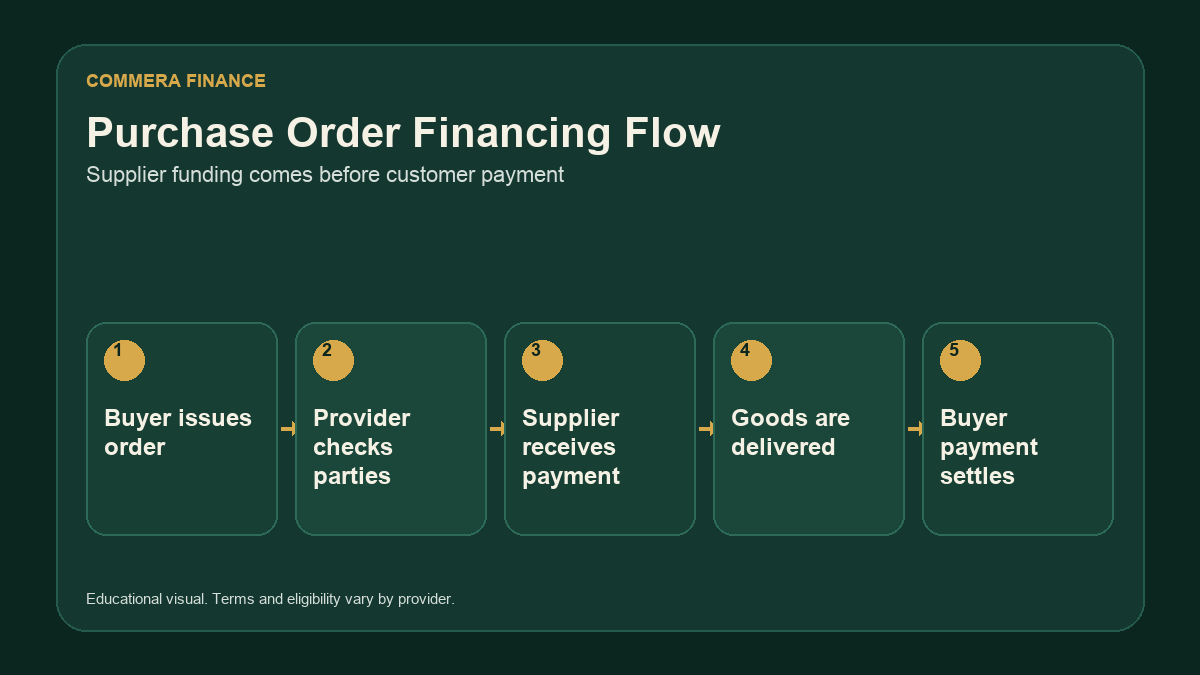
*In a normal settlement flow, buyer payment repays the facility after delivery and acceptance, subject to the contract's recourse and short-payment terms.*
How goods and money move

A simple flow has five steps:
- The buyer sends your business a purchase order.
- The financer verifies the buyer, supplier, order, and documents.
- The financer pays or assures payment to the supplier.
- The supplier produces and ships the goods under the approved plan.
- The buyer accepts the goods and pays a controlled account. The financer receives principal and fees, and the remaining cash goes to your business.
The flow may include a warehouse, inspector, freight forwarder, or factor. The OCC receivables and inventory financing handbook explains how asset based structures may control collections through lockboxes. Ask for a diagram naming each party, account, document, and condition.
What makes an order financeable
A financer commonly looks for:
- a firm order from a creditworthy business or government buyer
- finished goods or a simple production process
- a verifiable supplier
- clear price, cost, quantity, and delivery terms
- enough gross margin for all transaction costs
- limited performance risk after delivery
- clear inspection and acceptance rules
- a workable lien position
- management able to complete the order
A famous buyer name is not enough. A 2025 SFNet trade finance interview warns that purchase orders can include cancellation, offset, allowance, and buyback rights. Value can disappear if the seller cannot deliver the right quantity and quality on time.
For cross border orders, the ITA Trade Finance Guide explains payment tools and risks, including documentary collections and letters of credit. Country risk, currency, shipping documents, and payment method become part of the analysis.
Compare the main options
| Product | What it funds | Typical repayment event | Main risk |
|---|---|---|---|
| PO financing | Supplier cost for a confirmed order | Buyer pays after delivery | Rejection or performance failure |
| Line of credit | Broad recurring needs | Inventory and receivables turn to cash | Limit or borrowing base is too small |
| Factoring | Invoice after delivery | Customer pays the invoice | Dispute or recourse chargeback |
| Supplier terms | Purchases from one supplier | Business pays after sale | Term is too short |
| Customer deposit | Part of the order | Deposit applies to the invoice | Buyer refuses to prepay |
SBA Contract CAPLines may finance costs tied to specific contracts and may revolve or fund one transaction (SBA CAPLines). The SBA trade tools page also notes that businesses may seek working capital before an export sale or contract is final. Compare structures instead of assuming private PO financing is the only choice.
Worked example: margin and settlement
Methodology: This author calculation uses only the stated illustrative assumptions. It is not an observed transaction, customer outcome, or provider quote.
For example, assume a distributor has a noncancelable $250,000 customer order, a $160,000 supplier cost, and $12,000 of freight, inspection, and insurance costs. Assume the financer pays the supplier cost. Also assume a first thirty-day fee of 3 percent, an additional 1 percent for each later thirty-day period or part, buyer payment on day 68, and no rejects, offsets, duties, or currency changes.
| Illustrative base case | Calculation | Result |
|---|---|---|
| Gross margin before logistics and financing | $250,000 - $160,000 | $90,000 |
| Modeled fee | $160,000 x (3 percent + 1 percent + 1 percent) | $8,000 |
| Payoff to financer | $160,000 + $8,000 | $168,000 |
| Cash after financer | $250,000 - $168,000 | $82,000 |
| Contribution after listed logistics | $82,000 - $12,000 | $70,000 |
| Contribution margin after listed costs | $70,000 / $250,000 | 28 percent |
For example, a $15,000 rejection reduces customer proceeds to $235,000. Adding one fee period raises the modeled fee by $1,600 to $9,600. The stress-case contribution is $235,000 minus $160,000 minus $9,600 minus $12,000, or $53,400. That is 21.36 percent of the original invoice, and the modeled cushion falls by $16,600 from the base case.
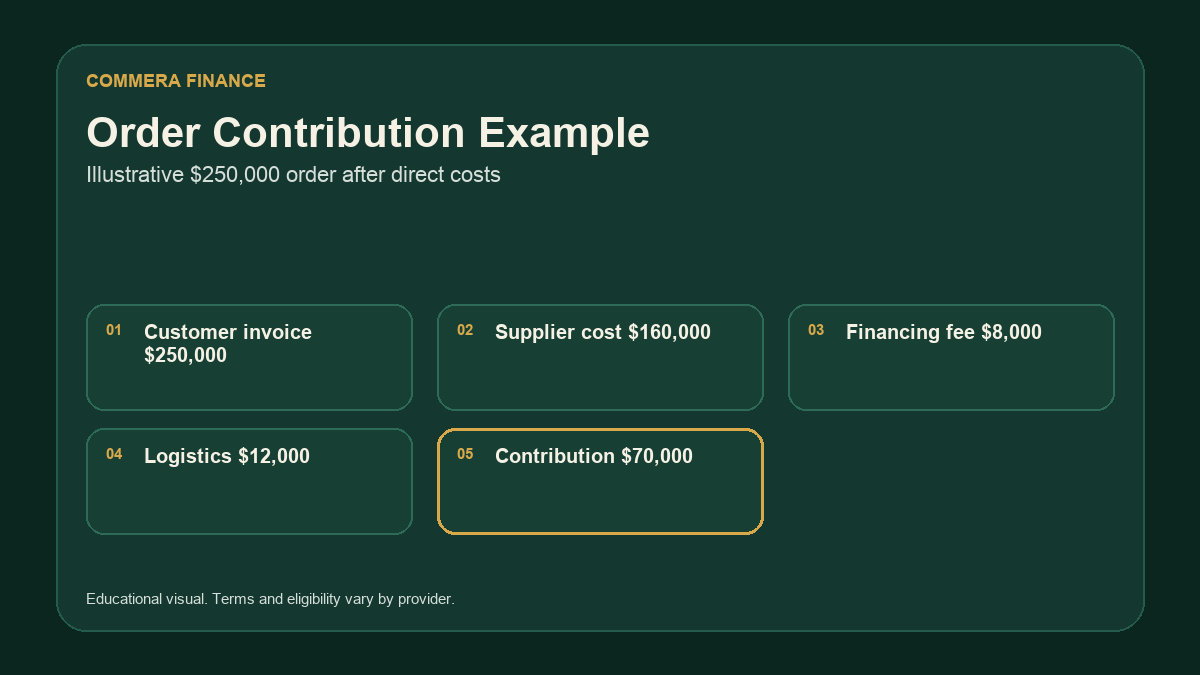
*Model the expected settlement and delayed payment cases before accepting the order.*
Use a transaction audit beside the model. Put the expected case next to late payment, short pay, and rejection cases. If one case leaves the business unable to meet uncovered freight, payroll, or tax obligations, the order may be too large for the proposed structure.
Calculate total cost before accepting the order
Request a schedule showing:
- the amount paid to the supplier
- the payment method
- fee periods and rounding rules
- diligence, wire, inspection, legal, and monitoring charges
- currency costs
- minimum and extension fees
- who pays freight, duties, storage, and insurance
- settlement priority after a short payment
- whether factoring is required after invoicing
A percentage per thirty days is not the same as an annual interest rate. A partial period may count as a full period, and the fee base may be supplier cost, committed amount, or invoice value. An eCapital cost discussion says cost can vary with size, duration, complexity, margin, customer credit, supplier terms, and risk. Public sources do not create a universal fee schedule.
The Export Import Bank describes a Working Capital support program that may support eligible export inventory, labor, and receivables through lenders. It also describes export credit insurance for certain foreign buyer nonpayment risks. Neither promises eligibility, and insurance does not remove product performance duties.
Build the file in delivery order
Include the signed order and master agreement, supplier quote, production schedule, legal names, product specifications, inspection rules, shipping plan, insurance, cost build up, current financials, existing liens, and customer correspondence.
A purchase order may include cancellation, return, offset, or acceptance conditions. Have counsel review the commercial contract, especially for a first large order.
Problems can arise after supplier payment but before customer cash. The supplier may ship late, inspection may fail, duties may rise, currency may move, a senior lender may refuse cooperation, or the expected factor may reject the invoice.
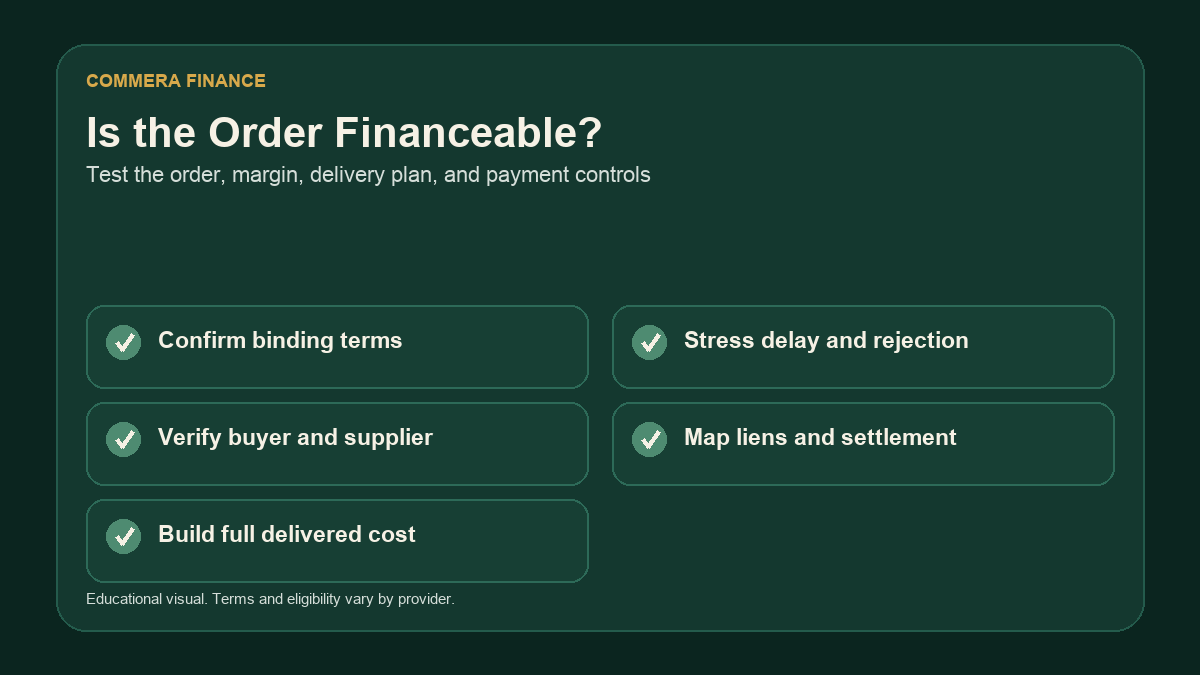
*A financeable order must remain workable after realistic delays, short payments, and delivery problems.*
Decide whether the order is survivable
Confirm the order and acceptance terms. Verify the buyer and supplier independently. Build margin from supplier cost through final delivery. Add financing under expected and delayed timing. Stress rejects, freight, duties, and currency. Map liens, title, payment control, and the settlement waterfall.
Before a final application, reconcile that file to a promised ship date. A funding readiness audit can use the completed transaction model, but the financer still decides whether the order and parties qualify. The goal is not simply to fill the order. It is to deliver, survive a delay or short payment, and keep enough cash after every required party is paid.
Does PO financing provide cash for general expenses?
Usually not. It commonly pays an approved supplier for a specific order. The agreement controls any additional funded costs.
Can a startup qualify?
Possibly, when the buyer, supplier, product, margin, and controls are strong. The financer still makes the eligibility and credit decision.
Does the customer know?
Often yes. The financer may verify the order and direct payment to a controlled account.
Is PO financing nonrecourse?
Do not assume so. Review repayment, guarantees, performance duties, and short payment rules in the contract.
Broker disclosure: Commera Finance is a broker, not a direct lender. Financing providers make their own eligibility, underwriting, approval, pricing, and term decisions.