

Overview
A seller financing business deal lets you pay part of the price later: the seller takes a promissory note instead of cash, and you repay it over time. With an SBA 7(a) loan in the deal, SBA rules decide whether that note counts toward your down payment and when you may pay it.
This guide is for buyers of a small business whose seller has offered to carry part of the price. It covers five things:
- SBA rules: How a seller note sits beside a 7(a) loan.
- Numbers: A worked example that prices one deal two ways.
- Tax: What interest rate the note needs and why.
- Negotiation: What each side gives and gets.
- Paperwork: What to check before you sign.
What is seller financing in a business sale?
Seller financing is a deal structure in which the seller of a business accepts part of the price as a promissory note that the buyer repays over time. The note is often called a seller note.
Seller financing for a business rarely pays for the whole deal. It usually sits beside a bank or SBA loan and your own cash. The seller becomes a lender to you, with a smaller and later claim than the bank's.
The rest of the purchase, including valuation and due diligence, is covered in our guide to the business acquisition loan.
Commera is a broker, not a lender. We compare offers from our lender partners. Commera does not take part in the seller note itself, which is a contract between you and the seller.
How a seller note works beside an SBA 7(a) loan
A seller note works beside an SBA 7(a) loan under rules that depend on one question: is the note on full standby? Full standby means no payments of principal or interest for the whole term of the 7(a) loan.
The rules below come from SBA SOP 50 10 8.1, Appendix 15, for change of ownership loans.
Down payment: Per SBA SOP 50 10 8.1, an Initial Acquisition needs an equity injection of 10% of total project cost, and that amount cannot be reduced. Limited sources, including standby debt, may provide no more than half of the required injection.
A note on full standby: Per the same SOP, seller debt that is subordinated to the lender and on full standby may count as equity. The lender uses SBA Form 155 or its own standby agreement, with a copy of the note attached.
- Interest: The standby note may accrue interest. That interest may be added to the debt and paid off after the 7(a) loan is paid in full.
- Lien: Per the SBA Form 155 page, the seller subordinates any lien rights to the lender. The seller also takes no action against you or the collateral without the lender's consent.
- Ownership: Per the SOP, the provider of standby debt may not take an equity stake in the business.
A note that pays: A seller note that is not on full standby does not count as equity. Per SBA SOP 50 10 8.1, total debt in the deal, including that note, is limited to the business valuation and must be supported by debt service coverage. For an Initial Acquisition, coverage must be at least 1.25 to 1. Historical coverage is EBITDA divided by the combined debt service after the purchase.
Interest-only notes: Per the same SOP, if additional debt that is not on full standby pays interest only, the lender tests it with an amortization of no more than 10 years.
Refinancing later: Per the SOP, seller debt can be refinanced after it has been in place and current for 36 months.
For how the 7(a) program works overall, see our SBA loan guide.
Seller financing a business: a worked example with two structures
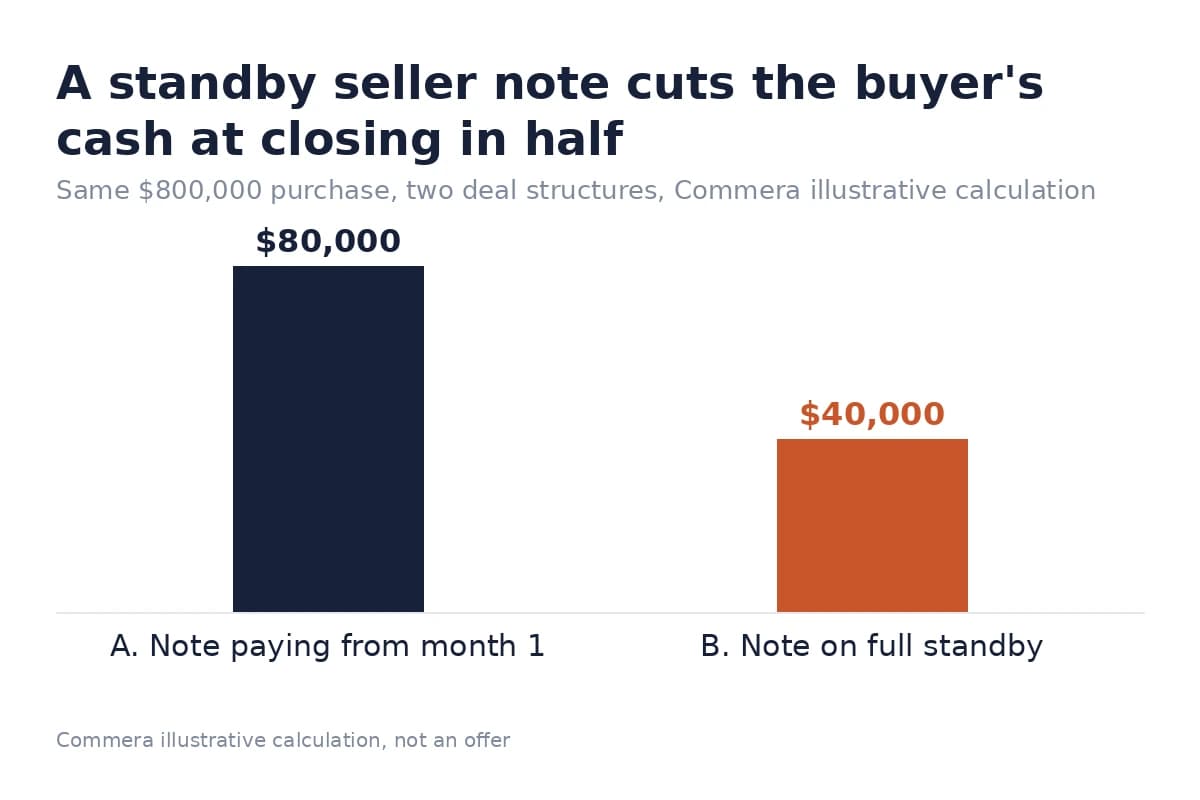
Seller financing a business changes three numbers at once: your cash at closing, the size of the SBA loan and your monthly debt service. The example below runs one deal two ways.
Methodology: Commera illustrative calculation with assumed inputs, not an offer and not a real deal. An Initial Acquisition with a total project cost of $800,000 and no real estate. The business earns EBITDA of $150,000.
In this illustrative calculation, the 7(a) loan carries 10.00%. That is the SBA ceiling for variable-rate loans over $350,000, Prime plus 3.0%, per SBA SOP 50 10 8.1. Prime is 7.00%, per the Federal Reserve H.15 release for October 9 to 15, 2026. The rate is held flat for the whole term.
In this illustrative calculation, the 7(a) loan runs 120 months with equal monthly payments.
Per the SOP, the SBA-backed portion is 75% for loans over $150,000. Per SBA Information Notice 5000-881797, the FY2027 upfront fee is 3% of that portion for loans of $150,001 to $700,000. For loans of $700,001 to $5,000,000, it is 3.5% of the SBA-backed portion up to $1,000,000. The example assumes the business is not in a zero-fee category.
In this illustrative calculation, the buyer pays the upfront fee from its own funds at closing. Est. APR counts the fee as a cost. It treats the loan as paying out its amount minus the fee.
The seller note carries 6.00% for 120 months in this illustrative calculation. Est. APR is the monthly internal rate of return times 12.
No prepayment, no late payments and no other fees are assumed.
Table 1. Two structures for one deal
| Structure | Buyer cash, $ | Seller note, $ | SBA loan, $ | SBA monthly payment, $ | Seller note monthly payment, $ | Annual debt service, $ | DSC, x |
|---|---|---|---|---|---|---|---|
| A. Seller note paying from month 1 | 80,000 | 80,000 | 640,000 | 8,457.65 | 888.16 | 112,149.73 | 1.34 |
| B. Seller note on full standby | 40,000 | 40,000 | 720,000 | 9,514.85 | 0 | 114,178.24 | 1.31 |
Table 2. Loan terms in each structure
| Loan | Amount, $ | Rate, % | Term | Monthly payment, $ | Upfront fee, $ | Total repayment, $ | Est. APR, % |
|---|---|---|---|---|---|---|---|
| A. SBA 7(a) | 640,000 | 10.00 variable | 120 months | 8,457.65 | 14,400 | 1,014,917.66 | 10.55 |
| A. Seller note | 80,000 | 6.00 fixed | 120 months | 888.16 | 0 | 106,579.68 | 6.00 |
| B. SBA 7(a) | 720,000 | 10.00 variable | 120 months | 9,514.85 | 18,900 | 1,141,782.37 | 10.64 |
| B. Seller note, standby | 40,000 | 6.00 fixed, accrues | 120 months standby, then 60 months | 1,406.96 from month 121 | 0 | 84,417.69 | 6.00 |
Source: Commera illustrative calculation, not an offer. Totals use unrounded payments. Buyer cash excludes the upfront fee.
Rates are not APR. Real terms are set by financing providers and are subject to underwriting.
Cash at closing: In this Commera illustrative calculation, structure B cuts the buyer's equity cash in half. The bigger SBA loan crosses into the higher fee tier, though, so the fee rises by $4,500.
Debt service: B's annual debt service is higher even though the seller is not paid at all. Coverage falls from 1.34 to 1.31. In this illustrative calculation, A needs EBITDA of about $140,187 to reach the 1.25 minimum, and B needs about $142,723.
The seller's side: In B, the seller waits. With interest compounded monthly, the standby note grows to $72,775.87 by the time the 7(a) loan is paid off. Paying that over 60 more months is an assumption of this illustrative calculation, not an SBA rule.
How to compare: Compare cash at closing, total debt service and what the seller receives, in that order. A structure that saves cash today can cost more each month. Run both before you agree.
Before you talk to a lender, you can check whether you may qualify for an SBA-backed acquisition loan.
What interest rate the seller note needs, and the tax angle
The seller note needs a stated interest rate at or above an IRS test rate, or part of the principal can be treated as interest for tax purposes. There is no "normal" rate beyond that floor. The rate is a deal term. Negotiate it.
The test rate: Per IRS Publication 537, a contract without adequate stated interest can have part of its principal recharacterized as interest. That interest is called unstated interest under section 483 or original issue discount under section 1274.
Per the same publication, the test rate is the lower of the applicable federal rates, or AFRs, for two 3-month windows around the contract and the sale. For a term over 3 years but not over 9, the AFR is the federal mid-term rate. For an installment note, the term is its weighted average maturity.
The October 2026 number: Per IRS Revenue Ruling 2026-19, the mid-term AFR for October 2026 is 4.61% with annual compounding. AFRs change every month, so check the month of your contract.
For the seller: Per IRS Publication 537, the seller reports interest on the note as ordinary income. Inventory sold with the business cannot be reported on the installment method, so that gain is taxed in the year of sale. Buyer and seller must both use the residual method to allocate the price across the assets.
For the buyer: The same allocation sets your basis in each asset. Agree on it in the purchase agreement. Do not leave it until after closing.
This is a summary of IRS rules, not tax advice. Consult a tax advisor before you set the rate or the price allocation.
Negotiating seller financing: what each side gives and gets
Negotiating seller financing is a trade: the buyer gets less cash at closing and a slower start, and the seller gets a better price or interest in exchange for waiting. Each term moves value. Know which way.
| Term | Buyer gets | Seller gets | What to watch |
|---|---|---|---|
| Note on standby | Counts as equity, no payments during the SBA loan | Interest that may accrue | The seller waits for the whole 7(a) term |
| Note that pays | A smaller SBA loan and a smaller upfront fee | Cash from month 1 | Payments count against debt service coverage, and the note is not equity |
| Rate versus price | A lower rate or a lower price, rarely both | More interest or a bigger headline price | A rate below the IRS test rate has tax effects. Total debt is limited to the business valuation |
| Longer note term | Smaller monthly payments | More interest over time | A longer term means the seller waits longer for the last payment |
| Second-position lien | Seller accepts a junior claim | Some security for the note | The seller subordinates to the SBA lender |
| Default terms | Time to cure a missed payment | Remedies if you stop paying | Standby limits seller action without lender consent |
For the buyer: Ask for standby when cash is the tight spot. Ask for a paying note when coverage has room. Trade rate against price, not both at once.
For the seller: A note on standby is a long, subordinated loan to the buyer. A seller who needs cash soon may prefer a smaller note. That note can pay from month 1.
Keep the seller in the game: A seller who is still owed money has a reason to help with the handover. Agree on the training period in writing.
Buying a business with seller financing: what to check before you sign

Buying a business with seller financing goes more smoothly when every term of the note is written down before closing. Check these points with the seller, the SBA lender and an attorney.
- Standby or not: Is the note on full standby? If not, in which month do payments start?
- Subordination: Will the seller sign SBA Form 155 or the lender's own standby agreement?
- Interest on standby: Does interest accrue during standby? How is it paid after the 7(a) loan?
- Rate versus AFR: Is the stated rate at or above the IRS test rate for the contract month?
- Seller's security: Does the seller take a lien, on which assets, and in which position?
- Default: What counts as default? Does a missed SBA payment also put the seller note in default?
- Prepayment: Can you pay the note early, and is there a fee for it?
- The seller after closing: How long does the seller stay to train you? What happens if they leave early?
Finding the right business comes first, and our guide to finding a business to buy covers that step. For a real-world deal shape, see our guide to buying a laundromat. When the structure is set, you can compare business loan offers for the SBA side through Commera.
This checklist is general information, not legal or tax advice. Have an attorney review the note and the purchase agreement before you sign.
Broker disclosure: Commera Finance is a broker, not a direct lender. Financing providers make their own eligibility, underwriting, approval, pricing, and term decisions.
Sources
- SBA SOP 50 10 8.1, effective October 1, 2026, Appendix 15 (change of ownership), Appendix 16 and Quick Reference Chart
- SBA Form 155, Standby Creditor's Agreement, accessed October 19, 2026
- SBA Information Notice 5000-881797, FY 2027 7(a) program fees
- Federal Reserve, H.15 Selected Interest Rates, release of October 16, 2026
- IRS Publication 537, Installment Sales (2025), accessed October 19, 2026
- IRS Revenue Ruling 2026-19, Applicable Federal Rates for October 2026
- 26 U.S.C. §483, via Cornell LII, accessed October 19, 2026
- 26 U.S.C. §1274, via Cornell LII, accessed October 19, 2026