

Overview
Short-term business loans are repaid in fixed installments over months rather than years, often with daily or weekly payments. Their real cost depends on the payment schedule, the fee withheld at funding and the payoff terms, not only on the rate in the offer.
This guide is for owners who hold an offer for short term business funding and want to know what it really costs. It covers five things:
- Definition: What counts as a short-term loan in this guide.
- Schedule: How daily, weekly and monthly payments change the estimated APR.
- Fees: Why a fee withheld at funding moves the price more than the schedule.
- Early payoff: Two contract types and what each one saves you.
- Questions: What to ask before you sign.
What is a short-term business loan?
A short-term business loan is a loan that is repaid in fixed installments over a short term, usually set in months rather than years. In this guide, short-term means a term of up to 18 months.
The 18-month line is our working frame for this guide, not a legal definition. Offers inside it can still look very different. One quotes a rate, another a total payback, a third a fee taken out before you get the money.
To compare them, turn every offer into the same measures: estimated APR, total repayment and cash in hand. Per 12 CFR §1026.22, the annual percentage rate is "a measure of the cost of credit, expressed as a yearly rate." It relates the amount and timing of money received to the amount and timing of payments made.
Regulation Z covers consumer credit. Still, New York's commercial financing law requires providers to calculate APR under the same section, per New York Financial Services Law §804. That makes it a fair yardstick for business offers too.
A short-term loan is one of several ways to borrow. Our guide to types of small business financing sets it beside longer loans, lines of credit and advances.
Commera is a broker, not a lender. We compare offers from our lender partners.
How payment frequency changes the cost: daily, weekly or monthly
Payment frequency changes the estimated APR even when the total repayment stays the same. Daily and weekly payments return money to the lender sooner, so you hold the full amount for less time.
Methodology: Commera illustrative calculation with assumed inputs, not an offer and not a real deal. The face amount is $50,000 and the term is 12 months.
These are illustrative inputs. Total repayment is the same under every schedule. A 3% fee of $1,500 is withheld at funding, so cash in hand is $48,500. Payments are equal: 12 monthly, 52 weekly or 252 daily debits on business days.
In this illustrative calculation, estimated APR is the internal rate of return of the cash flows, times the number of periods in a year (12, 52 or 252). That follows the actuarial approach described in Regulation Z. No late payments and no other fees are assumed.
Table 1. Same loan, three payment schedules
| Schedule | Payments, count | Payment, $ | Total repayment, $ | Cash in hand, $ | Est. APR, % |
|---|---|---|---|---|---|
| Monthly | 12 | 4,833.33 | 58,000.00 | 48,500.00 | 34.38 |
| Weekly | 52 | 1,115.38 | 58,000.00 | 48,500.00 | 36.29 |
| Daily | 252 | 230.16 | 58,000.00 | 48,500.00 | 36.78 |
Source: Commera illustrative calculation, not an offer. Real terms are set by financing providers and are subject to underwriting.
Rate is not APR. In this Commera illustrative calculation, the monthly schedule equals a nominal rate of 28.33% a year on the declining balance, or 2.3607% a month. The fee and the timing of payments push the estimated APR above that rate.
What changes: In this Commera illustrative calculation, daily payments raise the estimated APR by about 2.4 points over monthly payments. The dollars you repay are the same. Only the timing differs.
Frequency also changes how the payment feels. A daily debit comes out of the account on every business day, in good weeks and slow ones. Check that your deposits can carry it.
Every schedule in Table 1 has the same average monthly outflow. New York asks providers to show that figure for fixed payments, which makes offers with different schedules easier to set side by side.
For how amortization and longer terms work, see our guide to business term loans.
What moves the price more than the payment schedule
The fee withheld at funding moves the estimated APR more than the payment schedule does. In this Commera illustrative calculation, the 3% fee adds about 6 points of estimated APR to the monthly schedule.
Without the fee, cash in hand would be $50,000, and the same three schedules would give estimated APRs of 28.33%, 29.94% and 30.35% in this Commera illustrative calculation. The payments stay the same. You simply receive less money for them when the fee is withheld.
A fee weighs more on a short loan. The same dollar fee is spread over fewer months, so in annual terms it counts for more.
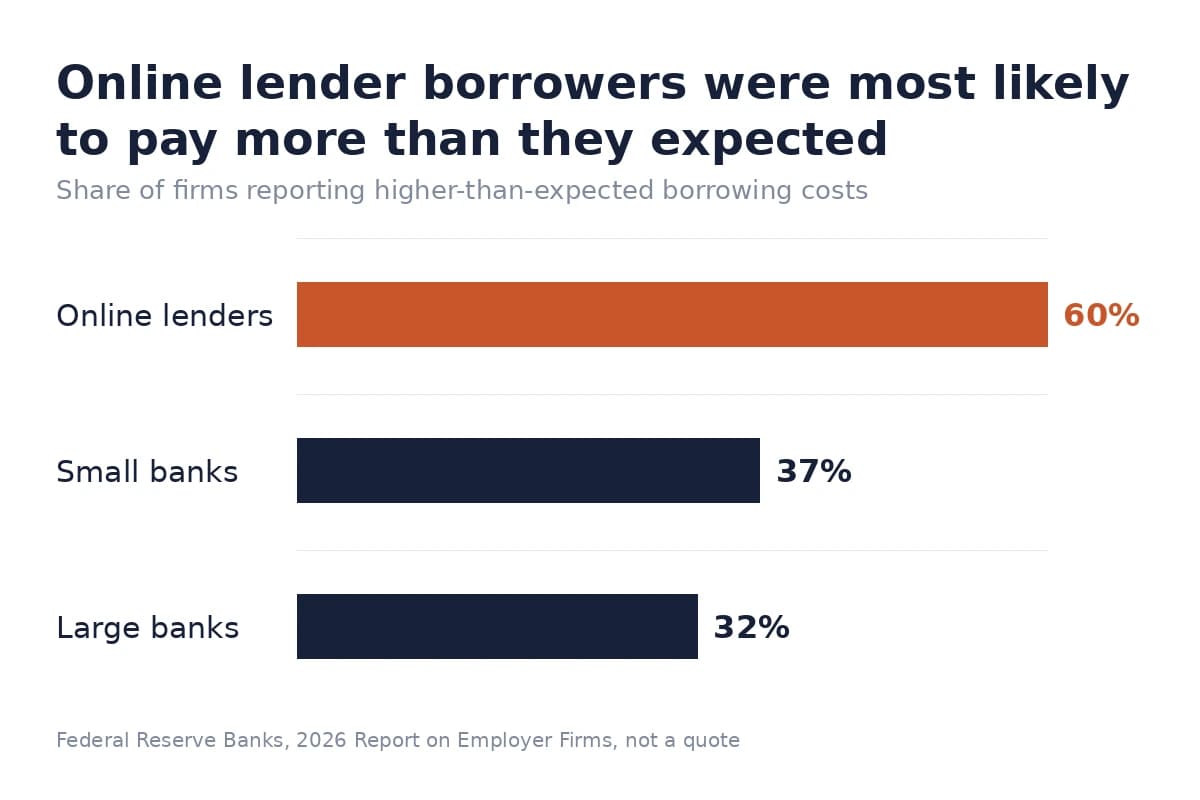
Higher costs than expected are common with some lenders. Per the Federal Reserve Banks' 2026 Report on Employer Firms, 60% of firms that borrowed from online lenders reported higher-than-expected borrowing costs. The share was 37% at small banks and 32% at large banks, per the same report.
The survey drew 6,525 responses in 2025, per the same report. It also found that high interest rates and unfavorable repayment terms were the most common challenges at online lenders.
The takeaway: Ask for cash in hand and estimated APR, not only the rate or the total payback. When you have those numbers, you can compare business loan offers through Commera.
Paying a short-term loan off early: two contract types
Paying a short-term loan off early saves money only if the contract stops charging interest at payoff. Under some contracts, the full finance charge stays due even when you repay early.
Contracts differ on this point, and the law asks providers to say which kind you have. Per New York Financial Services Law §804(h), the provider must disclose whether you would owe finance charges beyond interest accrued since your last payment. It must also disclose any extra fees for early payoff.
Per California Financial Code §22802(b), a covered provider must give "a description of prepayment policies." The two contract types below show why that line matters.
Methodology: Same Commera illustrative calculation as Table 1, monthly schedule, fee withheld. The business pays off the loan right after the sixth payment.
In contract A, interest stops at payoff, and the remaining balance runs at the nominal rate from Table 1. In contract B, the full finance charge stays due. Cost is total paid minus cash in hand.
Table 2. Paying off after month 6
| Contract type | Payoff after payment 6, $ | Total paid, $ | Cost, $ | Est. APR, % |
|---|---|---|---|---|
| A. Interest stops at payoff | 26,747.09 | 55,747.09 | 7,247.09 | 36.46 |
| B. Full finance charge stays due | 29,000.00 | 58,000.00 | 9,500.00 | 46.64 |
Source: Commera illustrative calculation, not an offer. Real terms are subject to underwriting.
Contract B: In this Commera illustrative calculation, early payoff saves no dollars. The estimated APR rises to 46.64%, about 12 points above the full-term figure, because you pay the same charge for half the time.
Contract A: In this Commera illustrative calculation, early payoff saves $2,252.91. The estimated APR is still above the 34.38% of the full term. The fee now spreads over 6 months instead of 12.
The takeaway: Before you plan to repay early, ask which contract type you are signing. Get the answer in writing.
Short-term loan, line of credit or advance?
A short-term loan, a line of credit and a merchant cash advance are repaid and priced in different ways. The table below compares how each one works, without rates.
| Product | How you repay | How cost is quoted | What to compare |
|---|---|---|---|
| Short-term loan | Fixed installments, daily, weekly or monthly, over a set term | Rate, total repayment or fee | Estimated APR, total repayment, cash in hand, payoff terms |
| Line of credit | You draw what you need and repay what you used | Rate on the drawn balance, plus any draw or maintenance fees | Cost of the amount you actually use, fees, renewal terms |
| Merchant cash advance | Repaid from future sales, often by daily or weekly debits. It is an advance, not a loan | Factor rate, which is not APR | Total repayment, estimated APR, what happens if sales drop |
A line suits needs that come and go, because you pay only for what you draw. For draws, rates and fees, see our guide to the business line of credit.
An advance is priced with a factor rate. Factor rates do not represent APR. Before you set an advance against a loan, read factor rate versus APR.
What to ask short-term business lenders before you sign

Short-term business lenders should answer the same questions in writing before you sign. The list below follows the disclosures New York and California require for covered commercial offers.
Per New York Financial Services Law §802, the New York rules do not apply to financial institutions or to deals over $2.5 million. Per California Financial Code §22800(n) and §22801(a), the California rules cover offers of $500,000 or less and exclude depository institutions. Ask for the same answers in any state.
- Amount and cash in hand: What is the financing amount, and how much reaches your account after fees withheld at funding?
- Finance charge: What is the total dollar cost of the financing?
- APR: What is the estimated APR, including fees you cannot avoid?
- Total repayment: What will you repay in total?
- Term: How long does the loan run?
- Payments: What is the payment amount and frequency? For a term longer than one month, New York also requires the average monthly payment.
- Avoidable fees: Which fees can you avoid, such as late payment or returned payment fees?
- Early payoff: If you repay early, do you owe more than interest accrued since your last payment? Are there extra fees?
- Collateral: Per New York §804(i), the provider must describe "collateral requirements or security interests, if any."
To test how a payment schedule changes what you repay, try the funding calculator.
This checklist is general information, not legal advice. Rules differ by state. If a clause is unclear, have an attorney review the agreement before you sign.
Broker disclosure: Commera Finance is a broker, not a direct lender. Financing providers make their own eligibility, underwriting, approval, pricing, and term decisions.
Sources
- 12 CFR §1026.22, Determination of annual percentage rate, via Cornell LII, accessed October 19, 2026
- New York Financial Services Law §§802 and 804, accessed October 14, 2026
- California Financial Code, Division 9.5, Commercial Financing Disclosures, §§22800 to 22802, accessed October 14, 2026
- Federal Reserve Banks, 2026 Report on Employer Firms: Findings from the 2025 Small Business Credit Survey, March 2026