

Overview
Freight factoring turns an unpaid load into cash now: you sell the invoice to a factoring company, and it collects from the freight broker or shipper later. The price is a fee per invoice, and what it really costs depends on how fast your broker pays and on the recourse terms in your agreement.
This guide is for owner-operators and small fleets running on their own authority, with brokers that pay in 30 to 60 days. It covers five things:
- Mechanics: How a factored load gets paid, step by step.
- Rates: A worked example that sets a flat fee against a tiered fee.
- Quick pay: When a broker's early payment beats a factor.
- Recourse: What happens if the broker never pays.
- Agreement: What to check before you sign.
What is freight factoring?
Freight factoring is a sale of a carrier's unpaid freight invoices to a factoring company that pays most of the amount now and collects from the broker or shipper later. The factor earns a fee for paying early and for taking over collection.
The sale has a legal frame. Per UCC §9-109(a)(3), Article 9 of the Uniform Commercial Code applies to "a sale of accounts," not only to secured loans. The UCC is a model law, and states adopt it with variations.
Factoring is usually structured as a sale, not a loan. Check your agreement, because the contract decides how the deal works.
A freight broker, per 49 CFR 371.2, is a person who, for compensation, arranges or offers to arrange the transportation of property by an authorized motor carrier. In this guide, "broker" means that freight broker.
Factoring is a niche product across small business. Per the Federal Reserve Banks' 2026 Report on Employer Firms, 3% of employer firms used factoring on a regular basis in 2025.
Factoring pays for loads you have already hauled. Buying the truck is a different need, covered in our guide to semi truck financing.
Commera is a broker, not a lender. We compare offers from our lender partners.
How a load gets paid once you factor it
A factored load gets paid in two parts: an advance when the factor buys the invoice, and the rest, minus the fee, when the broker pays. The steps below show a typical sequence. Your agreement sets the exact one.
- Deliver and invoice: You haul the load and send the invoice with the paperwork the factor asks for, such as the bill of lading and the rate confirmation.
- Notice of assignment: The factor tells the broker that the invoice now belongs to the factor and that payment goes to the factor.
- Advance: The factor pays you the advance on the schedule set in your agreement.
- Broker pays: The broker pays the full invoice to the factor on its normal terms.
- Reserve: If the factor held back part of the invoice, it releases that reserve to you, minus its fee.
The notice in step 2 matters more than it looks. Per UCC §9-406(a), once the broker receives a notice of assignment, it can discharge its debt only by paying the factor. Paying you no longer counts.
That rule shapes how you leave a factor. To switch, you usually need a release letter from the old factor, so the broker knows to pay you or the new factor. Ask how release works before you sign, not when you want out.
If you are still setting up your authority and first lanes, see our guide to starting a trucking business.
Freight factoring rates: flat fee or tiered fee?
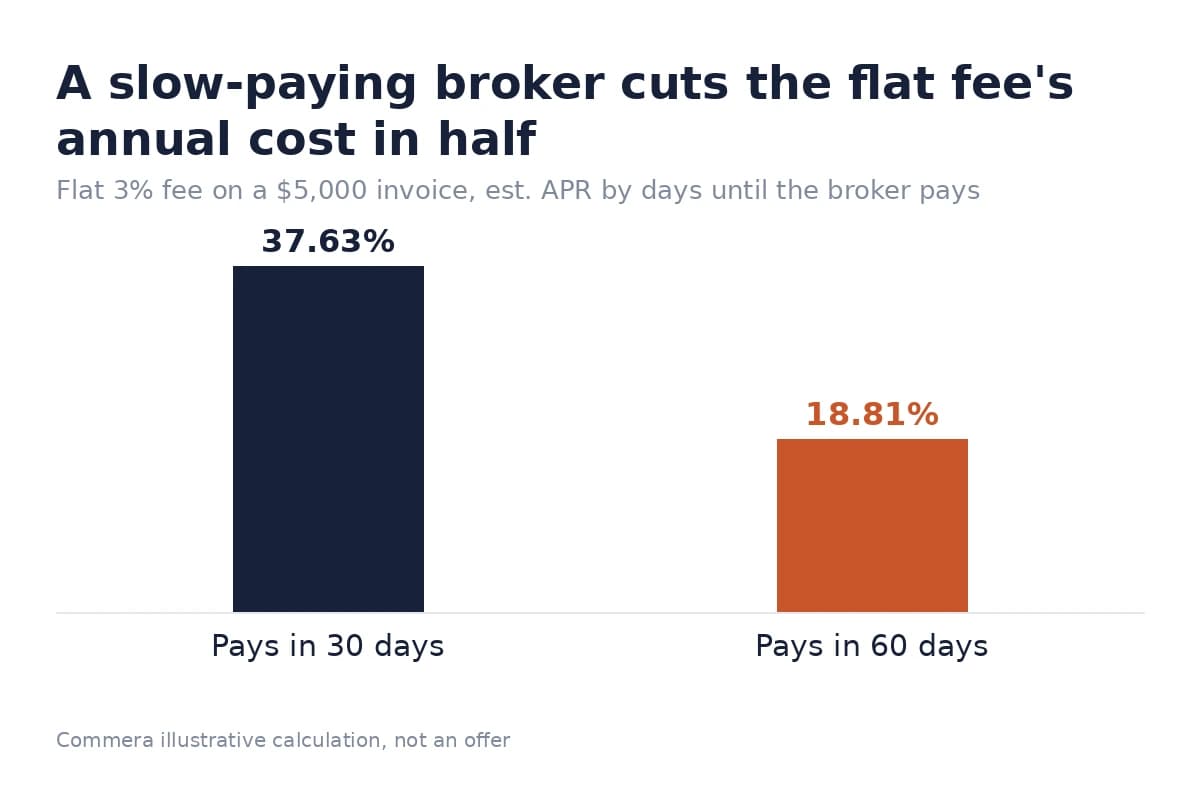
Freight factoring rates come in two common shapes: a flat fee for the invoice, or a fee that grows with each block of days until the broker pays. The worked example below prices one invoice both ways.
Methodology: Commera illustrative calculation with assumed inputs, not an offer and not a real deal. One invoice of $5,000, and the broker pays in 30, 45 or 60 days.
In this illustrative calculation, the flat structure charges 3% of face value for any term. It advances the full invoice minus the fee on the day of purchase, with no reserve. The tiered structure charges 1.5% for each 15 days or part of 15 days. It advances 90% and returns the reserve, minus the fee, when the broker pays.
Estimated APR in this illustrative calculation is the fee divided by the cash advanced, times 365, divided by the days until the broker pays. That treats each invoice as a single advance and a single payment. No other fees are assumed.
Table 1. One invoice, two fee structures
| Structure | Broker pays in, days | Advance rate, % | Fee, $ | Cash at purchase, $ | Total received, $ | Est. APR, % |
|---|---|---|---|---|---|---|
| Flat | 30 | 97 | 150 | 4,850 | 4,850 | 37.63 |
| Flat | 45 | 97 | 150 | 4,850 | 4,850 | 25.09 |
| Flat | 60 | 97 | 150 | 4,850 | 4,850 | 18.81 |
| Tiered, per 15 days | 30 | 90 | 150 | 4,500 | 4,850 | 40.56 |
| Tiered, per 15 days | 45 | 90 | 225 | 4,500 | 4,775 | 40.56 |
| Tiered, per 15 days | 60 | 90 | 300 | 4,500 | 4,700 | 40.56 |
Source: Commera illustrative calculation, not an offer. Real terms are set by financing providers and are subject to underwriting.
Flat fee: In this Commera illustrative calculation, the flat fee costs the same $150 whatever the broker does. A slow broker makes it cheaper in annual terms: est. APR falls from 37.63% at 30 days to 18.81% at 60 days.
Tiered fee: In this Commera illustrative calculation, the tiered fee keeps the same est. APR at every term shown, 40.56%. The dollars grow instead, and so does the wait for the reserve. The smaller advance also puts less cash in your hand on day one.
How to compare: Price each offer in dollars per load and in est. APR at your broker's real payment time. A low headline fee can still cost more if it resets with each new block of days.
The law points the same way. Per New York Financial Services Law §806(c), a covered factoring offer must show an estimated APR. It is calculated as a "single advance, single payment transaction." The term is set by the invoice due date or by the broker's average payment period over no more than the previous twelve months.
Per New York Financial Services Law §801(e), the finance charge in factoring includes the discount taken on the face value of the invoices. Per California Financial Code §22803, a factor may disclose an example transaction instead, including an annualized rate. California's rules cover offers of $500,000 or less, per §22800(n).
A factoring fee is not a factor rate on an advance, and neither one is APR. For the difference, read factor rate versus APR. For how invoice factoring compared with an advance works, see our side-by-side guide.
Broker quick pay or a factor?
Broker quick pay is an early payment that some freight brokers offer on their own loads, for a fee. Quick pay can cost less than a factor for one slow broker, while a factor covers every broker you haul for.
Quick pay has its own est. APR. In this Commera illustrative calculation, the broker's standard term is 30 days, and quick pay arrives on day 2 for a 2% fee.
On the same $5,000 invoice, in this illustrative calculation, the fee is $100, and you receive $4,900 on day 2 instead of the full amount on day 30. That works out to an est. APR of 26.60%, using the same formula as Table 1.
In this example, quick pay costs less in annual terms than the flat fee at 30 days. That comparison holds only for these assumed inputs. Run your own numbers with the fee your broker actually quotes.
- Quick pay can fit when: One or two brokers pay slowly, and the rest pay on time. You keep control of your invoices and pay only on the loads you choose.
- A factor can fit when: You haul for many brokers and need cash on every load. The factor also takes over collection from the broker.
- Watch for: Quick pay terms are set by each broker and can change. A factor's agreement may ask you to send it all invoices, which limits quick pay later.
Recourse vs non-recourse freight factoring
Recourse vs non-recourse freight factoring is about who absorbs the loss when a broker does not pay. Under recourse, you buy back the unpaid invoice. Under non-recourse, the factor absorbs some losses, but only the events your agreement names.
The UCC starting point favors the carrier. Per UCC §9-608(b), when the deal is a sale of accounts, the seller is not entitled to any surplus and the obligor is not liable for any deficiency.
Contracts change that default. Per UCC §9-607, a factor may collect from the account debtor, and the same section contemplates agreements that give the factor a right to charge back uncollected invoices or other recourse.
So "non-recourse" means only what the agreement says, depending on the agreement. Read which events it covers:
- Broker insolvency: Does non-recourse cover a broker that goes out of business or files for bankruptcy?
- Freight disputes: Who carries the loss if the broker disputes the load, such as damage, shortage or late delivery?
- Slow payment: If the broker pays late but does pay, can the factor still send the invoice back to you?
- Recourse window: After how many days can the factor return an unpaid invoice? Can it take the amount from your reserve or future advances?
Brokers have a backstop of their own. Per 49 CFR 387.307(a), in effect since January 16, 2026, a broker must keep a surety bond or trust fund of $75,000. The bond provides for payments to motor carriers if the broker fails to carry out its contracts.
You can also check what the broker recorded. Per 49 CFR 371.3, a broker keeps a record of each transaction for three years, and each party to the deal may review it. That record shows the freight charges the broker collected and when it paid the carrier.
A dispute with a broker or a factor is a legal question. Consult an attorney about your own agreement.
Factoring for owner operators: what to check in the agreement

Factoring for owner operators starts with the agreement: read it for cost, cash timing and exit terms before you sign. The checklist below follows the disclosures New York requires for covered factoring offers, plus the points from earlier sections.
- Advance rate: What share of each invoice do you receive on the day of purchase?
- Fee and period: What is the fee per period, and how is a partial period charged?
- Reserve: When is the reserve returned, and what can the factor deduct from it?
- Volume and all invoices: Is there a monthly minimum? Must you factor every invoice, or can you choose loads?
- Other fees: Per New York §806(e), a covered provider must describe all other fees you can avoid. Ask for that list in any state.
- What the factor buys: Per New York §806(f), the provider must describe the receivables purchased and any additional collateral requirements or security interests. Compare that with the scope of any UCC-1 filing.
- Recourse window: Which events trigger a buyback, and how many days does the factor wait?
- Term and exit: How long does the agreement run, how do you end it, and how fast will the factor send a release letter?
Factoring is one way to finance invoices. For other structures, such as an AR line or spot factoring, see receivables financing through Commera. For the wider picture, see our page on funding for trucking companies.
This checklist is general information, not legal advice. Rules differ by state. If a clause is unclear, have an attorney review the agreement before you sign.
Broker disclosure: Commera Finance is a broker, not a direct lender. Financing providers make their own eligibility, underwriting, approval, pricing, and term decisions.
Sources
- Uniform Commercial Code §9-109, via Cornell LII, accessed October 19, 2026
- Uniform Commercial Code §9-406, via Cornell LII, accessed October 19, 2026
- Uniform Commercial Code §9-607, via Cornell LII, accessed October 19, 2026
- Uniform Commercial Code §9-608, via Cornell LII, accessed October 19, 2026
- 49 CFR §371.2, Definitions, via Cornell LII, accessed October 19, 2026
- 49 CFR §371.3, Records to be kept by brokers, via Cornell LII, accessed October 19, 2026
- 49 CFR §387.307, Property broker surety bond or trust fund, effective January 16, 2026, via Cornell LII, accessed October 19, 2026
- New York Financial Services Law §801, accessed October 14, 2026
- New York Financial Services Law §806, accessed October 19, 2026
- California Financial Code, Division 9.5, Commercial Financing Disclosures, §§22800 and 22803, accessed October 14, 2026
- Federal Reserve Banks, 2026 Report on Employer Firms: Findings from the 2025 Small Business Credit Survey, March 2026