

Overview
Business loan collateral is the equipment, receivables, real estate or other property you pledge so a lender can claim it if the loan is not repaid. What matters most is not the asset's price but how much of its value a lender counts toward the loan.
This guide is for owners who have assets and need a loan larger than their cash. It covers five things:
- Assets: What can be pledged and how much of each one counts.
- Real estate: How property is valued and capped.
- Coverage: A worked example that adds up one business's assets.
- Shortfall: What happens when the assets do not cover the loan.
- Paperwork: What the lien documents actually say.
What is business loan collateral?
Business loan collateral is property that a borrower pledges to a lender so that the lender can claim it if the loan is not repaid. The pledge is written into a security agreement, and the lender's claim on that property is called a lien.
Collateral is common, and it is rarely the only promise. Per the Federal Reserve Banks' 2026 Report on Employer Firms, 51% of employer firms with debt secured it with business assets and 38% with personal assets. The same survey found that 59% backed their debt with a personal pledge to repay. Only 10% used no collateral and no personal pledge.
The survey describes what owners signed. It does not describe what any lender requires.
Collateral is one feature of a loan, not a loan type. Our guide to types of small business financing shows which products usually ask for it.
Commera is a broker, not a lender. We compare offers from our lender partners.
What can be used as collateral for a business loan?
Equipment, real estate, receivables, inventory and furniture can all be used as collateral for a business loan. Each one counts for only part of its value, and the share differs by asset.
The clearest published rules come from the SBA. Per SBA SOP 50 10 8.1, Appendix 19, a Standard 7(a) loan is "fully secured" when the lender takes liens on all available fixed assets, counted at these discounts, up to the loan amount. These are SBA rules for counting collateral. Other lenders set their own.
| Asset | Counting rule (SBA 7(a)) | Counts, % of value | Typical lien |
|---|---|---|---|
| New machinery and equipment | Share of price, minus prior liens | 75 | Lien on the equipment |
| Used machinery and equipment | Share of net book value, or of an orderly liquidation appraisal, minus prior liens | 50 of book, or 80 with appraisal | Lien on the equipment |
| Improved real estate | Share of market value | 85 | Mortgage or deed of trust |
| Unimproved real estate | Share of market value | 50 | Mortgage or deed of trust |
| Furniture and fixtures | Share of net book value or appraised value | 10 | Lien on the items |
| Receivables and inventory, term loan | Share of current book value, if the lender takes them | 10 | Lien on trading assets |
| Receivables, Working Capital CAPLine | Share of book value after ineligible receivables | Up to 80 | First lien on trading assets |
| Inventory, Working Capital CAPLine | Share of book value | Up to 50 | First lien on trading assets |
Source: SBA SOP 50 10 8.1, Appendix 19 and the Working Capital CAPLines section.
Equipment: Used equipment counts for more when an orderly liquidation appraisal backs the value. For buying machines with the machine as the pledge, see our guide to equipment financing.
Receivables and inventory: A term loan barely counts them. A line of credit counts much more. Per SBA SOP 50 10 8.1, a Working Capital CAPLine under $2,000,000 can skip a borrowing base if the lender instead holds collateral equal to the full line. The worked example below shows what that difference does to one set of invoices.
Assets the loan buys: Per the same SOP, when 7(a) proceeds buy or improve an asset, the lender takes a first lien on it. Narrow exceptions apply.
How lenders value real estate you pledge
Lenders value pledged real estate with an appraisal, then lend only a share of that value. The share depends on what the property is.
Banks work under federal guidelines. Per the Interagency Guidelines for Real Estate Lending in 12 CFR Part 34, Appendix A to Subpart D, a bank's own loan-to-value limits should not exceed these supervisory limits.
| Property type | Supervisory loan-to-value limit, % |
|---|---|
| Raw land | 65 |
| Land development | 75 |
| Construction, commercial | 80 |
| Improved property | 85 |
Source: 12 CFR Part 34, Subpart D, Appendix A.
These are ceilings for a bank's own policy, not targets. A bank can set lower limits, and the same guidelines allow documented exceptions on individual loans.
Appraisal for SBA loans: Per SBA SOP 50 10 8.1, Appendix 19, when a 7(a) loan requires an appraisal of commercial real estate, an independent state-licensed or state-certified appraiser must prepare it. It must follow USPAP and be dated within 12 months of the application. If the property is worth more than $1,000,000, the appraiser must be state-certified. A program-specific rule may allow a simpler evaluation instead, per the same appendix.
Your home: A house can also be pledged for a business debt. That is a bigger personal decision, covered in our guide to using home equity to fund a business.
How much loan do your assets support? A worked example
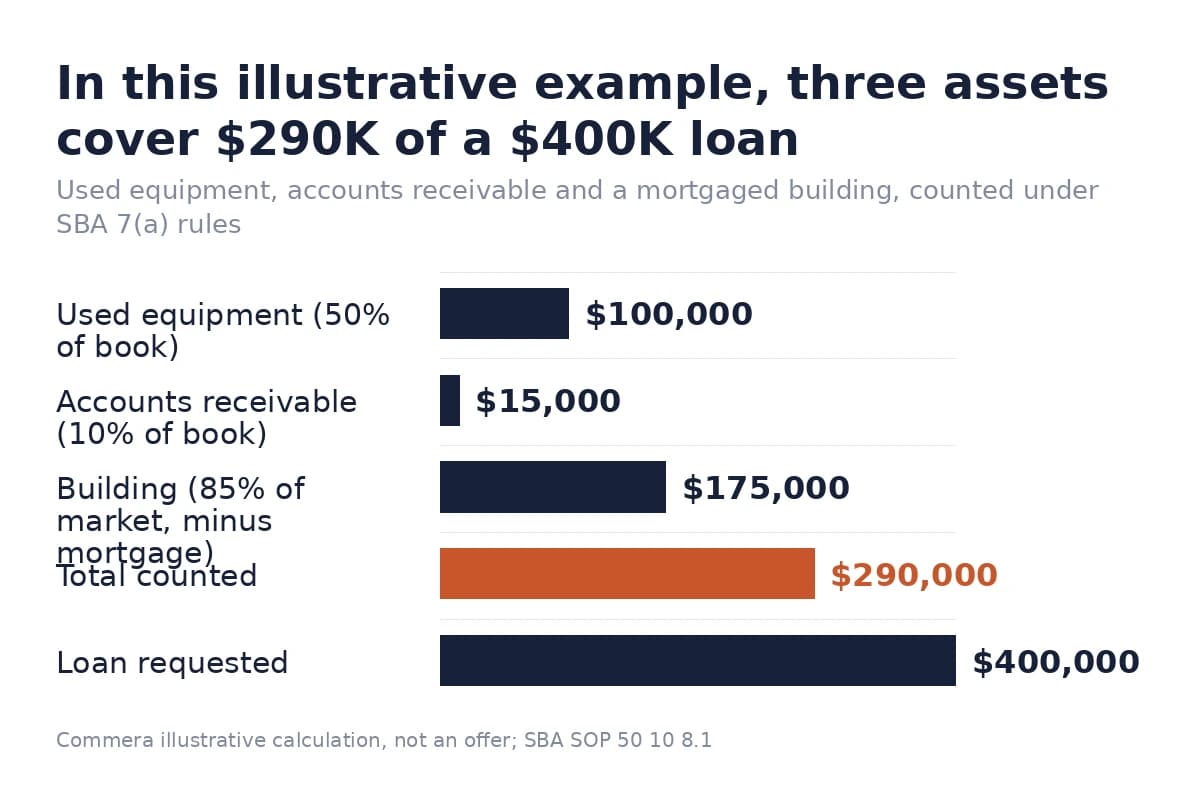
Your assets support less loan than their combined value. The example below adds up one business's collateral the way SBA 7(a) rules count it.
Methodology: Commera illustrative calculation under the SBA 7(a) "fully secured" rules above, not an offer and not a real deal. No rate or payment is calculated, only collateral coverage. The business asks for a Standard 7(a) loan of $400,000.
In this illustrative calculation, the business owns used equipment with a net book value of $200,000 and no appraisal. It holds accounts receivable of $150,000 at book value. It also owns an improved building with a market value of $500,000 and a $250,000 mortgage. The illustrative calculation assumes the mortgage balance is subtracted from the counted value.
| Asset | Value, $ | Counting rule | Counts toward the loan, $ |
|---|---|---|---|
| Used equipment | 200,000 net book value | 50% of net book value | 100,000 |
| Accounts receivable | 150,000 book | 10% of book | 15,000 |
| Building | 500,000 market, 250,000 mortgage | 85% of market value, minus mortgage | 175,000 |
| Total | 290,000 |
Source: Commera illustrative calculation, not an offer. Real terms are set by financing providers and are subject to underwriting.
The gap: In this Commera illustrative calculation, $850,000 of assets cover $290,000 of the loan. The shortfall is $110,000.
An appraisal helps: Suppose an orderly liquidation appraisal values the equipment at $150,000. At 80%, it counts for $120,000. In this illustrative calculation, total coverage rises to $310,000, and the gap falls to $90,000.
The same receivables in a line: Now put those receivables behind a Working Capital CAPLine instead. If $20,000 of them are ineligible, $130,000 remains. In this illustrative calculation, up to 80% of that counts, so the same invoices support $104,000 instead of $15,000.
The takeaway: An asset's value is not its collateral value. Receivables work harder behind a line of credit than behind a term loan.
When you know what your assets support, you can compare business loan offers through Commera.
What happens when collateral falls short?
A loan with a collateral gap can still be made. Per SBA SOP 50 10 8.1, Appendix 19, "a loan request must not be declined solely because collateral is inadequate." SBA backing still does not replace collateral the business has.
Personal real estate: Per the same appendix, when a Standard 7(a) loan is not fully secured, the lender must take available equity in the owners' personal real estate. A lien is not required when equity is under 25% of the property's fair market value. When a lien is taken, it may be limited to the collateral shortfall or to 150% of the equity, as applicable.
In the Commera illustrative calculation above, take an owner whose home is worth $400,000 with a $320,000 mortgage. Equity of $80,000 is below the threshold, so no lien on the home is required. With a $250,000 mortgage, equity clears the threshold, and the lien may be limited to the $110,000 shortfall.
Personal pledge: Collateral and a personal pledge are separate. Per SBA SOP 50 10 8.1, each owner of 20% or more must sign personally for the full debt.
Small loans: Per the same SOP, 7(a) Small and SBA Express loans of $50,000 or less need no collateral. For financing that does not name a specific asset, see our guide to unsecured business loans.
What to ask about a gap: Ask the lender which assets it counted and at what share. Ask whether an appraisal would raise the count. Ask whether a line of credit would make better use of your receivables.
None of this is a promise of approval. Lenders weigh cash flow and credit too, and each one makes its own decision.
Specific lien, blanket lien or personal pledge: what you sign

A lien is created by a security agreement you sign, and that agreement decides what the lender can claim. A specific lien names one asset. A blanket lien covers broad categories of business property. A personal pledge is not a lien at all.
The wording rules differ by document. Per UCC §9-108(c), a phrase like "all the debtor's assets" does not identify collateral in a security agreement. Per UCC §9-504(2), the public filing, called a financing statement, may still say it covers "all assets or all personal property." So read the security agreement to see what the lien reaches. How filings are searched and released is a separate topic.
Ask the lender these questions before you sign:
- Which assets: Does the lien name specific property or categories? Does it reach assets you buy later?
- Which position: Is this a first lien, or does another lender already hold one on the same asset?
- Who signs personally: Which owners must sign, and for how much of the debt?
- Release: When the loan is paid, how and when is the lien released?
Different loans use different structures. Our guide to business term loans explains how term loans are set up and repaid.
This section is general information, not legal advice. Rules differ by state, and an attorney can review the agreement before you sign.
Broker disclosure: Commera Finance is a broker, not a direct lender. Financing providers make their own eligibility, underwriting, approval, pricing, and term decisions.
Sources
- Federal Reserve Banks, 2026 Report on Employer Firms: Findings from the 2025 Small Business Credit Survey, March 2026
- SBA SOP 50 10 8.1, effective October 1, 2026, Section A, Ch. 5, Working Capital CAPLines and Appendix 19
- 12 CFR Part 34, Appendix A to Subpart D, Interagency Guidelines for Real Estate Lending, via Cornell LII, accessed October 19, 2026
- Uniform Commercial Code §9-108, via Cornell LII, accessed October 19, 2026
- Uniform Commercial Code §9-504, via Cornell LII, accessed October 19, 2026