

Overview
What is a UCC lien? A UCC lien is a lender's or funder's claim on your business property, made public through a UCC-1 filing with the state. It tells other creditors who has a claim on which assets, and it can stay on record after you pay off the debt unless someone files to end it.
This guide is for owners who found a UCC-1 in a search, a lender's decline or a financing contract. It covers five things:
- The filing: What a UCC-1 says and what it does not.
- Coverage: Which products usually come with which kind of lien.
- Search: How to look up filings on your own business.
- New financing: How an existing lien affects your next loan or advance.
- Removal: How to get a lien terminated after payoff.
What is a UCC lien?
A UCC lien is a security interest in business property that a lender or funder makes public by filing a UCC-1 financing statement, usually with the Secretary of State where the business is organized. The security interest itself comes from the agreement you sign. The filing puts it on the public record.
Filing is how most security interests are perfected, which means made effective against other creditors. Per UCC §9-310(a), a financing statement must be filed to perfect all security interests, with listed exceptions.
The state matters. Per UCC §9-307(e), a registered organization, such as a corporation or LLC, is located in the state under whose law it was organized. So a filing against your company usually sits in that state's records. Where you operate matters less.
The Uniform Commercial Code is a model law. Each state adopts it with its own variations, so your state's version controls.
UCC liens come up often with revenue-based products. Our guide to the merchant cash advance explains how those agreements work.
Commera is a broker, not a lender. We compare offers from our lender partners.
What a UCC-1 financing statement contains
A UCC-1 financing statement is a short public notice with three required parts. Per UCC §9-502(a), it is sufficient only if it gives the name of the debtor, the name of the secured party and an indication of the collateral.
- Debtor: Your business, under its exact legal name.
- Secured party: The lender or funder, or its representative.
- Collateral: What the claim covers. That can be one machine or "all assets."
Who authorizes it: You do, usually without a separate form. Per UCC §9-509(b), by signing a security agreement, the debtor authorizes the filing of a financing statement covering that collateral.
How long it lasts: Per UCC §9-515, a filed financing statement is effective for five years after the date of filing. A continuation statement filed within the last six months of that period extends it for another period of the same length. Without one, the filing lapses.
A filing is not the debt itself. It shows that a claim was asserted. The debt may be smaller, paid off or never drawn. Your agreement and records show which.
Blanket lien or specific asset: which filing comes with which product
A blanket lien covers broad categories of business property, while a specific lien names one asset. Which one you get depends on the product. Above all, it depends on your agreement.
The two documents follow different wording rules. Per UCC §9-504(2), a financing statement may describe the collateral as "all assets or all personal property." Per UCC §9-108(c), that phrase does not identify collateral in the security agreement itself. So a public filing can read wider than the agreement behind it.
| Product | What the filing usually covers | Source |
|---|---|---|
| SBA 7(a) loan that buys an asset | A first lien on the asset bought with the loan, under the agreement | SBA SOP 50 10 8.1, Appendix 19 |
| SBA 7(a) MARC loan | A lien on all business assets through a UCC-1 | SBA SOP 50 10 8.1, Appendix 19 |
| SBA Working Capital CAPLine with a borrowing base | A first lien on receivables and inventory | SBA SOP 50 10 8.1, Appendix 19 |
| Invoice factoring | The accounts sold, because a sale of accounts falls under Article 9 | UCC §9-109(a)(3) |
| Sales-based financing, such as a merchant cash advance | Depends on the agreement. In New York, the offer must describe any collateral or security interest | NY Financial Services Law §803(i) |
| Loan sold as "unsecured" | Usually no specific asset, though a general lien is possible under the agreement | Agreement terms |
Sources: SBA SOP 50 10 8.1, UCC §9-109 and New York Financial Services Law §803.
SBA loans: These rows are SBA program rules. They do not describe every lender. Other lenders write their own terms.
Sales-based financing: Per New York Financial Services Law §803(i), a covered provider must describe "collateral requirements or security interests, if any." Ask for that description in any state.
"Unsecured" products: A product marketed as unsecured can still come with a general lien. Our guide to unsecured business loans explains how to tell the difference.
Specific assets: When a loan finances one machine, the filing usually names that machine. See our guide to equipment financing for how those loans are set up.
How to run a UCC search on your own business

A UCC search on your own business starts at the filing office of the state where the business is organized, usually the Secretary of State. The search shows active financing statements that match your exact legal name under the office's search rules.
What the office must give you: Per UCC §9-523(c), the filing office tells any requester whether active financing statements name a particular debtor. It also gives the date and time of each filing and the information in it. Per §9-523(e), the office must do so no later than two business days after it receives the request, under the model text.
One state as an example: Per the California Secretary of State, its office is the central filing office for certain UCC financing statements. UCC Connect offers online inquiries, filings and debtor search certificate requests. The same office also handles judgment liens, attachment liens and federal and state tax liens. UCC filings there are public records.
How to read each result:
- Debtor name: Is it your exact legal name? Check for old names and spelling variants.
- Secured party: Do you recognize the lender or funder? A filing agent may appear in its place.
- Collateral: Does it name a specific asset or say "all assets"?
- Filing date: When does the filing lapse unless continued?
- Amendments: Has the filing been continued, assigned to another party or terminated?
Keep a copy of the results. The next lender may ask for them. So will any request to remove a lien.
How a UCC lien affects your next loan or advance
A UCC lien tells your next lender who already has a claim on your assets, and in what order. A new lender often runs this search before it makes an offer.
Priority: A first lien on an asset usually means that creditor is paid first from that asset. A second lender would sit behind it, so it may ask for a different asset, a smaller amount or the first lender's consent.
SBA refinancing: Per SBA SOP 50 10 8.1, Appendix 19, a 7(a) loan that refinances debt must generally be secured with at least the same collateral and lien priority as the debt it replaces.
No piggyback: Per the same appendix, an SBA lender must not use a "piggyback" structure. That is when an SBA-backed loan sits in a junior lien position, or has no lien, on collateral that secures a non-SBA loan made at or about the same time. Loans approved within 90 days of each other count as made at about the same time.
Stacking: Taking a new advance while an old one is still open is often called stacking. Whether your agreement allows it is a question for the agreement, not for the filing.
Before you apply, list every lien next to the debt it secures. Our guide to building a debt map before consolidation shows how.
How to remove a UCC lien after payoff
A UCC lien is removed by a termination statement, often filed on a UCC-3 form. Once the debt is paid and there is no commitment to lend more, you can demand one in writing. The model UCC sets a deadline for the secured party to act.
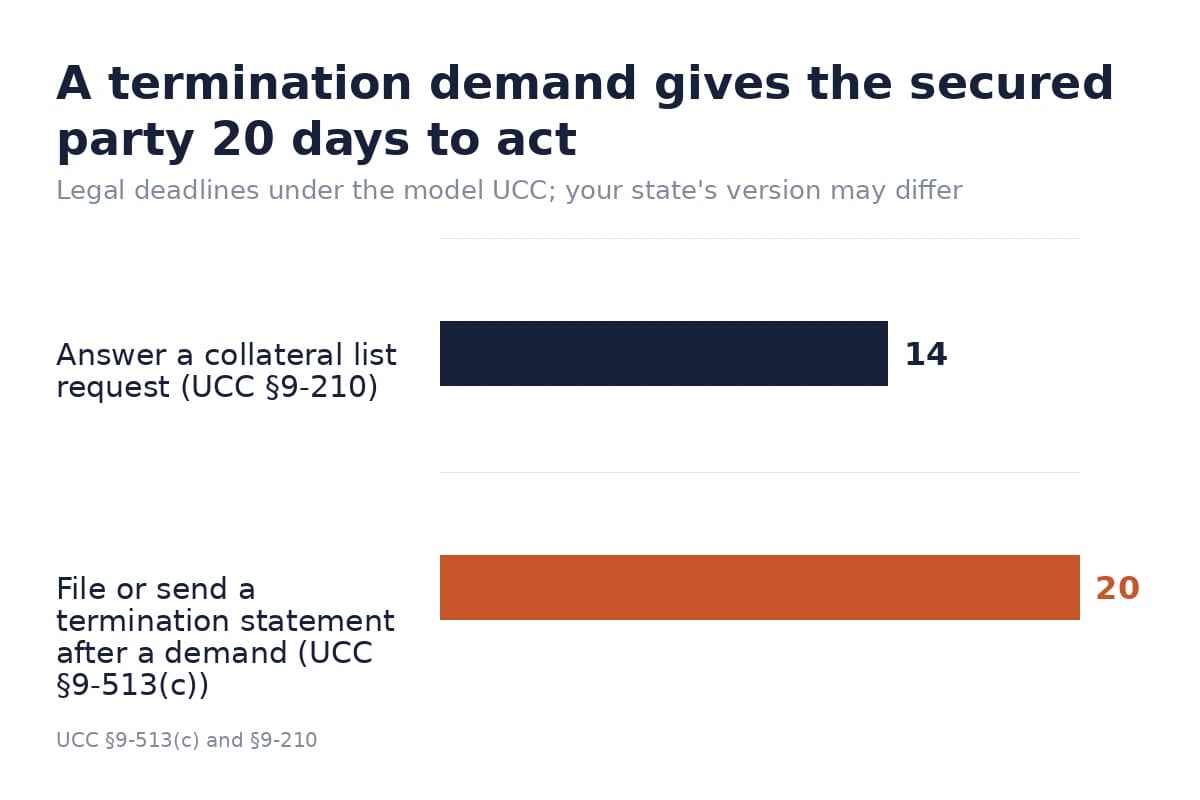
The demand: Per UCC §9-513(c), within 20 days after the secured party receives a signed demand from the debtor, it must file a termination statement or send one to the debtor. That applies when no obligation is secured and there is no commitment to make an advance. It also applies when the debtor never authorized the original filing.
If the secured party does nothing: Per UCC §9-509(d)(2), the debtor may then file the termination statement itself. The filing must say that the debtor authorized it.
Damages: Per UCC §9-625(e), a debtor may recover $500 from a person who fails to file or send a required termination statement or who files without authorization. Per §9-625(b), the debtor may also recover any loss caused, including the loss from being unable to get other financing or from paying more for it.
Check what the lender claims: Per UCC §9-210, you can ask a secured party to approve or correct a list of the collateral you believe secures the debt. It must answer within 14 days, but the duty does not apply to a buyer of accounts or payment intangibles, such as a factor that bought your invoices. One response in any six-month period is free, and each additional one can cost up to $25.
Enforcement exists: According to a 2022 FTC press release, two settling defendants in an FTC case over merchant cash advances were ordered to "release any liens against their customers' property."
Methodology: Commera illustrative timeline under the model UCC, not legal advice. It assumes a business debt, paid in full, with no commitment to lend more. Day 0 is the day the secured party receives your signed demand. Your state's version of the UCC and your agreement control.
| Step | Who acts | Timing | Rule |
|---|---|---|---|
| Send a signed demand for termination | You | Day 0 | UCC §9-513(c) |
| File a termination statement or send it to you | Secured party | By day 20 | UCC §9-513(c) |
| File the termination yourself, marked as debtor-authorized | You | After the deadline passes | UCC §9-509(d)(2) |
| Search again to confirm the termination is on file | You and the filing office | Office answers within the state's set time | UCC §9-523(e) |
Source: Commera illustrative timeline based on the model UCC sections listed.
If you are moving from one advance to another, compare revenue-based financing options only after you know which liens are still on file.
Rules differ by state, and this section is general information. Consult an attorney before you file anything yourself or claim damages.
Broker disclosure: Commera Finance is a broker, not a direct lender. Financing providers make their own eligibility, underwriting, approval, pricing, and term decisions.
Sources
- Uniform Commercial Code §9-108, via Cornell LII, accessed October 19, 2026
- Uniform Commercial Code §9-109, via Cornell LII, accessed October 19, 2026
- Uniform Commercial Code §9-210, via Cornell LII, accessed October 19, 2026
- Uniform Commercial Code §9-307, via Cornell LII, accessed October 19, 2026
- Uniform Commercial Code §9-310, via Cornell LII, accessed October 19, 2026
- Uniform Commercial Code §9-502, via Cornell LII, accessed October 19, 2026
- Uniform Commercial Code §9-504, via Cornell LII, accessed October 19, 2026
- Uniform Commercial Code §9-509, via Cornell LII, accessed October 19, 2026
- Uniform Commercial Code §9-513, via Cornell LII, accessed October 19, 2026
- Uniform Commercial Code §9-515, via Cornell LII, accessed October 19, 2026
- Uniform Commercial Code §9-523, via Cornell LII, accessed October 19, 2026
- Uniform Commercial Code §9-625, via Cornell LII, accessed October 19, 2026
- California Secretary of State, Uniform Commercial Code, accessed October 19, 2026
- SBA SOP 50 10 8.1, effective October 1, 2026, Appendix 19
- New York Financial Services Law §803, accessed October 14, 2026
- FTC press release, Merchant Cash Advance Providers Banned from Industry, Ordered to Redress Small Businesses, January 5, 2022