

Overview
Unsecured business loans give your business money without a pledge of a specific asset, such as equipment or real estate. The trade-off is often a higher price, and the agreement may still include a general lien on business property or a personal pledge to repay.
This guide is for owners who have no asset to pledge or do not want to risk one. It covers four things:
- Terms: Three ideas that search results mix up, and what each one means for you.
- Products: Which loans skip collateral, and what their agreements can still include.
- Cost: A worked example that sets one secured loan against three unsecured options.
- Contract: What to read before you sign.
What is an unsecured business loan?
An unsecured business loan is financing that is not backed by a pledge of a specific asset, such as equipment or real estate, that the lender can claim if payments stop. The lender leans on your cash flow and credit instead.
Per the Federal Reserve Banks' 2026 Report on Employer Firms, 59% of employer firms with debt backed it with a personal pledge to repay, and 51% used business assets. Only 10% reported neither collateral nor a personal pledge. The survey covers all business debt in 2025, not only unsecured loans.
"Unsecured" describes collateral. It says nothing about cost or paperwork. You still apply, pass underwriting and sign an agreement. That agreement decides what the lender can do if the business stops paying.
An unsecured loan is one of several ways to borrow. Our guide to types of small business financing compares it with secured term loans, lines of credit and advances.
Commera is a broker, not a lender. We compare offers from our lender partners.
Unsecured, no specific collateral, and a personal pledge are three different things
Unsecured, no specific collateral and a personal pledge are three different promises, and one loan can combine them. Check which ones your agreement contains.
| Concept | What you sign | What it gives the lender | Source |
|---|---|---|---|
| No security at all | A promise to repay, with no security agreement | A claim for the debt, but no security interest in your property | UCC §9-203(b) |
| No specific collateral, general lien | A security agreement that lists broad categories of business property | A security interest in those categories. The public filing may say "all assets" | UCC §9-504(2) and §9-108(c) |
| Personal pledge to repay | A separate promise by the owner to pay the business debt | A right to collect from the owner who signs personally if the business does not pay | SBA SOP 50 10 8.1, Section A, Ch. 5 |
What the UCC says: Per UCC §9-203(b), a security interest generally becomes enforceable only once the debtor signs a security agreement that describes the collateral. Per UCC §9-504(2), the public filing, called a financing statement, may say it covers "all assets or all personal property." Per UCC §9-108(c), a description like "all the debtor's assets" does not identify collateral inside the security agreement itself. So the categories listed in your agreement show what a lien reaches.
How filings are made, searched and released is a separate topic. So is how lenders value specific collateral.
Personal pledge: A personal pledge is not a lien on any asset. It is personal liability for the debt. If the business does not pay, the lender can pursue the owner who signed.
The two can sit side by side. Per SBA SOP 50 10 8.1, any person who owns 20% or more of the applicant must sign personally for the full debt. That rule holds even for SBA loans where collateral is not required.
The takeaway: "Unsecured" does not mean "nothing to sign." Ask which of the three your offer contains, and get the answer in writing.
Which business loans without collateral can you compare?

Business loans without collateral with published rules include small SBA-backed loans, SBA Express lines of credit and revenue-based advances. Banks and online lenders also sell unsecured term loans, and each agreement sets the terms.
| Product | Specific collateral | General lien possible? | Personal pledge? | Source |
|---|---|---|---|---|
| SBA 7(a) Small or SBA Express loan or line, $50,000 or less | Not required | For 7(a) Small, the lender may still take collateral under its own policies | Yes, from each owner at or above the SBA ownership threshold | SBA SOP 50 10 8.1, Section A, Ch. 1 and 5, Appendix 19 |
| Revenue-based advance or merchant cash advance | No specific asset named | Possible, depending on the agreement | Possible, depending on the agreement | FTC, RCG Advances case, 2020 and 2022 |
Small SBA loans: Per SBA SOP 50 10 8.1, Appendix 19, collateral is not required for 7(a) Small and SBA Express loans at that size. The owner signature rule from the previous section still applies. So a small SBA-backed loan can need no collateral and still make you personally liable.
Lines of credit: Per SBA SOP 50 10 8.1, SBA Express can be set up as a revolving line of credit, and the collateral rule in the table applies at the same size. Other lines set rates, fees and any lien in the agreement. For how draws, rates and fees work, see our guide to the unsecured business line of credit.
Revenue-based advances: An advance is repaid from future revenue and does not name a specific asset. According to a 2022 FTC press release, merchant cash advance companies typically make daily withdrawals from the business bank account. That says nothing about what the contract contains.
According to a 2020 FTC business blog post, RCG Advances advertised that it required no personal pledge from owners. The FTC alleged that its contracts included one anyway. Read the contract, not the ad. For how revenue-based financing works through Commera, see the product page.
What lenders check when there is no collateral
Without collateral, the review leans on cash flow and credit. Per SBA SOP 50 10 8.1, the cash flow of the business, not the sale of collateral, is the primary source of repayment for SBA-backed loans.
- Credit history: Per SBA SOP 50 10 8.1, a 7(a) Small lender reviews the personal credit reports of the owners and of anyone who signs personally.
- Cash flow: Per the same SOP, a 7(a) Small loan needs operating cash flow of at least 1.10 times the payments on all business debt, including the new loan. The lender also reviews the last 2 months of business bank statements.
- SBA: Per SBA SOP 50 10 8.1, Appendix 19, a lender must not decline a 7(a) request solely because collateral is inadequate. You still have to show repayment ability.
- Revenue-based financing: Per Commera's revenue-based financing page, providers review 3 to 4 months of business bank statements.
These rules cover SBA-backed loans and one product page. Other lenders set their own criteria, and none of this is a promise of approval. Options for owners with weak credit are a separate subject.
If the need is short-term, compare these loans with working capital loans. Those cover gaps such as payroll and inventory.
How much more does an unsecured loan cost? A worked example
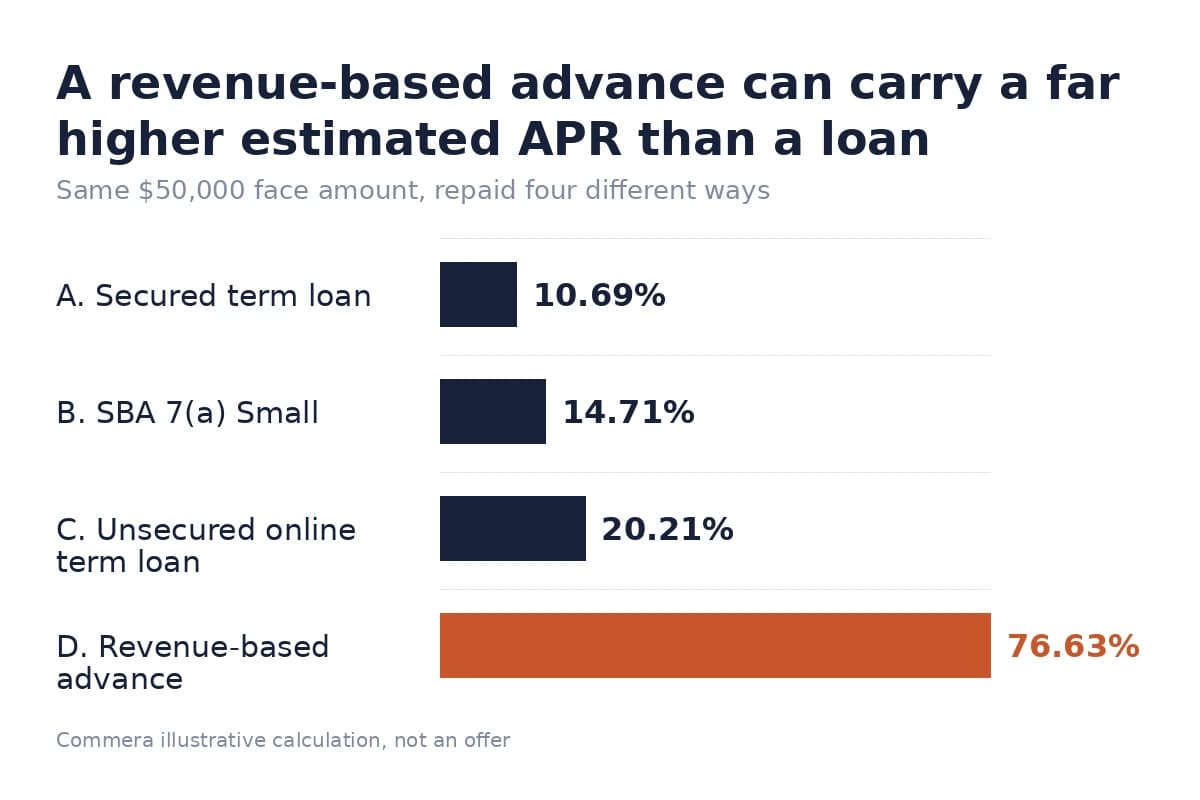
An unsecured loan can cost more than a secured one, but fees and repayment speed matter as much as the label. The example below prices one amount four ways.
Methodology: Commera illustrative calculation with assumed inputs, not an offer and not a real deal. Every option has a face amount of $50,000.
The three loans run 36 months with equal monthly payments. Fees are withheld at funding.
The rates for A, C and D are assumptions, and so are the fees for A and C. Rate B is the SBA ceiling for variable-rate 7(a) loans of this size, Prime plus 6.5%, per SBA SOP 50 10 8.1. Prime is 7.00%, per the Federal Reserve H.15 release for October 9 to 15, 2026. Rate B is held flat for the whole term.
B's fee is the FY2027 upfront fee of 2% of the SBA-backed share, per SBA Information Notice 5000-881797. The share is 85%, as in the SOP's own fee example. The example assumes the business is not in a zero-fee category.
In this Commera illustrative calculation, D is repaid in equal debits each business day. Estimated APR is the internal rate of return of the cash flows. For loans it is the monthly rate times 12, and for D the daily rate times 252 business days.
No prepayment and no late payments are assumed.
| Option | Amount, $ | Rate or factor | Term | Withheld at funding, $ | Cash in hand, $ | Payment, $ | Total repayment, $ | Cost, $ | Est. APR, % |
|---|---|---|---|---|---|---|---|---|---|
| A. Secured term loan, lien on equipment | 50,000 | 10.00% fixed | 36 months | 500 | 49,500 | 1,613.36 monthly | 58,080.94 | 8,580.94 | 10.69 |
| B. SBA 7(a) Small, no collateral, owner signs personally | 50,000 | 13.50% variable | 36 months | 850 | 49,150 | 1,696.76 monthly | 61,083.52 | 11,933.52 | 14.71 |
| C. Unsecured online term loan | 50,000 | 18.00% fixed | 36 months | 1,500 | 48,500 | 1,807.62 monthly | 65,074.31 | 16,574.31 | 20.21 |
| D. Revenue-based advance | 50,000 | Factor 1.30 | 180 business days | 0 | 50,000 | 361.11 daily (1,805.56 weekly) | 65,000.00 | 15,000.00 | 76.63 |
Source: Commera illustrative calculation, not an offer. Totals use unrounded payments. Cost equals total repayment minus cash in hand.
Rates are not APR. Factor rates do not represent APR.
Real terms are set by financing providers and are subject to underwriting.
What changes: In this calculation, every unsecured loan row costs more than the secured loan A. B still asks the owner to sign personally, so "no collateral" does not mean "no personal risk."
Dollars versus APR: Per the Commera illustrative calculation above, D costs fewer dollars than C. Yet D's estimated APR is 76.63% against 20.21% for C. D is repaid in 180 business days, so the same cost lands on money you hold for a much shorter time. If D also carried a 2.5% fee withheld at funding, its estimated APR would rise to 84.44% in this calculation.
How to compare: Compare estimated APR, total repayment and cash in hand together. One number alone can mislead.
Read factor rate versus APR before you set an advance against a loan. When you are ready, you can compare business loan offers through Commera.
What to check in the agreement before you sign
Before you sign an unsecured business loan, read the agreement for collateral, personal liability and cost. This checklist is general information, not legal advice.
- Security agreement: Is there one? If so, which categories of property does it list?
- UCC filing: Will the lender file a financing statement? Does it say "all assets"?
- Who signs personally: Which owners sign? Is the pledge for the full debt or a capped amount? Is a spouse asked to sign?
- Confession of judgment: Does the contract let the provider get a court judgment without a contest? According to the 2022 FTC press release above, the FTC alleged that defendants used these clauses to pursue customers' personal assets in court.
- Collateral disclosure: Per New York Financial Services Law §803(i), a provider of sales-based financing must describe "collateral requirements or security interests, if any." Ask for the same description in any state.
- Cost and exit: Get the estimated APR, total repayment and prepayment terms in writing.
Rules differ by state. If a clause is unclear, have an attorney review the agreement before you sign.
Broker disclosure: Commera Finance is a broker, not a direct lender. Financing providers make their own eligibility, underwriting, approval, pricing, and term decisions.
Sources
- Uniform Commercial Code §9-203, via Cornell LII, accessed October 19, 2026
- Uniform Commercial Code §9-504, via Cornell LII, accessed October 19, 2026
- Uniform Commercial Code §9-108, via Cornell LII, accessed October 19, 2026
- SBA SOP 50 10 8.1, effective October 1, 2026, Section A, Ch. 1 and 5, Section B (7(a) Small underwriting), Appendix 19 and Quick Reference Chart
- SBA Information Notice 5000-881797, FY 2027 7(a) program fees
- Federal Reserve, H.15 Selected Interest Rates, release of October 16, 2026
- Federal Reserve Banks, 2026 Report on Employer Firms: Findings from the 2025 Small Business Credit Survey, March 2026
- FTC Business Blog, Looking for small business financing? Read this first, June 10, 2020
- FTC press release, Merchant Cash Advance Providers Banned from Industry, Ordered to Redress Small Businesses, January 5, 2022
- New York Financial Services Law §803, accessed October 14, 2026