
Overview
A business debt consolidation loan replaces several obligations with one new facility. The goal is often a lower required payment, fewer withdrawal dates, or both.
A lower payment does not always mean a lower cost. A longer term can reduce pressure now while increasing total interest and fees. The useful question is whether the new schedule gives the business enough room to stabilize and whether operating cash flow can support the payment.
Owners often compare business debt refinancing when they need to consolidate business debt into one controlled schedule. The analysis should still separate payment relief from total cost.
Keep the search intent clear. A working capital loan adds liquidity for operations, while business loans no personal guarantee describes a requested guaranty structure. Neither term is interchangeable with a consolidation facility that pays off existing obligations.
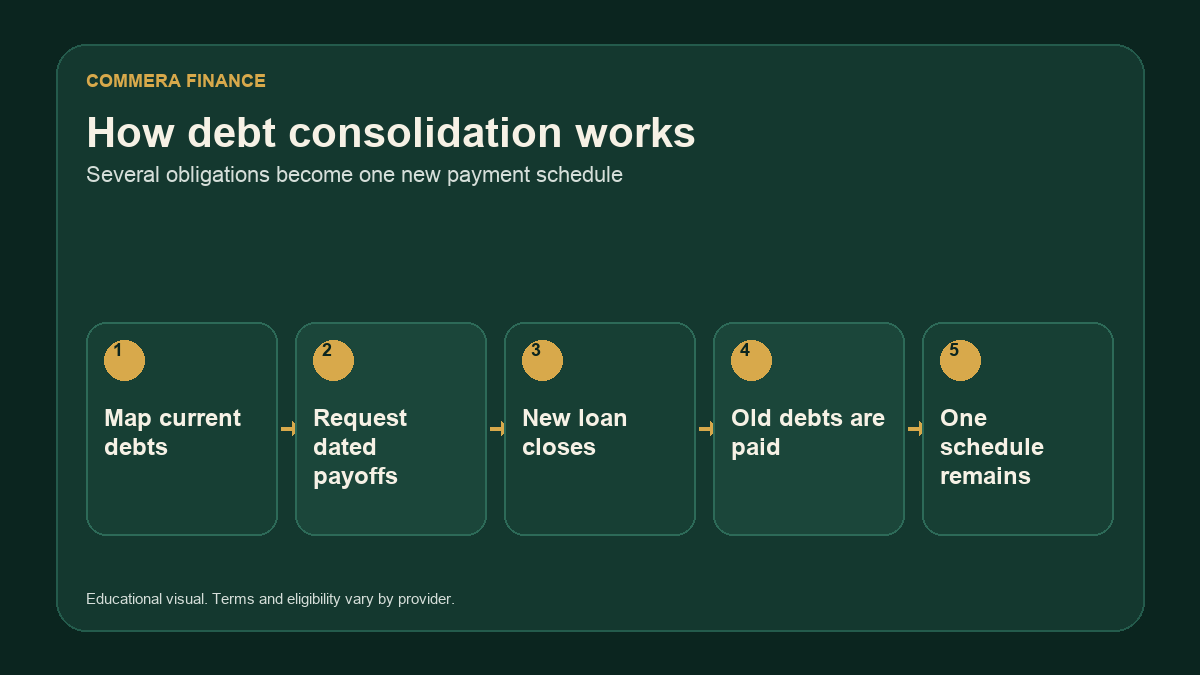
*A consolidation loan replaces old obligations but may also change cost, liens, and guaranties.*
What consolidation can change

A new loan may pay off term loans, lines, equipment debt, or daily debit products. It can change more than the number of payments:
- Repayment term and payment frequency
- Interest rate or another pricing method
- Collateral and lien priority
- Personal guaranties
- Prepayment rules
- Reporting requirements
- Total dollars paid through maturity
The lender will usually want dated payoff statements from every creditor. Existing liens may need to be released or subordinated. If the new loan includes working capital, show that amount separately. Otherwise, added borrowing can look like payment savings.
SBA states that 7(a) proceeds can be used to refinance current business debt, subject to program and lender requirements. See the SBA 7(a) loan overview. SBA also says applicants must be creditworthy and show a reasonable ability to repay in its 7(a) terms, conditions, and eligibility guidance. An SBA guaranty supports the lender, while the lender and SBA still determine borrower eligibility and credit approval.
Government program benchmarks, not offer terms
These published limits are screening context, not a quote for any applicant:
- According to the SBA 7(a) overview, the program maximum is $5 million.
- According to the SBA program comparison, most 7(a) term loans have maturities of 10 years or less, while real estate financing can extend to 25 years.
- According to the SBA lender guide, 7(a) Small loans have a $350,000 maximum, and the maximum federal share is 85 percent up to $150,000 and 75 percent above that threshold.
Those figures do not predict the amount, term, price, collateral, or decision for a particular business. Compare any bank or business term loan proposal on its own signed terms.
Build a complete debt map
List every obligation before requesting quotes. For each one, record:
- Current payoff amount and the date through which it is valid
- Required payment and frequency
- Number of payments remaining
- Interest rate, noninterest pricing multiplier, or purchased amount
- Prepayment premium or payoff discount
- Collateral, UCC filings, and guarantors
- Automatic debit terms
- Past due amounts and default charges
- Whether the creditor will release or subordinate its lien
Do not estimate a payoff from an account dashboard. Daily interest, pending debits, and fees can change the closing amount.
This map may show that payment timing is the main problem. A profitable company can still run short when several daily or weekly withdrawals hit before customers pay. A funding readiness audit can test the schedule against a dated cash forecast before offers are compared.
Compare payment relief with total cost
Use four figures:
| Measure | Why it matters |
|---|---|
| Next month of old payments | Shows immediate pressure |
| Remaining old scheduled payments | Gives a baseline if nothing changes |
| New total scheduled payments | Shows the cost of the proposed schedule |
| Monthly cash released | Shows the liquidity created by refinancing |
Ask every provider for the same comparison fields: funds provided, total dollar cost, term, payment method and frequency, and prepayment policy. Coverage rules vary by transaction and jurisdiction, but using one worksheet helps expose differences between proposals.
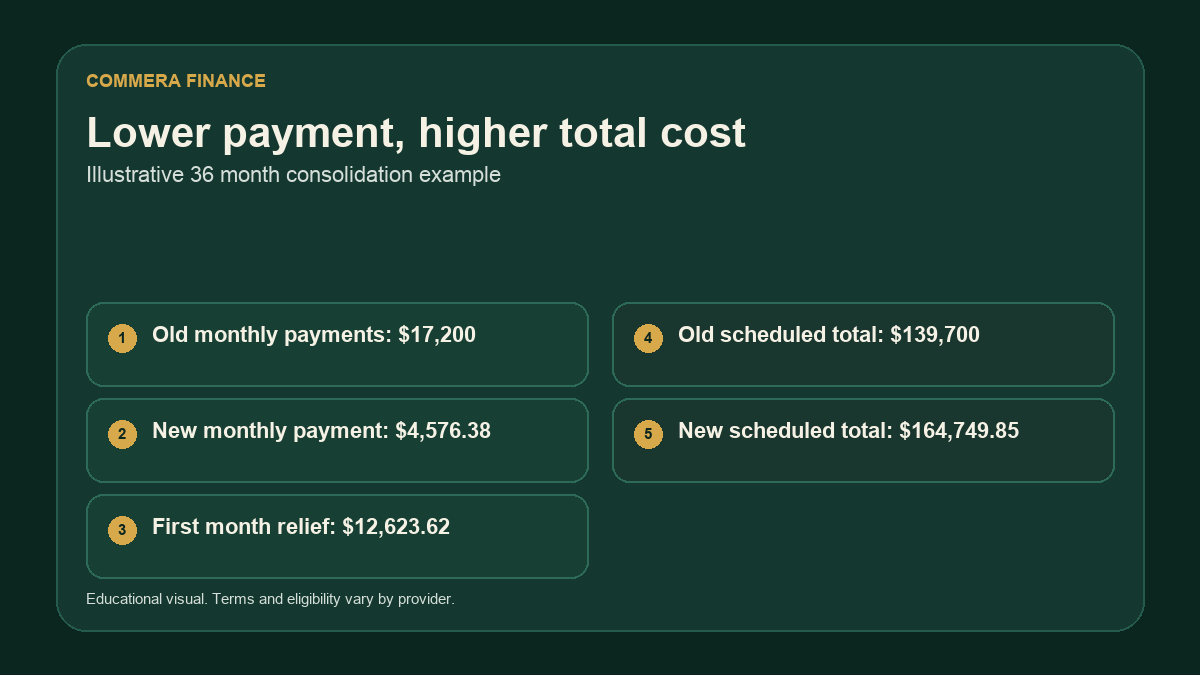
*Payment relief can be valuable even when a longer schedule increases total cost.*
Illustrative example: payment falls while total cost rises
Methodology: This is an author calculation from the stated assumptions, not an observed customer result or financing quote. All figures below are illustrative.
Assume three existing debts:
- For example, Debt A has a $70,000 payoff and ten monthly payments of $7,500 left.
- For example, Debt B has a $40,000 payoff and eight monthly payments of $5,400 left.
- For example, Debt C has a $20,000 payoff and five monthly payments of $4,300 left.
| Illustrative measure | Calculation | Result |
|---|---|---|
| Combined payoff | $70,000 + $40,000 + $20,000 | $130,000 |
| First-month old payments | $7,500 + $5,400 + $4,300 | $17,200 |
| Remaining old scheduled payments | ($7,500 x 10) + ($5,400 x 8) + ($4,300 x 5) | $139,700 |
| New principal | $130,000 + $3,900 financed fees | $133,900 |
For example, assume the new loan carries a 14 percent nominal annual interest rate, amortizes through 36 monthly payments, and has no other charges. Using the standard amortizing payment formula with a monthly rate of 14 percent divided by 12, the modeled payment is $4,576.38 and the modeled total of payments is $164,749.85.
For example, the first-month payment reduction is $17,200 minus $4,576.38, or $12,623.62. A separate comparison subtracts the old scheduled total from the new modeled total: $164,749.85 minus $139,700 equals $25,049.85 of additional scheduled cost. Dividing that added cost by $12,623.62 shows that it equals just under two months of the initial payment relief.
The model makes the tradeoff explicit. Lower required payments can create room, but the longer schedule and financed fees can raise total cost. The owner still needs a written use for the released cash. Preventing missed payroll or funding profitable orders may support the choice. A more comfortable payment by itself does not.
Common consolidation structures
| Structure | Possible benefit | Main concern |
|---|---|---|
| Bank or credit union term loan | Fixed schedule may spread repayment | Qualification can be strict and the process can take time |
| SBA backed 7(a) loan | May support eligible refinancing and a longer structure | Documentation, eligibility, and lender review still apply |
| Online term loan | May move faster | A short term or high total cost may provide little relief |
| Asset based facility | Availability can follow receivables or inventory | Borrowing capacity can fall if collateral weakens |
| Creditor modification | Changes terms without a new lender | It may not address every debt or add working capital |
Ask the provider to separate creditor payoffs, new working capital, origination charges, third party costs, and any broker compensation.
When consolidation can help
A business debt consolidation loan is stronger when the company has a payment timing problem rather than a permanent profitability problem. Helpful signs include:
- Operating cash flow is positive before current debt service.
- The new payment fits a conservative forecast.
- The debt originally funded assets or work that now produce revenue.
- The new term matches the useful life of what was financed.
- Paid off accounts will be closed or controlled.
- The business has a written plan for the cash released each month.
The OCC warns lenders to assess whether a borrower can refinance under reasonable future conditions rather than relying only on current collateral. See the OCC bulletin on refinance risk. An owner can apply the same test: if the new loan came due during a weak quarter, would operations provide a repayment path?
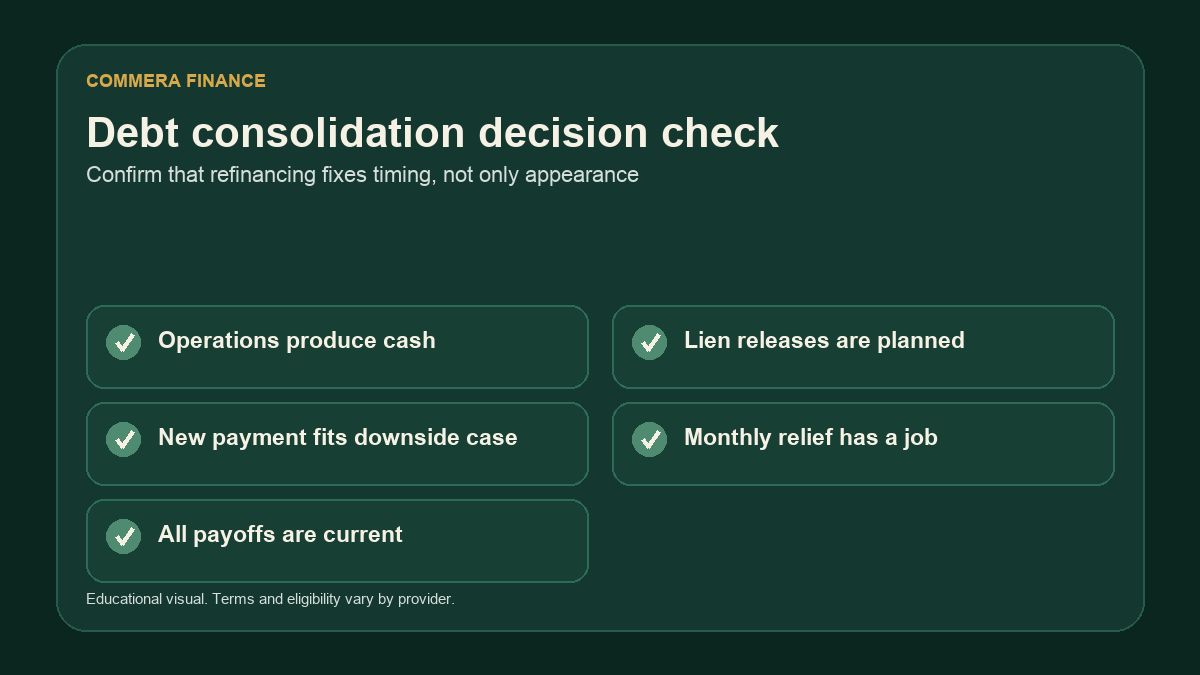
*Refinancing is stronger when the business has a clear repayment source and a plan for released cash.*
When consolidation only delays the problem
Refinancing does not create a repayment source. If operations lose cash before debt payments, a lower payment may only extend the runway.
Other warning signs include:
- Tax, rent, or vendor arrears remain after closing.
- A revolving account paid off at closing can be drawn again.
- Fees consume the expected working capital.
- The new lender takes a blanket lien that blocks another assumed facility.
- The forecast depends on immediate sales growth.
- Automatic debits continue after the old debt is paid.
The FTC's case against Yellowstone Capital included allegations of unauthorized withdrawals and misleading statements about funding amounts and product features. The FTC case page concerns that matter, not every provider. It still shows why the signed agreement and closing statement should match the debits that actually leave the account.
Build a closing bridge
Start with each dated payoff letter and end with the new principal. Show:
- Payoff dollars and accrued amounts
- Premiums, discounts, and fees
- Costs paid in cash and costs financed
- New working capital
- Net cash delivered to the business
- First payment date and every scheduled payment
- Payoff calculations at future dates
Attach a lien plan. Identify which UCC filings will end, which creditors must subordinate, and which accounts and debits must close. Then test the new payment under both a moderate and a severe revenue decline. Show cash left after payroll, taxes, rent, inventory, and debt service.
Does consolidation reduce principal?
Not automatically. Financed fees and added working capital can make the new principal larger than the combined payoffs.
Can SBA 7(a) refinance business debt?
SBA lists refinancing current business debt as a possible use. Current program rules and lender underwriting still control the transaction.
Should the new loan include working capital?
Only when the amount has a named use and a credible repayment source. Keep it separate from payoff proceeds in the closing bridge.
Give the payment relief a job
A consolidation decision needs two tests. First, confirm that the new payment fits under conservative operating assumptions. Second, decide whether the cash released each month will rebuild reserves, cure a named payable, fund profitable work, or reduce principal.
A complete application should include the debt map, dated payoffs, closing bridge, lien plan, and downside forecast so the lender can evaluate the actual transaction. If the paid off balances return after closing, the business has added debt instead of solving it.
Broker disclosure: Commera Finance is a broker, not a direct lender. Financing providers make their own eligibility, underwriting, approval, pricing, and term decisions.