

Overview
Commercial truck leasing comes in two broad forms: a full-service lease, where the lessor maintains the truck, and a finance lease, where you pay for repairs yourself. The choice decides who pays the shop, who carries the truck's value at lease end and what you owe each month.
This guide prices a full-service, a TRAC and a buyout lease on one tractor. It then finds the maintenance cost per mile at which full service pays for itself.
What is commercial truck leasing?
Commercial truck leasing is an agreement that gives a business the use of a truck for a set term in exchange for scheduled payments, while the lessor keeps title unless the truck is bought. The lease type sets the rest: maintenance, mileage and the end of the term.
A lease is not a loan; ownership, tax treatment and end-of-term obligations depend on the lease type and the specific contract. Consult a tax advisor.
Commera is a broker, not a lender. We compare offers from our lender partners. Leasing is one way to put a truck on the road. Pickups, vans and mixed fleets are covered in our guide to commercial vehicle financing.
Is this an equipment lease or leasing on to a carrier?
The word "lease" means two different things in trucking. This article covers an equipment lease, where a leasing company lets your business use a truck. Federal rules use the same word for putting equipment under a carrier's authority.
Under 49 CFR 376.2(e), a lease is an arrangement in which the owner grants the use of equipment, with or without driver, to an authorized carrier for compensation. Part 376 requires a written lease for that arrangement. The lease must give the carrier exclusive possession, control and use of the equipment for its duration.
Part 376 also lists exemptions. Per Section 376.21(c), the leasing rules, apart from the equipment identification requirement, do not cover equipment leased without drivers from a person principally engaged in that business. That describes the leases in this article. A leasing company hands you a tractor, and you supply the driver.
Leasing on to a carrier is a separate topic. If you are setting up your own authority first, start with how to start a trucking business.
Full-service, TRAC and finance leases: what each one covers
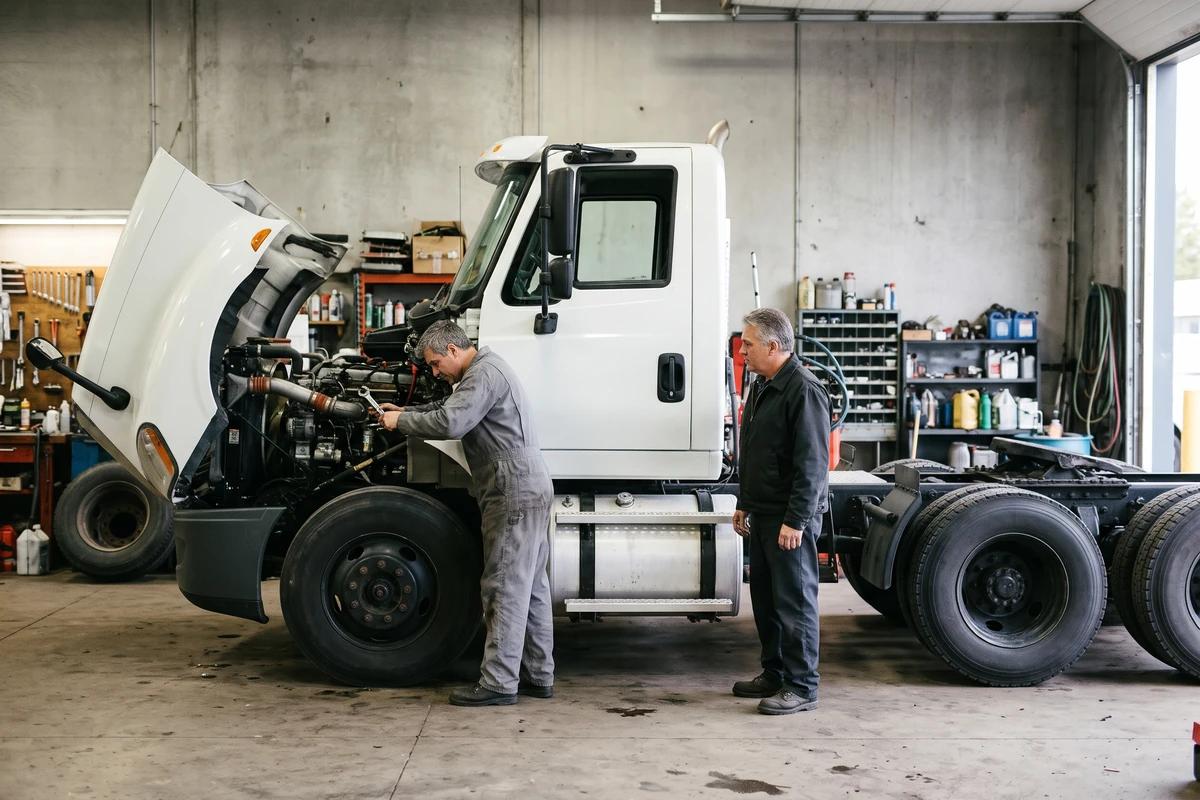
A full-service lease bundles the truck with maintenance and support, while TRAC and finance leases cover the truck alone. The lease types also split the risk of the truck's value at the end. The table compares them.
| Lease | Who pays maintenance | Residual risk | Mileage terms | End of term |
|---|---|---|---|---|
| Full-service | Lessor, per contract | Set by the contract | Set by the contract | Set by the contract |
| TRAC | Lessee | Lessee, against a preset residual | Per contract | Truck is sold; lessee pays or receives the difference from the residual |
| Finance lease | Lessee | Lessee | Per contract | Lessee buys the truck for a nominal amount |
Sources: the federal TRAC definition and the UCC lease test, both linked below. Full-service terms differ from one lessor to the next, so the table leaves them to the contract.
Full-service. A full-service lessor runs the truck's upkeep. What a full-service lease includes is set by the contract, so read the service list before you sign.
TRAC. A TRAC lease is a lease with a terminal rental adjustment clause, which moves the final rent up or down by the truck's value at the end. Under 26 U.S.C. 7701(h), the lessee certifies that it intends more than 50 percent of the truck's use to be in its trade or business. For the settlement mechanics, see how a TRAC lease settles the residual.
Finance lease. A finance lease suits a buyer who is reasonably sure to keep the truck. It ends with an option to buy the truck for a nominal amount, such as $1. Under UCC 1-203(b)(4), a lease that the lessee cannot terminate, with an option to become the owner for nominal additional consideration, creates a security interest.
Worked example: three leases on one $150,000 tractor
In a Commera illustrative calculation, the full-service lease has the highest mandatory payments, but it is the only one that includes maintenance. The TRAC lease has the smallest monthly payment and leaves the truck's end value with you.
Methodology: Commera illustrative calculation with assumed figures. It is not an offer, a quote or a real deal.
In this illustrative case, the truck is a new Class 8 day cab at the price in the heading, federal excise tax included. The term is 60 months, within the terms on Commera's equipment financing page and subject to underwriting. The truck runs 100,000 miles a year, or 500,000 over the term.
TRAC and buyout payments are monthly in advance at an assumed implicit rate of 9.50%. For reference, the bank prime rate is 7.00% per Federal Reserve H.15. Both leases carry an assumed $400 fee at signing. The TRAC residual is 20% of cost.
The full-service terms are an illustrative assumption, not a market price: $3,300 a month plus $0.20 a mile. Its deposit equals one payment and is refunded if the contract terms are met.
| Item | Full-service lease | TRAC lease | $1 buyout lease |
|---|---|---|---|
| Equipment cost, $ | 150,000 | 150,000 | 150,000 |
| Due at signing, $ | 3,300 first payment + 3,300 refundable deposit | 2,736.06 first payment + 400 fee | 3,125.52 first payment + 400 fee |
| Monthly payments, $ × number | 3,300 × 60 | 2,736.06 × 60 | 3,125.52 × 60 |
| Mileage charge, $ | 0.20 a mile, 100,000 at 500,000 miles | None | None |
| Mandatory payments over term, $ | 298,000 | 164,563.60 | 187,931.20 |
| Maintenance and repairs | Included per contract | Lessee | Lessee |
| End of term | Return truck; wear charges per contract | Residual 30,000 settled on sale: sells at 24,000, lessee pays 6,000; sells at 36,000, lessee receives 6,000 | Buy for 1 |
| Acquisition cost, $ | n/a | 194,563.60 if bought at residual | 187,932.20 |
| Est. APR, % | n/a; lease cost for the term is 298,000 | 9.60 (buy at residual) | 9.62 |
Mandatory payments are the fee plus every monthly payment, with the first counted once, plus the mileage charge. The deposit sits on its own line. The buyout is not included. Acquisition cost adds the buyout to the mandatory payments.
Est. APR is an IRR on dated cash flows. Month 0 is the truck cost less the first payment and the fee. Months 1 to 59 are payments, and the final month is the buyout, with the monthly rate multiplied by 12.
The implicit rate is not the est. APR. A full-service lease has no buyout. No APR is shown for it.
If the TRAC truck is sold instead of bought, the cost depends on the sale price and no APR applies.
Worked example: when a full-service lease pays for itself

A full-service lease pays for itself when your own maintenance would cost more per mile than the gap between the two leases. In this Commera illustrative calculation, the break-even sits above the industry average for every sale price tested.
Methodology: The same assumed leases as the previous example, with assumed sale prices at lease end. Break-even maintenance equals the full-service mandatory payments, less the TRAC mandatory payments and the TRAC adjustment, divided by the miles over the term. A TRAC payment at lease end adds to your cost, and a TRAC refund lowers it. This is not an offer.
| Truck sells at lease end for, $ | TRAC adjustment, $ | Break-even maintenance, $ a mile |
|---|---|---|
| 24,000 | +6,000 paid | 0.255 |
| 30,000 | 0 | 0.267 |
| 36,000 | 6,000 received | 0.279 |
Repair and maintenance costs rose 8.6% in 2025 to an average $0.22 a mile, according to ATRI data reported by FleetOwner. At that average, the TRAC lease plus your own maintenance comes to $274,563.60 in this illustration. That is $23,436.40 less than the full-service lease.
The gap is the price of predictable costs, replacement trucks and someone else doing the paperwork. Some fleets will pay it gladly. Others will keep the money and run their own shop.
The average is not your fleet. A new truck under warranty tends to cost less to keep running, and an older truck costs more. Pull your own repair records and work out your cost per mile.
If it lands above the break-even in the table, full service pays in this illustration. If it lands below, TRAC plus your own maintenance costs less.
What to check in a commercial truck lease before you sign
A commercial truck lease is only as cheap as its fine print. Check the mileage, wear, exit and tax terms before you sign. Each one changes the total cost.
- Mileage charge. Ask how the per-mile charge is set and how miles are verified. Ask what happens if the truck runs more or fewer miles than planned.
- Excess wear. Get the return standard in writing, with examples of what counts as chargeable damage.
- Early termination. Ask what you owe if you end the lease early, and whether the lease can be transferred.
- Replacement truck. On a full-service lease, check when a substitute is provided, how fast it arrives and who pays for it.
- Registration, taxes and fees. Confirm who registers the truck and who pays licensing, taxes and fees each year.
- Federal excise tax. Per IRS Publication 510, a 12% tax applies to the first retail sale of heavy trucks and tractors. A lease of 1 year or more before that sale counts as a taxable sale, and the tax is imposed on the lessor. Ask whether the tax is built into the price.
- Insurance. Ask what coverage the lessor requires and whose name goes on the policy.
A lease is not the only route. If you plan to keep the truck for its full working life, compare the lease with a purchase financed by a loan. Truck loans and carrier lease-purchase programs are covered in our guide to semi truck financing. Commera's equipment financing page covers both financing and leasing for commercial vehicles, subject to underwriting.
Broker disclosure: Commera Finance is a broker, not a direct lender. Financing providers make their own eligibility, underwriting, approval, pricing, and term decisions.
Sources
- eCFR, 49 CFR Part 376, Lease and Interchange of Vehicles, sections 376.2, 376.11, 376.12 and 376.21
- 26 U.S.C. 7701(h), Motor vehicle operating leases, Cornell LII
- UCC 1-203, Lease distinguished from security interest, Cornell LII
- IRS, Publication 510, Excise Taxes
- FleetOwner, ATRI report breaks down Class 8 truck operating costs by region and expense category
- Federal Reserve, H.15 Selected Interest Rates, bank prime loan rate