
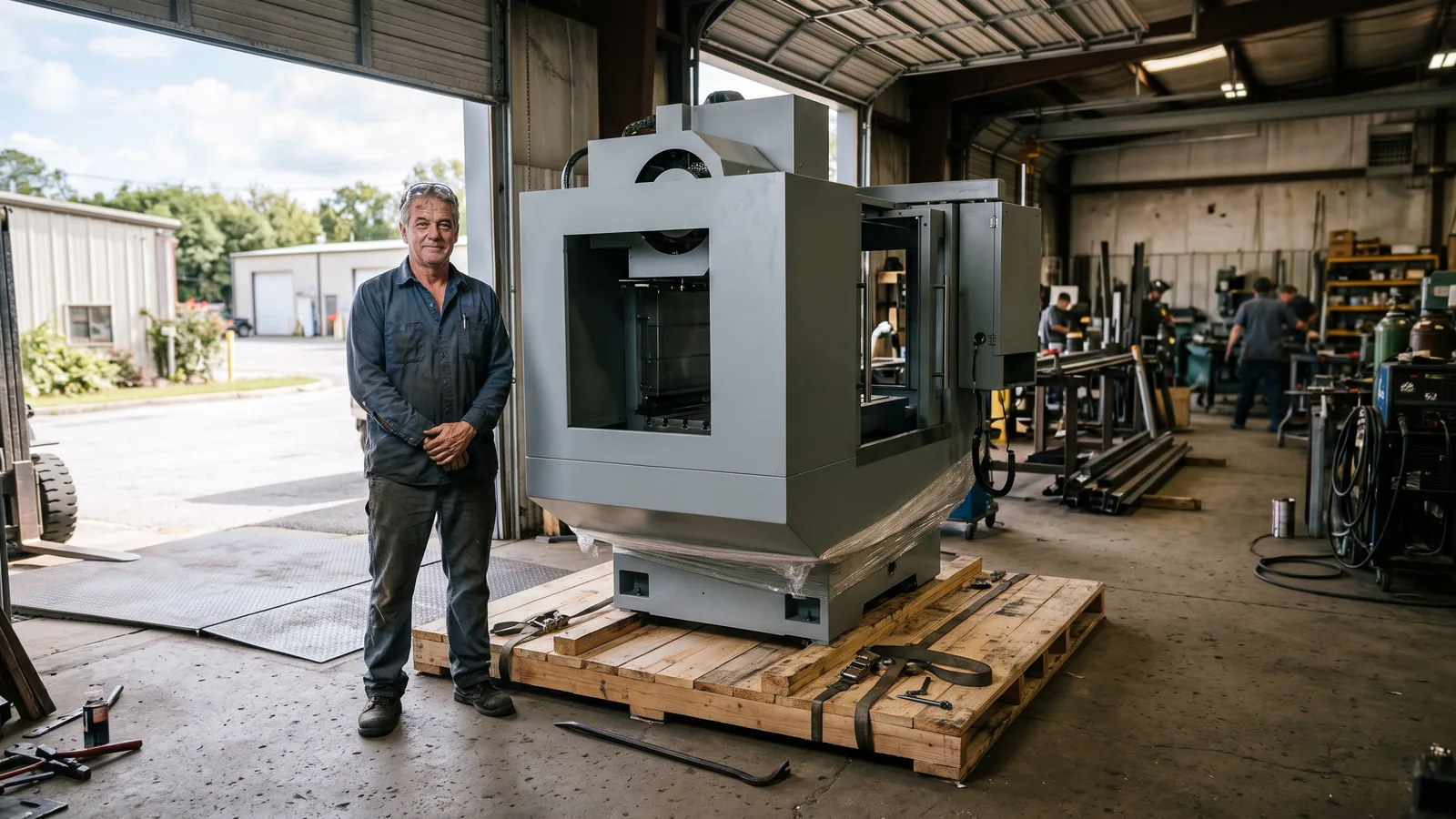
What is equipment leasing?
Equipment leasing is a contract that lets a business use equipment for a fixed term in exchange for scheduled payments, while the lessor keeps title until any purchase option is used. The lease type decides what you pay at signing, what you owe at the end, and whether you ever own the machine.
Every lease ends in one of three ways. You buy the equipment. You return it. Or you renew for another term.
The contract sets which of those you may choose and at what price.
A lease is one route to new equipment, and a loan is the other. Our guide to equipment financing covers that choice. Here we assume you already hold a lease quote and want to know what it really costs.
Commera is a broker, not a lender. We compare offers from our lender partners.
How do equipment leases work, from quote to last payment
An equipment lease works in four steps: you pick the machine, a lessor buys it from the supplier, you accept delivery, and you pay on schedule until the term ends.
Three parties are involved. You are the lessee. The lessor owns the equipment. The supplier, often a dealer or the manufacturer, sells it to the lessor.
A business equipment lease can fit the UCC definition of a finance lease. Under UCC § 2A-103(1)(g), the lessor in a finance lease does not select, manufacture, or supply the goods. It acquires them in connection with the lease. In plain terms, the lessor is the money, not the dealer.
That status has a sharp consequence. Under UCC § 2A-407, the lessee's promises in a finance lease that is not a consumer lease become irrevocable and independent once the lessee accepts the goods. From then on, they cannot be cancelled or modified without the consent of the party they run to.
So a finance lease does not end because the machine disappoints you. Complaints about the equipment go to the supplier and its warranty. Payments to the lessor continue. An early exit exists only if the contract writes one in.
State law can differ; ask an attorney about your own contract.
The money side follows the quote. A lease can bill payments in advance or in arrears, and the quote should say which. With payments in advance, the first payment is due at signing, together with any fees and any deposit. Approval, the rate built into the payment, and the term are all subject to underwriting by the lessor.
Equipment lease types: $1 buyout, 10% option, FMV, and TRAC

Equipment lease types differ mainly in who carries the risk of what the machine is worth when the term ends. The lower the price fixed for the end of the term, the more of the machine you pay for through the monthly payments.
| Lease type | Who carries resale risk | How it ends | Usual fit |
|---|---|---|---|
| $1 buyout | You | You buy the machine for a nominal price | You plan to run the machine for its working life |
| 10% purchase option | Mostly you | You buy at a fixed percentage of cost, or return it | You expect to keep it but want a smaller payment |
| Fair market value (FMV) | The lessor | You buy at market value, return it, or renew | Equipment you may replace when the term ends |
| TRAC | Shared, by a formula in the contract | Rent is adjusted against what the vehicle sells for | Motor vehicles and trailers only |
The legal line between a lease and a disguised purchase sits in UCC § 1-203. Under § 1-203(b)(4), a lease the lessee cannot terminate creates a security interest when the lessee may become the owner for no or nominal additional consideration. A $1 buyout fits that test. Under the UCC, it works like a secured sale, not a true lease.
Per UCC § 1-203(c)(6), an option to buy at a fixed price equal to or above the reasonably predictable fair market value does not, by itself, create a security interest. A 10% option sits between the two. Per § 1-203(a), whether it creates a lease or a security interest is decided by the facts of each case. An option priced at fair market value on the day it is used is not nominal, per § 1-203(d).
A terminal rental adjustment clause, or TRAC, belongs to vehicles. Under 26 U.S.C. § 7701(h)(2)(A), the agreement it covers concerns a motor vehicle, including a trailer. A TRAC on a machine tool falls outside that definition. For trucks and trailers, read our guide to the TRAC lease.
A sale-leaseback runs the other way: you sell equipment you already own to a lessor and lease it back.
Worked example: $1 buyout vs 10% purchase option on a $100,000 machine
A $1 buyout lease has a higher monthly payment than a 10% purchase option on the same machine, yet it ends in ownership for a nominal price. The Commera illustrative calculation below shows both, with the FMV lease alongside for the next section.
Methodology: Commera illustrative calculation, not an offer and not a real deal. The machine cost is in the first row of the table. There are 48 monthly payments in advance, the first one due at signing.
The implicit rate is 10.00%, an illustrative assumption that is not an APR. A documentation fee of $395 is paid at signing. There are no mandatory end-of-term fees. Taxes, delivery, and insurance are left out.
Est. APR is a monthly IRR: the machine cost as an inflow at signing, the first payment and fee (for FMV, also the deposit) out at signing, 47 further payments, and the end price in month 48 (for FMV, the deposit comes back).
| Item | $1 buyout | 10% purchase option | FMV |
|---|---|---|---|
| Equipment cost, $ | 100,000 | 100,000 | 100,000 |
| Residual used to price the lease, $ | 1 | 10,000 | 15,000 (assumed lessor estimate) |
| Monthly payment, 48 payments in advance, $ | 2,515.28 | 2,346.41 | 2,261.97 |
| Documentation fee at signing, $ | 395 | 395 | 395 |
| Due at signing, first payment + fee, $ | 2,910.28 | 2,741.41 | 2,656.97 |
| Refundable security deposit, $ | 0 | 0 | 2,261.97, returned at the end if lease terms are met |
| Mandatory contract payments, fee + 48 payments, $ | 121,128.44 | 113,022.68 | 108,969.56 |
| End of term | Buy for $1 | Buy for $10,000 or return | Buy at FMV, return, or renew |
The mandatory payments do not include the optional purchase price. Add it only in the scenario where you buy.
| Scenario | Paid at end, $ | Total, $ | Owns it? | Est. APR, % |
|---|---|---|---|---|
| $1 buyout, buy | 1 | Acquisition cost 121,129.44 | Yes | ≈ 10.22 |
| 10% option, buy | 10,000 | Acquisition cost 123,022.68 | Yes | ≈ 10.20 |
| 10% option, return | 0 | Cost of lease over term 113,022.68 | No | Not calculated |
Read the rows in pairs. In this Commera illustrative calculation, the 10% option lowers the monthly payment. Bought out at the end, though, it costs more in total than the $1 buyout, because the option price arrives in one lump in month 48. Returned, it costs the least of the three rows, and you walk away with nothing.
The implicit rate is not an APR. Both leases in this illustrative calculation are priced at the same assumed rate. Yet the estimated APR of the $1 buyout comes out higher, because the fee is paid at signing on top of the first payment. Without the fee, the IRR of the same cash flows equals the implicit rate.
To test your own quote, rebuild both tables with the fee, deposit, and end price from your contract.
Worked example: FMV lease, return it or buy it
An FMV lease has the smallest monthly payment of the three in this example, and it costs the least only if you return the machine. If you buy it at the end, the market price you pay decides the result.
Methodology: Commera illustrative calculation with the same inputs as the first worked example. Two more assumptions apply here.
Return freight is an illustrative $1,500. Fair market value at the end of the term is $20,000. The real FMV is set under the contract at the end of the term, not by this example. In both rows the deposit is returned because the lease terms are met.
| Scenario | Paid at end, $ | Total, $ | Owns it? | Est. APR, % |
|---|---|---|---|---|
| FMV, return (return freight, assumed) | 1,500 | Cost of lease over term 110,469.56 | No | Not calculated |
| FMV, buy at the assumed FMV | 20,000 | Acquisition cost 128,969.56 | Yes | ≈ 12.21 |
The return row has no APR. You do not end up owning anything, so the honest number is the cost of the lease over its term. Compare it with renting a similar machine, not with a loan.
The buy row tells a different story. In this Commera illustrative calculation, the FMV lease costs $253.31 a month less than the $1 buyout. Bought out at the assumed market price, it ends up $7,840.12 more expensive than the $1 buyout. A small payment is not a small total.
The renew path has no row because its price is set when the term ends. Ask the lessor how renewal rent is set before you sign. A rent fixed at fair market rent on the renewal date is not known in advance.
The choice comes down to one question. Will you still want this machine at the end of the term? If yes, an FMV lease is a bet that the market price will be low. If no, it is the least costly path in this example.
What the tax and accounting labels mean
Tax and accounting rules look at what a lease does, and the two systems use different tests. A finance lease under the UCC and a finance lease in accounting share a name only. The UCC label turns on who supplies the goods. Per FASB ASC 842, the accounting label decides how the lease shows in the financial statements.
IRS Publication 334 says: "If you have or will receive equity in or title to the property, you can't deduct the rent." A $1 buyout lease builds toward title, so it sits closer to a purchase than to rent. Purchase treatment brings in depreciation and the Section 179 deduction. An FMV lease with no equity and no title transfer is closer to rent, but the contract decides.
Accounting does not keep leases off the books. Under FASB ASU 2016-02, a lessee records a right-of-use asset and a lease liability for both finance and operating leases. Per the same update, a lessee may elect not to record them for leases of 12 months or less. So the claim that a lease means "no debt on the balance sheet" does not hold for most multi-year equipment leases.
The finance and operating labels still matter. Per ASU 2016-02, a finance lease shows interest separately from amortization of the asset. An operating lease shows a single lease cost, spread over the term on a generally straight-line basis.
A lease is not a loan; ownership, tax treatment and end-of-term obligations depend on the lease type and the specific contract. Consult a tax advisor.
What to check in an equipment lease agreement

An equipment lease agreement should state in dollars what you pay at signing, every month, and at the end, and who sets the end price. Use this checklist on every quote before you sign.
Equipment lease agreement checklist
- End-of-term type and buyout price. Find the exact purchase price in dollars, or the formula behind it. "Purchase option" alone tells you nothing.
- Who sets FMV, and how. Ask whether an appraiser, a lessor schedule, or a negotiation sets fair market value. Get the method in writing.
- Fees at signing and at the end. List the documentation fee and any end-of-lease fee. Add both to the mandatory payments.
- Deposit and its return conditions. A refundable deposit comes back only under stated terms. It is also not the same as a down payment, which lowers the amount financed.
- Delivery, installation, taxes, and insurance. Check who pays each item. Ask whether any of them sit inside the monthly payment.
- Early termination. After acceptance, a finance lease has no exit the contract does not create. Ask for the payoff formula in writing.
- Auto-renewal and notice period. Check whether the lease renews by itself if you miss a deadline. Note how many days of notice it requires.
- Return condition and return freight. Read the wear standard and who ships the machine back. Return costs belong in the cost of the lease.
Before you ask for quotes, see which financing options may fit your business. Once you hold two quotes, compare lease and loan offers on the same machine and term.
Broker disclosure: Commera Finance is a broker, not a direct lender. Financing providers make their own eligibility, underwriting, approval, pricing, and term decisions.
Sources
- Uniform Commercial Code § 2A-103, Definitions (finance lease), Legal Information Institute
- Uniform Commercial Code § 2A-407, Irrevocable Promises: Finance Leases, Legal Information Institute
- Uniform Commercial Code § 1-203, Lease Distinguished from Security Interest, Legal Information Institute
- 26 U.S.C. § 7701(h), Motor vehicle operating leases, Legal Information Institute
- IRS Publication 334, Tax Guide for Small Business, Rent Expense
- FASB Accounting Standards Update 2016-02, Leases (Topic 842), Summary