

What are trucking loans?
Trucking loans are business financing products that carriers use to pay for trucks, repairs, insurance, fuel, and the wait between delivery and payment. The truck is only one of those costs, and often not the one that drains cash first.
Buying or leasing a tractor is its own decision with its own math, covered in our guide to semi truck financing. This guide covers what comes after the purchase. It matches each running cost to a financing type and prices the cash gap on one truck.
Commera is a broker, not a lender. We compare offers from our lender partners. Every amount, rate, and term below is illustrative and subject to underwriting.
Where the money goes after the truck is bought
After the truck is bought, most of a carrier's money goes to running costs per mile, and those costs keep climbing. The industry-average cost to operate a truck in 2025 was $2.336 per mile, 3.4% higher than a year earlier, according to ATRI's 2026 operational costs release.
Fuel is a big share, but not the fastest-growing one. Excluding fuel, costs rose 4.2% to $1.854 per mile, per the same ATRI release. The largest percentage gains came in tolls at 13.2% and in repair and maintenance at 8.6%, also per ATRI.
Margins leave little room to absorb that. Per ATRI, operating margins in the truckload and refrigerated sectors were still below 1.0% in 2025. A carrier at that margin has almost no cushion for a surprise bill.
Insurance is a large, fixed obligation on top. Under 49 CFR 387.9, a for-hire interstate carrier hauling nonhazardous property in a vehicle rated at 10,001 pounds or more must carry at least $750,000 in public liability coverage. That premium comes due whether freight is moving or not. It does not wait for the broker.
If you are still building a budget for a new authority, the startup costs of a trucking business are a separate list. The point here is simpler. Costs arrive on schedule. Broker payments do not.
Match each cost to a financing type
Each trucking cost fits a different financing type, because each has its own size, timing, and payback source. A repair is a one-off bill. Fuel is a weekly bill. A freight bill is money you have earned but will not see for weeks.
| Cost | Timing | Product that usually fits | Watch out for |
|---|---|---|---|
| Truck or trailer purchase | Once, large amount | Equipment financing, see the semi truck guide above | Down payment and a term longer than the truck's useful life |
| Major repair | Unplanned, one-off | Term loan or line of credit | The truck earns nothing while the money is pending |
| Insurance premium | Annual or in installments | Line of credit | Paying a fixed yearly bill with short-term debt every year |
| Fuel | Weekly, ongoing | Line of credit | Borrowing for fuel the freight rate never covers |
| Waiting on broker payment | Every load | Freight factoring or line of credit | A fee for every period the invoice stays unpaid |
Two products cover most of the table. Freight factoring sells unpaid freight bills for cash now. A business line of credit lets you draw and repay up to a limit. Factoring rests on invoices you already have, while a line rests on your whole file.
Two narrower tools also exist. Some insurers and agents offer premium financing, which splits the policy cost into installments. Fuel cards can also push the fuel bill back a few days. Compare both on full cost, like any other credit.
Truck repair financing when the truck is down
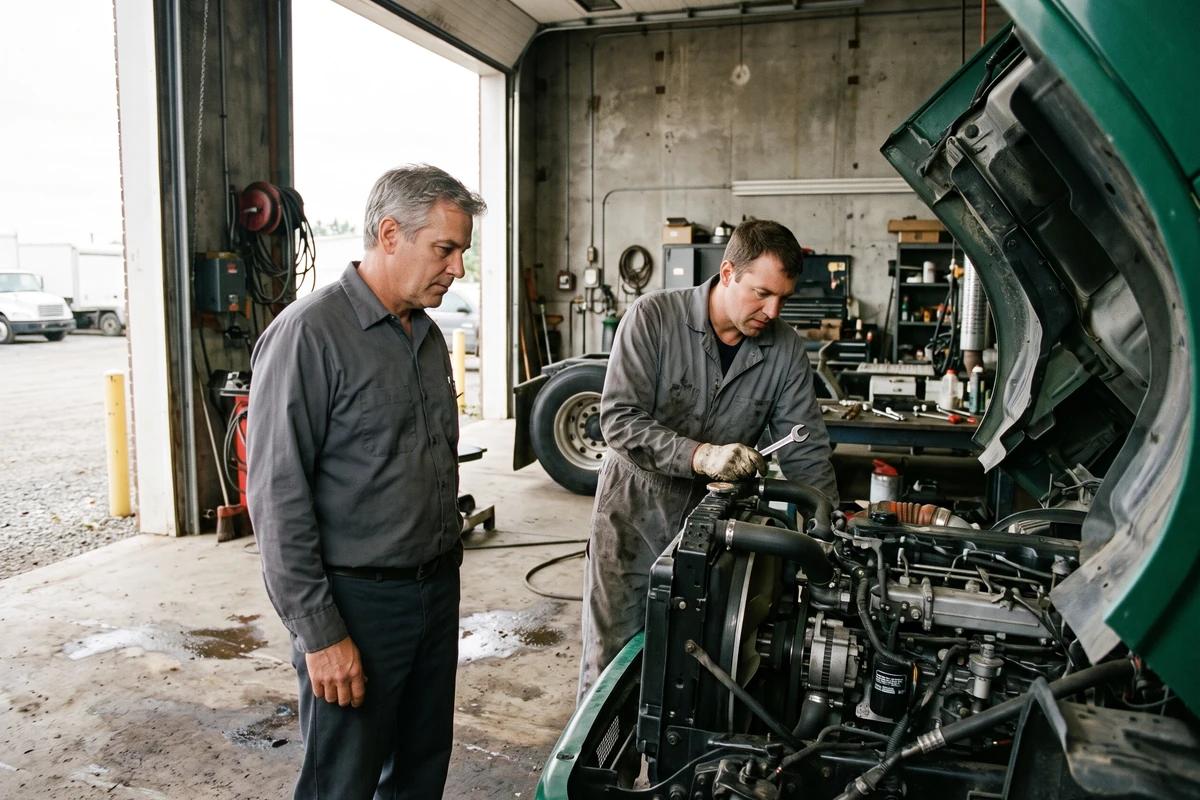
Truck repair financing is a decision about downtime first and price second. A truck in the shop earns nothing, so the real cost of a repair includes every day the truck sits waiting for parts, labor, or money.
Repair costs are rising faster than costs overall. ATRI put the 2025 increase for repair and maintenance at 8.6%, against 3.4% for all operating costs, per the release cited above. A repair budget set two years ago is probably too small today.
Size and downtime point to the product:
- Small repair, truck down a day or two: pay from cash or draw on a line you already have, since a new application can take longer than the repair itself.
- Large repair, such as an engine or a transmission: a term loan spreads the cost over months. Timing is subject to underwriting, so ask the provider before the shop starts work.
- Repair close to the truck's value: compare it with replacing the truck, which turns it into a purchase decision.
Get the paperwork before you apply. Ask the shop for a written estimate with parts, labor, and the truck's VIN, then keep the final invoice. Providers want to see exactly what the money pays for.
Loans secured by the truck's title are covered in the semi truck financing guide linked above, so this guide does not repeat them.
Worked example: the cash gap on net-30 freight
The cash gap on net-30 freight is a full month of operating cost that one truck must carry before the first broker payment lands. In a Commera illustrative calculation, that gap comes close to the whole month's invoiced freight.
Methodology: Commera illustrative calculation with assumed inputs, not an offer and not a real carrier. One truck runs 10,000 miles a month at a freight rate of $2.50 per mile, both assumptions. Cost per mile is the ATRI 2025 industry average quoted above, not the budget of any single owner-operator. The broker pays 30 days after delivery (assumption), and all first-month costs are treated as paid within that month.
| Item, first month | Amount, $ |
|---|---|
| Operating cost (miles × ATRI cost per mile) | 23,360 |
| Invoiced freight (miles × freight rate) | 25,000 |
| Cash received in month 1 | 0 |
| Cash gap before the first payment | 23,360 |
| Monthly margin once payments flow | 1,640 |
Source: Commera illustrative calculation, with cost per mile from ATRI's 2026 operational costs release.
Revenue is not cash. The truck bills the full month and collects nothing in it.
From month two, last month's invoices pay this month's costs, and the truck keeps the margin. The gap does not disappear. It rolls forward for as long as the truck runs on net-30 terms.
Slower payers make it worse. If a broker pays in 45 days, the gap grows and so does the cost of carrying it.
Worked example: factoring vs a line of credit for that gap
Factoring and a line of credit cost about the same for that gap in this example. Either one takes close to half of the truck's monthly margin. Both cases are Commera illustrative calculations, not offers, and real terms are subject to underwriting.
Methodology: Commera illustrative calculation for the same truck and the same first month. Factoring assumes a 90% advance rate and a fee of 3% of the invoice face for 30 days, with the broker paying on day 30 and no other fees. The line of credit assumes a $30,000 limit, a $24,000 draw for 30 days, 18% a year simple interest on the drawn amount, a 1.5% draw fee, and no maintenance fee. The minimum payment equals accrued interest, the broker payment repays the draw in full on day 30, and the estimated APR divides each option's cost by the advance or the draw over a 365-day year.
Option 1: freight factoring
| Factoring item | Value |
|---|---|
| Invoices sold, $ | 25,000 |
| Advance rate, % | 90 |
| Advance received now, $ | 22,500 |
| Fee for 30 days, 3% of invoices, $ | 750 |
| Invoice payment term, days | 30 |
| Rebate when the broker pays, $ | 1,750 |
| Gap still paid from cash, $ | 860 |
| Est. APR, % | ≈ 40.6 |
Option 2: business line of credit
| Line of credit item | Value |
|---|---|
| Credit limit, $ | 30,000 |
| Draw for 30 days, $ | 24,000 |
| Rate on the drawn amount | 18% a year, simple |
| Draw fee, 1.5%, $ | 360 |
| Maintenance fee, $ | 0 |
| Interest for 30 days, $ | 355.07 |
| Minimum payment (accrued interest), $ | 355.07 |
| Total cost for the month, $ | 715.07 |
| Est. APR, % | ≈ 36.3 |
Source: Commera illustrative calculation. Commera does not set rates or fees.
A rate is not an APR. The line's stated rate is about half its est. APR here, because the draw fee falls on a single month.
In this illustrative calculation, factoring still leaves $860 of the gap to cover from cash. The line covers all of it, since the draw is larger than the gap.
Now the margin. In this illustrative example, carrying the gap costs $715.07 to $750 a month against a margin of $1,640. That is about 44% to 46% of what the truck keeps. Net-30 has a price.
The cheaper option depends on the terms, not on the product name. Factoring fits when you have invoices and want to sell them rather than borrow. A line fits when your file qualifies and you would rather borrow than sell invoices. With 45-day payers, both cost more, because the fee period and the interest run longer.
When you know your own gap, see which financing options may fit before you compare offers.
What lenders ask a trucking company for

Lenders ask a trucking company for proof of cash flow, proof of an active authority, and proof of what the money pays for. The list is short, but one missing item can still stall the file.
Trucking loan document checklist
- Business bank statements: recent statements for the business account, covering the months the provider asks for.
- Operating authority and its history: your USDOT and MC numbers and how long the authority has been active.
- Proof of insurance: a current certificate showing your liability coverage.
- Broker and receivables reports: an aging report of unpaid freight bills by broker. Factoring providers read it first.
- Repair estimate: for a repair, the shop's written estimate with parts and labor.
Keep all five in one folder. Credit thresholds are not listed here, because each provider sets its own criteria and reads the whole file. With these documents ready, you can compare business loan offers from our lender partners on the same terms.
Broker disclosure: Commera Finance is a broker, not a direct lender. Financing providers make their own eligibility, underwriting, approval, pricing, and term decisions.
Sources