
What gas station financing covers
Gas station financing is business credit that pays for buying, building or upgrading a fuel site, usually secured by the land, the tanks and the store. For many owners, a common route is an SBA 7(a) or 504 loan made by a private lender.
Gas station loans come in three kinds of deals, and each one builds a different file.
- Buying an operating station. You take over the business, the store and often the property. One loan covers goodwill, equipment and real estate.
- Building a new site. You put up a station on land you own or buy. The property is the main asset.
- Upgrading equipment. You replace tanks, pumps or lines at a station you already run.
All three meet the same two checks: the environmental file and the fuel supply agreement. The rules for both come from SBA SOP 50 10 8.1, effective October 1, 2026, and both are covered below.
Commera is a broker, not a lender. We compare offers from our lender partners. The SBA rules in this guide apply whichever lender reviews your deal.
SBA loans for a gas station: 7(a) or 504
An SBA loan for a gas station is usually a 7(a) when you buy the business and a 504 when you buy or build the property. The 7(a) can pay for the whole deal. The 504 pays only for major fixed assets.
| Program | Max amount, $ | Borrower contribution, % | What it pays for |
|---|---|---|---|
| SBA 7(a) | 5,000,000 | 10 for an initial acquisition | Goodwill, equipment, real estate, inventory and working capital in one loan |
| SBA 504 | 5,500,000 | 10 minimum, 15 for a new business or a special purpose property, 20 for both | Land, buildings and long-life machinery and equipment |
Sources: SBA 7(a) loans, SBA 504 loans and SBA SOP 50 10 8.1, as of October 26, 2026.
The split matters for a station purchase. Per the SBA 504 page, a 504 loan cannot be used for working capital or inventory. Goodwill is not on its list of eligible uses either. So the business itself, the part you pay for above the property and equipment, needs 7(a) money.
One SOP label matters for both programs. Gas stations appear by name on the SBA list of limited or special purpose properties, per SOP 50 10 8.1. That label raises the 504 contribution and opens a longer 7(a) term, as the next sections show.
For how either program works from application to closing, see our SBA loan guide.
Buying a gas station: the 85% real estate test
Buying a gas station with a 7(a) loan caps the business part of the loan at 10 years, per SOP 50 10 8.1, Appendix 15. The real estate part can run longer, and one exemption lets the whole loan run as long as the real estate part.
Appendix 15 gives a purchase that includes real estate three ways to set the term:
- Separate loans. Per SBA rules, one loan covers the business on a 10-year term and one covers the real estate on up to 25 years. The real estate loan can be a 504.
- One blended loan. Per Appendix 15, the term is a weighted average of the uses of proceeds, rounded to the nearest full year. Real estate counts at up to 25 years, everything else at 10. The lender runs this math before applying any equity, and a 504 cannot be blended.
- The special purpose exemption. You buy an owner-occupied special purpose property together with the business that runs on it. Per Appendix 15, if 85% or more of total project cost goes to real estate, the lender may set a term of up to 25 years. The property must be integral to the business and impossible to separate from it.
Who decides "special purpose"? The lender does. The SOP calls it "a limited-market property with a unique physical design, special construction materials, or a layout that restricts its utility to the specific use for which it was built." Gas stations are named on the SBA's 504 list of examples. Per the same SOP, the appraiser on a special purpose property must have experience in that industry.
The equity rule does not bend. For an initial acquisition, the 7(a) contribution shown in the table above cannot be reduced or eliminated, per Appendix 15. Real estate bought with the business carries the same requirement. A 504 piece follows the 504 rules instead.
This is the fuel version of a business acquisition loan. Some buyers also add a note from the seller next to the 7(a). Our guide to seller financing explains how that piece fits.
Worked example: a $2 million station, two allocations
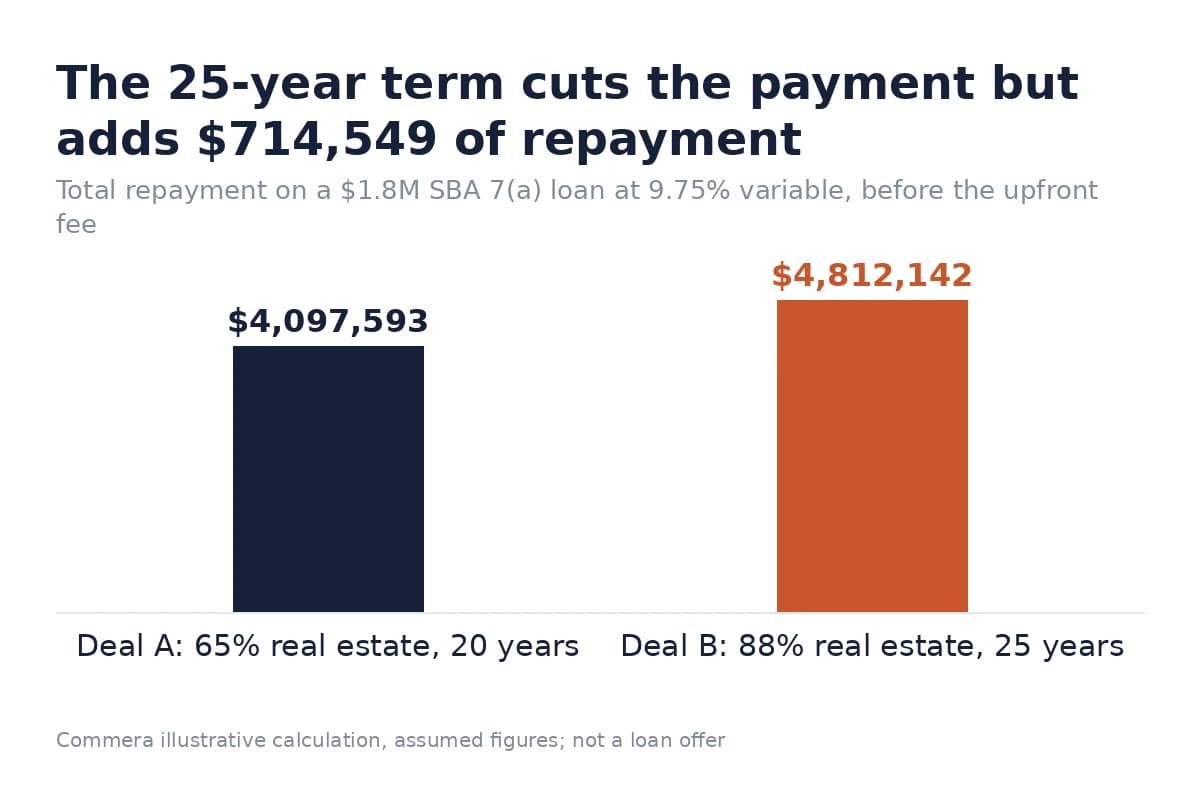
The same $2,000,000 purchase costs $17,073.30 a month on a blended term and $16,040.47 a month on the exemption term, in a Commera illustrative calculation. The only change is how much of the price is real estate.
Methodology: Commera illustrative calculation with assumed figures. It is not a loan offer and not a real deal.
- Project. An illustrative operating station with a store. Total project cost is $2,000,000, including the price and closing costs such as the Phase I.
- Equity and loan. Equity is $200,000, the minimum for an initial acquisition. The SBA 7(a) loan is $1,800,000.
- Rate. The rate is 9.75% variable: Prime of 7.00% per Federal Reserve H.15 released October 23, 2026, plus an assumed margin of 2.75 percentage points. Per SOP 50 10 8.1, the cap for loans over $350,000 is Prime + 3.0.
- Payments. Level monthly payments, no balloon.
- SBA upfront fee. Per SBA Information Notice 5000-881797, the fee is 3.5% of the SBA-backed portion up to $1,000,000 plus 3.75% above it. The SBA-backed portion here is 75% of the loan, or $1,350,000. So the fee is $35,000 plus $13,125, or $48,125, assumed paid at closing from your own funds.
- Annual service fee. The same notice says the lender may not pass its annual service fee on to you. It is left out of the APR.
- Cash flow. Cash flow available for debt service, after the owner's pay, is an illustrative assumption of $260,000 a year. We assume no other business debt.
In the illustrative Deal A, 65% of the cost is real estate: $1,300,000 of property and $700,000 of business and equipment. The blend is 0.65 × 25 + 0.35 × 10 = 19.75 years, rounded to 20.
In the illustrative Deal B, 88% is real estate: $1,760,000 of property and $240,000 of business. That clears the real estate test. If the lender accepts the site as special purpose, it may set a 25-year term.
| Figure | Deal A: 65% real estate | Deal B: 88% real estate |
|---|---|---|
| Loan amount, $ | 1,800,000 | 1,800,000 |
| Interest rate, variable, % | 9.75 | 9.75 |
| Term, years | 20 (blended) | 25 (exemption) |
| Monthly payment, $ | 17,073.30 | 16,040.47 |
| Annual debt service, $ | 204,879.64 | 192,485.68 |
| Total repayment, $, before the upfront fee | 4,097,592.79 | 4,812,142.07 |
| Est. APR, with the upfront fee, % | 10.14 | 10.10 |
| DSCR at $260,000 of cash flow | 1.27 | 1.35 |
In this Commera illustrative calculation, Deal B is $1,032.83 a month cheaper but $714,549.28 more expensive over the life of the loan. The longer term buys DSCR room, not savings.
Both deals clear the SBA minimum: per SOP 50 10 8.1, debt service coverage must be at least 1.15. Deal B simply clears it with more cushion.
The interest rate is not the APR. In this illustrative calculation, the estimated APR is the internal rate of return of the monthly payments against the $1,751,875 you net after the fee. The rate is variable, so the payment moves with Prime. Every term in this example is subject to underwriting.
Cash at closing is the same in both illustrative deals: $200,000 of equity plus the upfront fee.
The environmental file a lender needs
A lender financing a gas station secured by the site or its tanks needs a Phase I environmental site assessment, whatever the loan size. Per SOP 50 10 8.1, a property with a NAICS code starting with 457, gas stations with or without convenience stores, must start with a Phase I. The lender must also follow Appendix 7.
Appendix 7 adds these points to a standard Phase I:
- Independent professional. An independent Environmental Professional conducts the Phase I.
- Full records. The review covers the property and adjoining properties, including any records the seller provides.
- Tank and equipment testing. The Environmental Professional determines whether the station meets all tank and equipment testing rules. The file documents that finding.
- Phase II, if recommended. It must be done by an independent professional with a current Professional Engineer or Professional Geologist license. That person also needs the equivalent of 3 years of full-time relevant experience, per Appendix 7.
- Cleanup estimate. If the property is contaminated, the file includes a detailed description and cost estimate for remediation.
Two rules can move your closing date. Per Appendix 7, a loan may not be disbursed until the station fully complies with tank and equipment testing rules. Leaking or defective equipment must be repaired or replaced before disbursement.
Contamination changes the deal. The lender can decline the loan. If it goes ahead on a purchase, Appendix 7 requires the seller to sign the SBA Indemnification Agreement. Raise that with the seller before the LOI.
The general Phase I process applies to any business purchase, not just fuel sites. Our due diligence checklist covers it.
Branded fuel supply agreements and SBA franchise rules
A fuel supply agreement covered by federal petroleum marketing law makes your station a franchise in the eyes of the SBA. Per SOP 50 10 8.1, agreements covered by the Petroleum Marketing Practices Act fall within the FTC definition of a franchise. The SOP lists distributor, fuel supply, dealer and jobber agreements.
So the lender runs your deal through the SBA franchise procedures, including the SBA Franchise Directory. That holds even though these agreements are exempt from FTC disclosure requirements, per the same SOP. You may never receive a Franchise Disclosure Document. The lender still treats the fuel contract as a franchise.
Steps that save time:
- Get the current supply agreement and its transfer terms before you sign the LOI.
- Send it to the lender with the rest of the file.
- Ask the lender how it checks your supplier against the Franchise Directory.
- Read the contract terms yourself rather than assume them from the brand on the canopy.
Fuel versus the store: what the cash flow has to carry
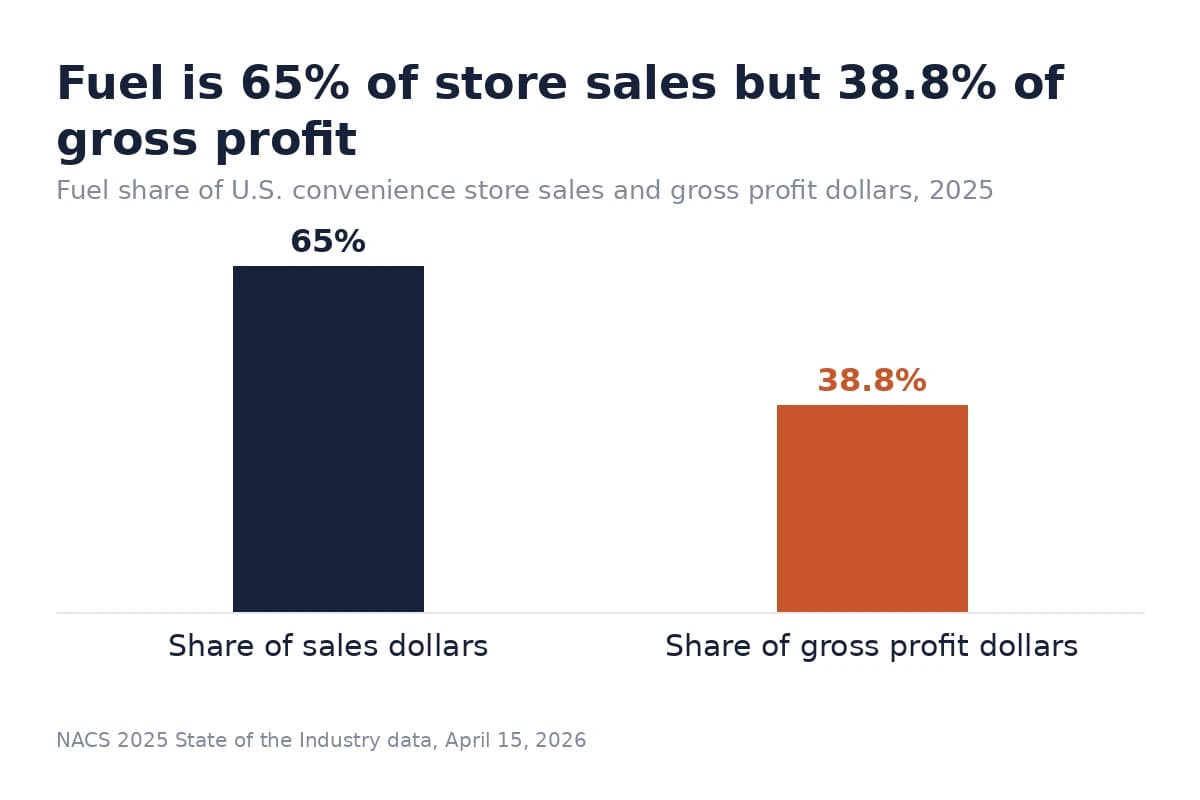
Fuel brings in most of the sales but well under half of the gross profit. According to NACS 2025 State of the Industry data, fuel was 65.0% of convenience store sales dollars but 38.8% of gross profit dollars in 2025.
The store earns its keep. Per the same NACS release, foodservice alone produced 38.9% of in-store gross profit. Convenience stores also sell an estimated 80% of the fuel bought in the U.S., NACS reports.
Sales are not profit, and a lender reads gross profit and cash flow, not gallons.
Per SOP 50 10 8.1, debt service covers the payments on all business debt, including the new SBA loan. A supplier loan or an equipment note counts against your coverage too.
Tanks also bring a fixed cost of their own. Under 40 CFR 280.93, owners or operators of petroleum underground storage tanks at petroleum marketing facilities, such as gas stations, must show $1 million of financial responsibility per occurrence. The same rule applies to sites that handle more than 10,000 gallons a month on average.
The annual aggregate is $1 million for 1 to 100 tanks, according to the same section of 40 CFR 280.93. Budget the cost of meeting it as an operating expense, because it recurs every year.
Expect questions about the operator, too. The lender will want to know who runs the pumps and the store, and what fuel and retail experience they bring. Branded or unbranded, give the lender the supply contract itself, not a summary.
Building or upgrading a fuel site
Building or upgrading a fuel site usually means a 504 loan for the property or a 7(a) loan for the equipment. Per SOP 50 10 8.1, a 504 borrower contributes at least 10%. The floor is 15% for a new business or a special purpose property, and 20% for a project that is both.
A new station built by a new business is both. The business is new, and gas stations sit on the special purpose list. Plan for the higher contribution from the start.
Car washes sit on the same list. Our guide to car wash financing shows how the rule plays out on another single-use site.
Term limits follow the asset, per SOP 50 10 8.1, Appendix 17:
- Real estate and construction. A 7(a) real estate loan can add a reasonable construction period to the real estate maximum above.
- Equipment. Tanks, pumps and dispensers generally get up to 10 years. The term can reach 15 years if the IRS asset class useful life supports it. Consult a tax advisor on how your equipment is classed.
Collateral on the tanks alone does not avoid the environmental file. Appendix 7 applies to loans secured only by gas station equipment, such as tanks, pumps and lines.
If you want to compare an SBA structure with a conventional mortgage on the property, see our page on commercial real estate loans.
Broker disclosure: Commera Finance is a broker, not a direct lender. Financing providers make their own eligibility, underwriting, approval, pricing, and term decisions.
Sources
- SBA, SOP 50 10 8.1, effective October 1, 2026, including Appendices 7, 15 and 17
- SBA, 7(a) loans
- SBA, 504 loans
- SBA Information Notice 5000-881797, FY 2027 7(a) Program Fees, effective October 1, 2026
- Federal Reserve, H.15 Selected Interest Rates, bank prime loan rate
- NACS, U.S. Convenience In-Store Sales Top $340 Billion, April 15, 2026
- eCFR, 40 CFR 280.93, Amount and scope of required financial responsibility