
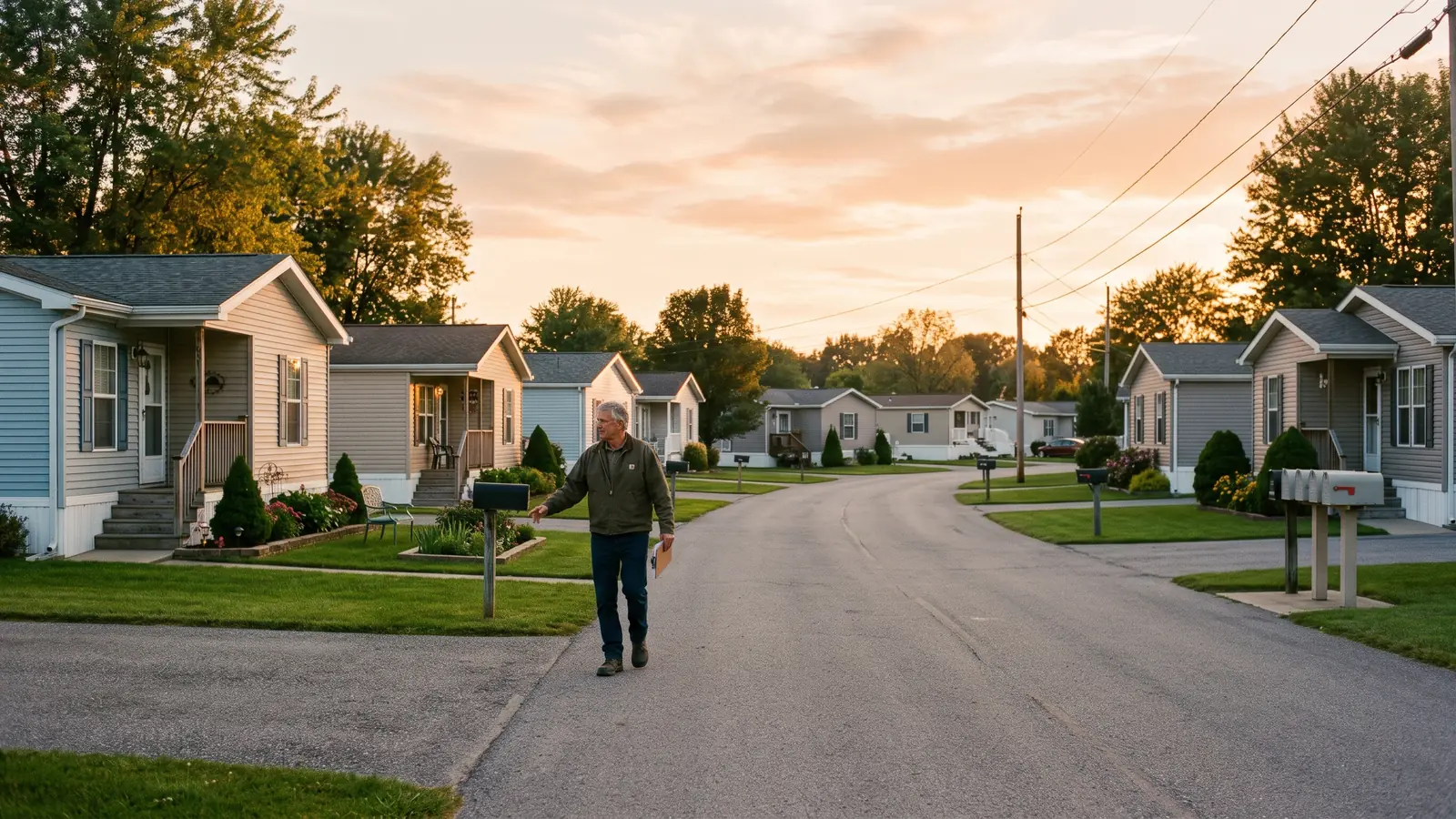
What is mobile home park financing?
Mobile home park financing is commercial real estate debt that a buyer or owner uses to purchase or refinance a manufactured housing community, sized on lot-rent income and secured by the land and infrastructure. The lender reads the park's rent roll first.
When residents own their homes and rent the pad under them, the owner collects lot rent. That rent pays the debt, so it sets how large the loan can be.
A loan to a resident to buy a home in the park is a different product. This guide covers the investor who buys or refinances the whole park.
Commera is a broker, not a lender. We compare offers from our lender partners. The rules below come from published program documents, so you can check them before you talk to anyone.
Mobile home park loan options: bank, agency, bridge and seller
Mobile home park loan options come down to four routes: a local or regional bank, an agency loan through Fannie Mae or Freddie Mac, a bridge or private loan, and seller financing. Each route sizes the debt by its own rules.
Older listings still call it trailer park financing. Lenders and the agencies say manufactured housing community, or MHC.
| Route | Who it fits | What the published rules say |
|---|---|---|
| Local or regional bank | Smaller parks and buyers with a banking relationship | Each bank sets its own terms. Ask whether the loan ends in a balloon before full payoff. |
| Fannie Mae MHC | Stabilized, professionally managed parks with an experienced key principal | Made through lenders Fannie Mae approves. At least 50 pad sites, Quality Level 3 to 5, term 5 to 30 years, amortization up to 30 years, max LTV 80%, min DSCR 1.25x, non-recourse with standard carve-outs. |
| Freddie Mac MHC | Stabilized parks, including smaller ones | Five or more home sites. Occupancy of at least 85% for three consecutive months before closing. A key principal with park experience. |
| Bridge or private lender | Parks with vacancy or a repositioning plan | Each lender sets its own terms. The loan is short, so plan the refinance before you sign. |
| Seller | Deals where the seller carries part of the price | Terms are negotiated between buyer and seller. |
Sources: Fannie Mae MHC term sheet and Freddie Mac Multifamily Guide, chapter 22, as of November 13, 2026. Terms are subject to underwriting.
The agency rows are program rules, not an offer. You do not apply to Fannie Mae or Freddie Mac directly. An approved lender originates the loan under their rules.
Bank terms vary from bank to bank. Compare the term, the amortization and the exit rules side by side.
Seller financing fills a gap when a lender stops short of the price. The seller takes a note for part of it. Our guide to seller financing covers how that note is usually structured.
What lenders check on a park before they quote

Park lenders check income first, then the homes, the operator and the site. Income sets the loan size, and the other checks decide whether the park fits the program at all.
Income comes from the rent roll and the trailing 12 months of operating statements, or T-12. From them, the lender builds net operating income and tests the debt service coverage ratio: NOI divided by annual debt service. Per the Fannie Mae term sheet, underwriting assumes economic vacancy of at least 5%, even in a full park.
Commera's commercial real estate page lists the rent roll, leases and operating statements among the documents for a property loan. A park file adds park-specific checks.
Example: what a park lender will ask for
- Rent roll and T-12. Lot rent by pad, occupied pads, and 12 months of income and expenses. This is where NOI and the DSCR come from.
- Occupancy history. Per Freddie Mac Guide chapter 22, stabilized occupancy is generally at least 85% of home sites, held for three consecutive months before closing.
- Park-owned homes. Per the Fannie Mae term sheet, park-owned homes generally may not exceed 25% of the homes, or up to 35% with a business plan to reduce them. Under Freddie Mac chapter 22, a park is ineligible if the borrower, its affiliates and third-party investors own more than 25% of the homes.
- Operator experience. Fannie Mae says at least one Key Principal should have experience operating a park. Freddie Mac asks a key principal for at least two years of park ownership, operation or management, or ownership of another park.
- Third-party reports. Fannie Mae requires an appraisal, a Phase I Environmental Site Assessment and a Property Condition Assessment.
- Density and homes. Per Fannie Mae, an existing park generally should not exceed 12 homes per acre. With limited exceptions, homes should meet HUD Code standards.
- Lease terms. Fannie Mae bars a tenant option to buy the pad in leases of 2 years or longer. Freddie Mac rules out leases with purchase options and expects initial lease terms of at least 12 months.
These checks sit on top of the usual buyer work. Our due diligence checklist covers the rest of the review before closing.
Worked example: sizing a loan on a 60-pad park
In a Commera illustrative calculation, one 60-pad park supports a $1,748,000 bank loan and a $2,000,000 agency-style loan. The gap, $252,000, comes out of the buyer's own cash.
Methodology: Commera illustrative calculation with assumed figures: 60 pads, lot rent of $450 a month, 54 pads occupied (90%), operating expenses at 35% of effective gross income, a $2,500,000 price and no park-owned homes. Rates, fees, the bank's 75% LTV cap and 1.25x coverage floor, and the price are assumptions, not market data and not a Commera rate, and payments are monthly in arrears. Estimated APR is the IRR of the loan amount net of a 1% origination fee at closing, the monthly payments and the balloon at maturity. This is not a loan offer and not a real deal.
The agency-style column borrows the Fannie Mae limits from the options table. It is a model, not a Fannie Mae quote.
| Item | Bank loan | Agency-style loan |
|---|---|---|
| Effective gross income, $/yr | 291,600 | 291,600 |
| Operating expenses (35%), $/yr | 102,060 | 102,060 |
| NOI, $/yr | 189,540 | 189,540 |
| Rate, % / amortization, yrs / term, yrs | 7.25 / 25 / 5 | 6.00 / 30 / 10 |
| Max LTV, % / min DSCR, x | 75 / 1.25 | 80 / 1.25 |
| Loan by DSCR, $ | 1,748,185 | 2,107,579 |
| Loan by LTV, $ | 1,875,000 | 2,000,000 |
| Loan amount (lower, rounded), $ | 1,748,000 | 2,000,000 |
| Monthly payment, $ | 12,634.66 | 11,991.01 |
| Actual DSCR, x | 1.25 | 1.32 |
| Balloon at end of term, $ | 1,598,563.75 | 1,673,714.50 |
| Total repayment over term, with balloon, $ | 2,356,643.35 | 3,112,635.70 |
| Origination fee (1%), $ | 17,480 | 20,000 |
| Est. APR, % | 7.50 | 6.14 |
| Buyer equity, $ | 752,000 | 500,000 |
In this illustrative calculation, the bank loan hits the DSCR limit first and stops at 69.9% of the price, below its own LTV cap.
The agency-style loan hits the LTV cap first, and its coverage lands at 1.32x, with room to spare.
The rate is not the APR. The origination fee pushes each est. APR above its note rate.
The cap rate in this illustrative calculation is 7.58%, NOI divided by price, a result of the assumptions and not a market figure. The 60 pads clear the Fannie Mae pad minimum. All terms are subject to underwriting.
Worked example: the year-5 balloon on a bank loan

A bank loan with a 5-year term leaves a $1,598,563.75 balloon in this Commera illustrative calculation. If rates rise to 9.25% and NOI stays flat, the owner needs about $123,054 of new cash to refinance it.
Methodology: Commera illustrative calculation that continues the bank loan above. At the end of year 5, a new 25-year loan is sized at the same coverage floor, at three assumed refinance rates, with NOI either flat or growing 3% a year. Cash needed is the balloon minus the largest new loan, and a negative number is cash left over. Rates are assumptions, not a forecast.
| Refinance rate, % | NOI flat: max new loan, $ | Cash needed (+) / spare (-), $ | NOI +3%/yr (219,729): max new loan, $ | Cash needed (+) / spare (-), $ |
|---|---|---|---|---|
| 7.25 | 1,748,185 | -149,621 | 2,026,625 | -428,062 |
| 8.25 | 1,602,638 | -4,074 | 1,857,896 | -259,333 |
| 9.25 | 1,475,510 | +123,054 | 1,710,521 | -111,957 |
The balloon is a rate bet placed in year 5. At the same rate, the refinance frees cash, and one point higher it barely breaks even.
Rent growth changes the picture. With rising NOI, every row in the growth columns leaves cash to spare.
Two levers cut this risk. A longer term pushes the balloon further out, and rent increases build coverage before it comes due.
Ask any bank for the term, the amortization and the prepayment rules before you sign.
How to choose the structure for your park
The right structure for a park follows its size, its homes and its occupancy. Start with the agency limits, then work down.
If the park has fewer than 50 pads or many park-owned homes → a bank, a bridge lender or the seller is the likely route.
If the park is stabilized, large enough for the agency programs and you have operating experience → get an agency-route quote next to a bank quote.
If the park is under-occupied → a bridge loan with a written plan to refinance once occupancy stabilizes.
Every route carries risk, and Commera's commercial real estate loans page lists the main ones. The property secures the loan, so default can mean foreclosure.
A balloon forces a refinance or sale. Prepayment penalties can make an early exit expensive, and personal guaranties are common.
Agency loans have their own exit cost. Per the Fannie Mae term sheet, a fixed-rate loan prepaid early pays yield maintenance.
Lender appetite for parks varies, so ask each lender early whether it finances manufactured housing communities. If you also own retail, office, warehouse or multifamily property, you can check your funding options for that property.
Broker disclosure: Commera Finance is a broker, not a direct lender. Financing providers make their own eligibility, underwriting, approval, pricing, and term decisions.
Sources